
How Continuous Line Art Can Improve Your Mental Health
Get the outline; the details usually fall in place.
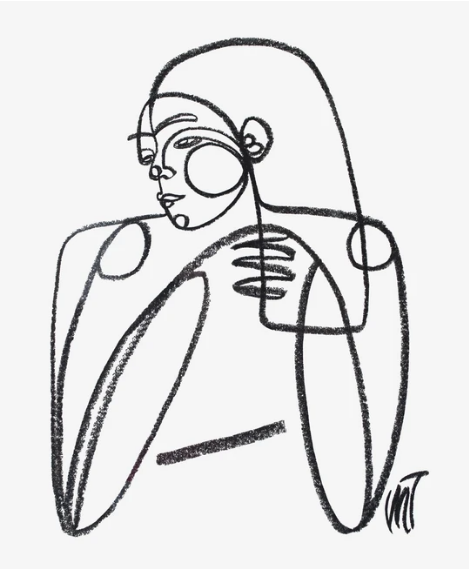
I am not an artist by any means but I doodle-a lot. I am a writer, my favourite form of expression is through poetry. Last year, I found myself completely unmotivated and in a cycle that drained my creative juices. I picked up a pen, and instead of words, I doodled. It kept me occupied but mindlessly so. It is in this place I discovered continuous line drawing or contour drawing. There are many names for this kind of art, where you complete a piece of drawing from start to finish with a single unbroken line; the trick is not lifting the pen from the page. Continuous line art in its most basic form is a drawing exercise that helps:
- increase hand-eye coordination
- simplify the complex world and
- improve an artist’s observation skills
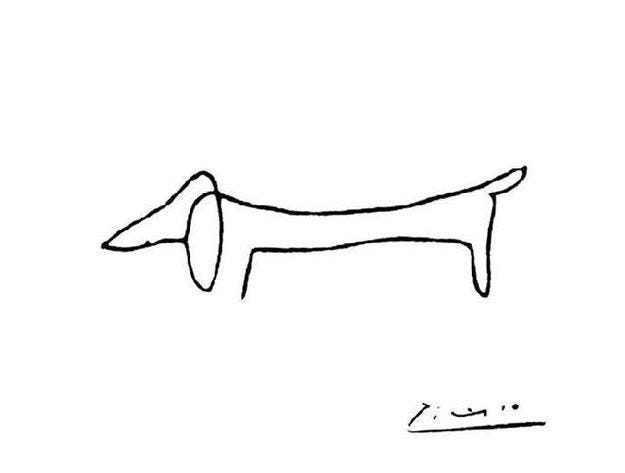
Michelle Gemmeke explores different contemporary continuous line artists, their styles and motivations here. A worthy mention is a continuous line drawing of Picasso’s dachshund. It was said that Picasso dabbled a lot in this sort of art. Here is a picture of Picasso’s dachshund, which has been replicated many times over the years.
Like most forms of art and creativity, the benefits of continuous line art to one’s mental health are numerous. Some of these benefits include;
- Increased awareness and focus: To fully engage in a continuous line drawing, you must carefully observe the subject matter. The beauty is not in how a thing looks but in what we see. We often become so accustomed to an object that we fail to see the finer features that make up the object. This act of looking to truly see draws attention from whatever might be causing anxiety and focuses this instead on the object or subject in front of you. Some people experiencing emotional triggers from a traumatic experience might also benefit from this as a grounding technique that helps remind them that they are not back in that place that caused them trauma. In a study comparing colouring doodling and free drawing, results showed that although all three creative self-expression conditions activated the reward pathway, doodling evoked the most activation. This focus relaxes the body and mind, which can be found very rewarding.
- Mood regulation and stress reduction: The study also showed that art-making could be a way to regulate mood, addictive behaviours and evoke a sense of pleasure. Adults who participated in a 2016 study reported lower levels of the stress hormone cortisol after a 45-minute art therapy exercise.
- Boosts mindfulness: One of the prime causes of anxiety is consistent thoughts of what might be. Continuous line art helps interrupt those thoughts to help us become more present.
Mindfulness is the basic human ability to be fully present, aware of where we are and what we’re doing, and not overly reactive or overwhelmed by what’s going on around us.
- You are not confined to a box: There is pleasure derived from knowing that this will not be perfect. In most cases, you would have no idea where a line leads. It does not have to look like an object or person. Your outline of a hand might be completely different from another person’s outline of a hand, and that is fine. These low stakes increase pleasure. I enjoyed drawing stick figures as a child; this is also one reason continuous line art appealed to me. Think of your work as a stick figure. You would be surprised what you end up with.
I am in a much better place in life, and my general mental health has greatly improved, but I also learnt a couple of life lessons from practicing continuous line art that carries on to real-life situations. Here is what I learnt:
- The importance of a reference; These days, I think people would call it “manifesting,” The concept that if you can look at a picture in your mind’s eye that you can visibly bring it to being. While the jury is still out on the power of manifesting and the secret contained in the book titled “the secret” there is a lot to be said on having a frame of reference. We see this in the need to have mentors and role models. This is also one of the reasons I advocate for representation in media, in business etc. You become what you continuously look at. While it is true that you can draw from memory, the recommended approach is to draw using a reference. This is because you can forget the subtle details of the picture as a whole; these subtleties help guide the overall outcome of the design.
- You will make a lot of mistakes, keep going; A lot of mistakes can be avoided by looking back at the reference. Some mistakes cannot be avoided no matter how much you try. I quite like the concept of failing fast and failing forward. Sometimes the outcome of failure is much easier to overcome than the fear of failure itself. If 2020 taught me anything is how everything can change in a heartbeat, and you can go from a high-paying job to no job and not see it coming. In continuous line art, there is no going back to erase mistakes, some might see this as a drawback, but because of this, these drawings carry a certain visual appeal. If you make a mistake, you stop and ponder your next course of action and then move. You have to keep moving.
- It’s ok not to know where the line leads: The line takes you in weird directions, and sometimes you wonder how you can close the gap and create a whole picture. Don’t fret; let the line lead you. Sometimes you have no idea what the outcome of a decision holds, but your gut compels you. Don’t worry; trust your gut. The growth does not lie in never falling but not getting up after each fall. Pivot, adapt and let the line lead you.
At the end of the day, what might work for the goose might not work for the gander. Continuous line art, however therapeutic, does not replace therapy but is a great tool to have in your back pocket.
To receive a notification when I publish a new story, subscribe here. For less than $5 each month, you can signup for Medium and start earning money passively from publishing articles. You would also get access to every story I have written (and thousands of other writers on Medium). Signup using my referral link here