


How Concepts Like Viskvatomukham and Sarva-gatah Parallel Mathematical Principles of Self-Similarity and Interconnectedness
From Sanskrit Pearls of Wisdom to the Fractal Dodecahedral Universe

Vedanta is one of the primary philosophical systems in Indian philosophy, comprising a body of knowledge based on the Upanishads, and ancient Hindu texts delving into the ultimate reality, the self, and the universe.
The word “Vedanta” translates to “the culmination of the Vedas,” indicating the philosophical and spiritual teachings derived from the Vedas, specifically the Upanishads. Vedanta underscores the oneness of all beings and the ultimate reality of the Self (Atman) being identical to the ultimate reality of the universe (Brahman).
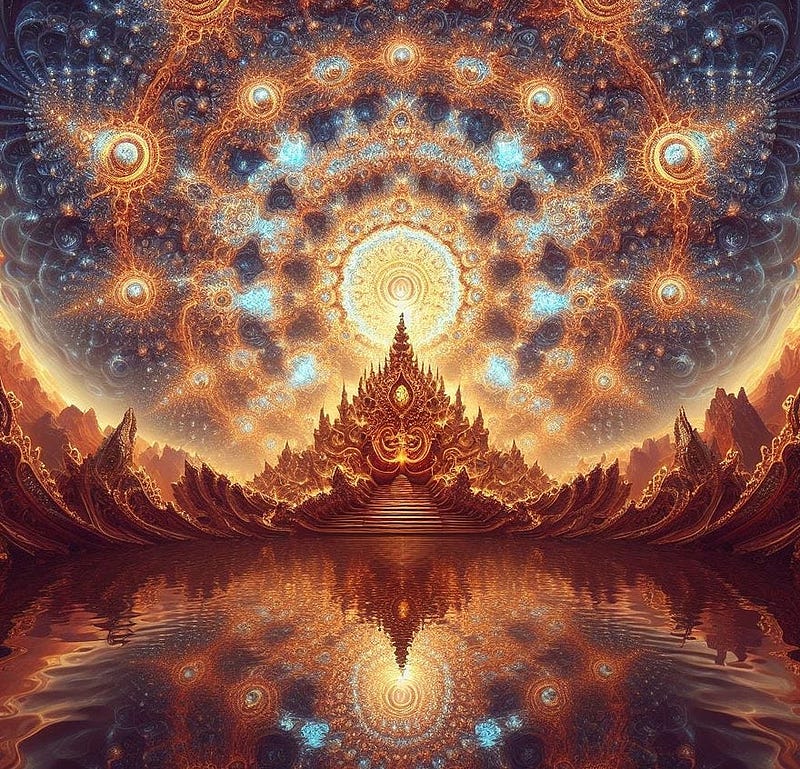
The Vedantic notion of Visvatomukham, meaning “with the face on all sides”, shares deep resonances with fractal geometry’s vision of the universe. Viskvatomukham conveys that the divine reality shines through all manifested forms. This echoes how fractals reveal self-similar patterns across scales — each microcosm reflects the macrocosm.
The Upanishads proclaim “From fullness, fullness comes. When fullness is taken from fullness, Fullness remains.” This declares that infinity perpetually pours forth from the eternal source, which is never depleted. Mathematically, fractals also iterate endlessly to generate immense complexity from simplicity. The fundamental pattern is preserved within each iteration.
In Vedanta, Brahman is understood as the fundamental reality that transcends and expresses the diverse universe. Fractals symbolise this interplay of unity and diversity, the enfolding of the whole within each part. They depict the wondrous interbeing of part and whole.
Fractal dodecahedron
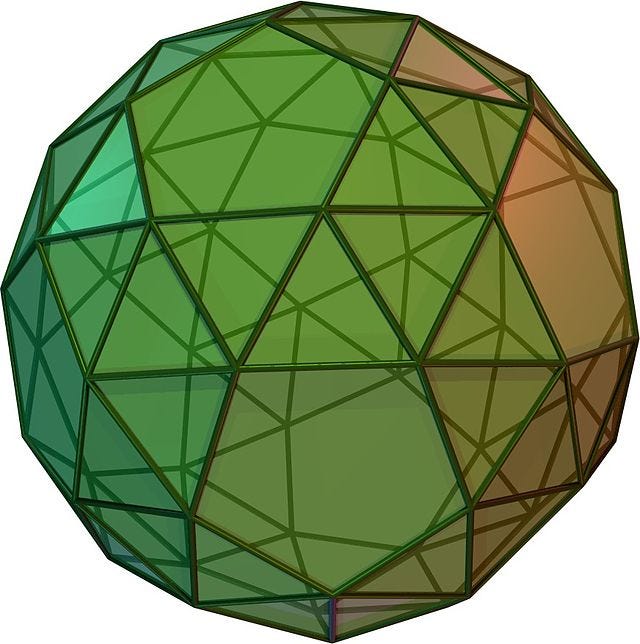
The standard model of cosmology assumes that the universe is infinite and flat. However, some cosmologists have proposed a different idea: that the universe is shaped like a finite and curved dodecahedron. A dodecahedron is a twelve-sided polygon with pentagonal faces, and in the context of the universe, the dodecahedron is a fractal, meaning that it has the same shape at different scales.
This theory was proposed to explain certain anomalies in the observations of the cosmic microwave background (CMB) radiation. The CMB is the residual heat from the Big Bang, and it should be isotropic (homogeneus), meaning that it should have the same temperature in all directions. However, some observations of the CMB have shown a lack of large-scale fluctuations in temperature, which was unexpected in an infinite and flat universe.
The theory of a dodecahedral universe suggests that these anomalies could be explained by the fact that the universe has a finite and curved shape, with the CMB appearing isotropic only because we are located near the center of the dodecahedron. In this universe, the CMB radiation would appear to be the same in all directions, even though it is not. However, it's important to note that this theory is still highly speculative and has not been widely accepted by the scientific community. Further observations and data analysis will be needed to determine whether the universe is indeed shaped like a dodecahedron or not.
Some of the scientists who worked on this theory are:
- Jean-Pierre Luminet, a French astrophysicist and writer, published a paper on the dodecahedral model in 2003;
- Glenn Starkman, a professor of physics and astronomy at Case Western Reserve University, co-authored a paper on the dodecahedral model in 2003;
- Jeffrey Weeks, an American mathematician and MacArthur Fellow developed software to visualize the possible shapes of the universe.
Fractals
Fractals are objects or mathematical series characterized by a fundamental property: self-similarity. This means that the fractal is formed by parts which replicate the structure of the whole on different scales. In mathematical terms, a fractal presents scale symmetry: enlarging or reducing parts of the object, one obtains details similar to the entire structure.
Fractals can be created artificially through algorithmic iterations, but they are also commonly found in nature due to complex dynamic processes. Let’s now analyze 10 natural examples of fractal patterns:
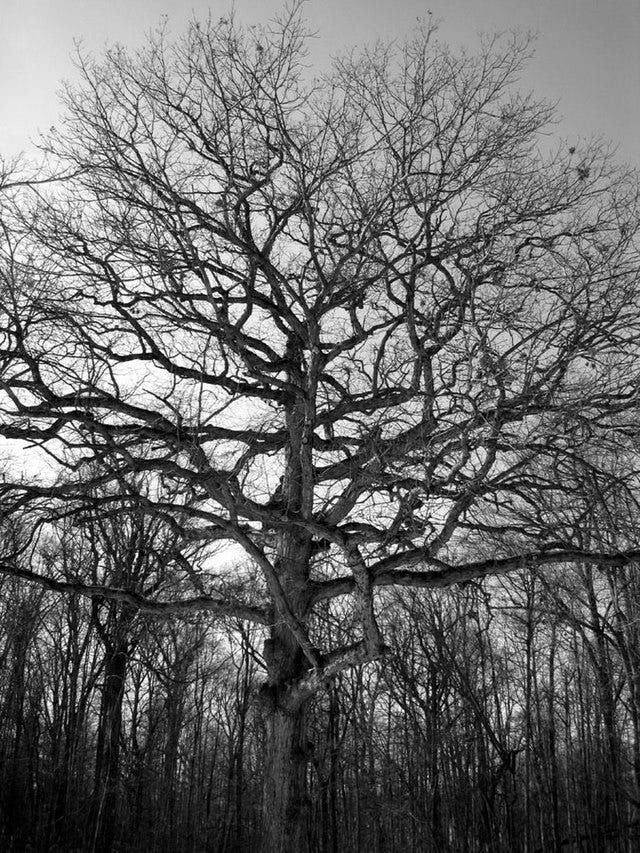
Tree branches — Each little branch seems to reproduce the shape of the tree itself. This is because growth happens through dichotomous branching, each branch dividing into two increasingly slender branches.
River network — The paths of rivers with their tributaries form watersheds with a fractal shape, which appears similar at different scales.
Jagged coastlines — Seen from above, the inlets repeat irregularly the complex shape of the coastline.
Cloudiness — The jagged contours of the clouds, generated by the turbulent motion of the atmosphere, are fractals.
Snowflakes — Each snowflake has an intricate hexagonal structure that exhibits self-similarity.
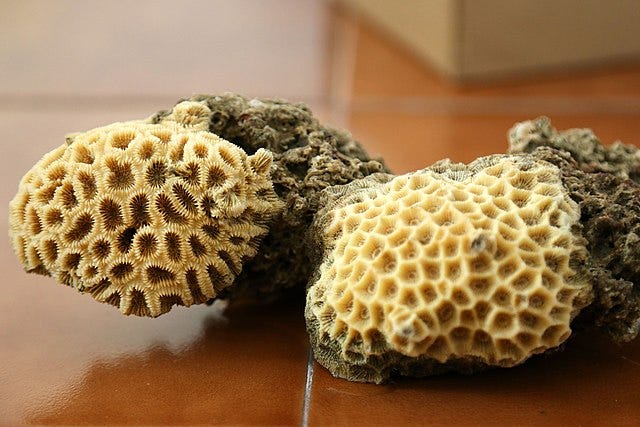
Coral — The branching of coral into increasingly finer sub-branches is a fractal process of growth.
Romanesco — This cauliflower exhibits fractal spirals with conical tips that self-replicate on decreasing scales.
Spiderwebs — The intricate webs have a fractal structure determined by the spider’s way of weaving.
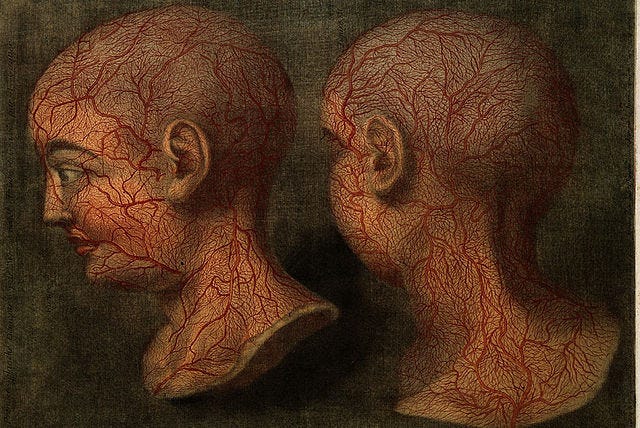
Blood vessels — The branching of the cardiovascular system, from arteries to capillaries, is fractal.
Bronchial tree — The airways of the respiratory system also follow a fractal pattern of dichotomous division. — The air ducts of the respiratory system also follow a fractal pattern of dichotomous division.
Sarva-gatah
The Vedantic vision of Sarva-gatah, (“all-pervading”, “that extends everywhere” or “that fills everything”), the understanding of Brahman as all-pervading, and the fractal perspective both reject reductionism and duality, unveiling the intrinsic unity-in-diversity of existence. Sarva-gatah refers to the omnipresence of Brahman, the Absolute Reality which permeates the entire cosmos while still transcending it. Through recursive self-similarity across scales, fractals mathematically manifest the interpenetration of part and whole. This echoes how the unbounded Brahman wholly manifests in each fragment of the cosmos according to sarva-gatah, the All-pervader. Both worldviews subvert ordinary logic to express higher truths about the totality’s irreducible complexity.
Translation of “Fractal” into Sanskrit
Recently, in an unlikely but fascinating quest, assisted by AI, I had fun thinking about how the word “fractal”, coined by Benoit Mandelbrot in 1975, could have been translated starting from the ancient Indo-European linguistic roots, in particular from the Indo-Iranian branch, and later into Sanskrit. I did this because I strongly believe in the fractal nature of Vedantic teachings and I wanted to find parallels also at the linguistic level.
Here is a possible translation of “fractal” into Sanskrit that I elaborated, trying to capture the literal meaning of the word:
bhrama-rupa-anubhava-pravāh
The phrase has two translations:
Illusory repeated movement of self-similar forms of unity.
Illusory form-experience-flow of unity.
Let’s explore the Indo-European roots:
bhrama (भ्रम):
- Syllables: bhra + ma
- Meaning: illusion, error, confusion
- Indo-European root: bher, meaning “to wander”, “to stray”, “to be confused”;
rupa (रूप):
- Syllables: ru + pa
- Meaning: form, appearance
- Indo-European root: reu, meaning “to see” or “to perceive”;
anubhava (अनुभव):
- Syllables: anu + bhav
- Meaning: experience, perception, understanding
- Indo-European root: anbheue, meaning “to become aware of” or “to perceive”;
pravāh (प्रवाह):
- Syllables: pra + vāh
- Meaning: flow, movement
- Indo-European root: wegh, meaning “to carry”, “to transport”
Explanation
Fractals, as aforementioned, are forms that embody the paradox of infinity enclosed within the finite. They are self-similar objects, in which every part reflects the totality, in an endless mise en abyme.
First, there is “bhrama” — illusion, a trick of the eyes. Fractals seem like shapes that go on forever even as they take up no space. They draw you into a maze with no way out, a waking dream you cannot awaken from. Like a mirage in the desert, they show water where there is only sand. Such optical tricks confuse the observer.
Next comes “rupa” — form or shape. Although fractals keep their shapes shifting like smoke, stare long enough and patterns emerge. Spires and snowflakes and ferns slowly come into focus out of chaos. Intricate webs appear where before there was only haze, geometric art sculpting itself from nothingness. Defying logic, order crystallizes despite no boundaries to guide it. Mandelbrots blossom in imaginary space. Without reason, beauty manifests.
After that is “anubhava” — experience or revelation. Only by diving deep into the fractal flux can their secrets be unlocked. Exploring the maze leads to eureka moments as veils lift to unveil worlds within worlds. Scaling knowledge into wisdom, we grasp the hidden templates governing endless iterations. From confusion comes clarity as we comprehend the symmetries across magnitudes. Through observation, the oracle unveils its mysteries.
Lastly, there is “pravāh” — flow and dynamism. Fractals have no fixed forms, only endless rebirth through continual generation. Shapeshifting perpetually, they cascade into newfound possibilities unhindered by limits. Their destiny remains unwritten as they transcend rigidity. Every recreation brings unexpected vistas bursting out of the void at scales micro and macro. Unconfined by space and time, evolution runs wild in fractal realms. Motion seems omnipresent among their numberless iterations.
And in between illusion and form, experience and flow, fractal paradoxes emerge. Deceptions give way to revelations, mazes lead to meanings, and aimlessness aligns with order as space fills itself in. By chasing bhrama-rupa-anubhava-pravāh we uncover gems of insight hidden in the blink of an eye.
Conclusions and Takeaways
Whether through abstract geometry or embodied spirituality, we approach the infinite intricacy of nature’s patterning. We touch the divine mystery of the One radiating as the many. Yet this diversity is not fragmented but endlessly interconnected, by tubes of flow and recursion, into a seamless tapestry — a fractal dodecahedron flowering from the self-similar seed of Sarva-gatah, the omnipresent origin. Thus diversity complexity and infinity issue forth in resonant harmonies, visibly in fractal modeling, intuitively through nondual insight. Conceptually distinct yet intuitively confluent, these visions beckon us toward wisdom vaster than rationality. They call us to revere the all-pervading fullness that dwells within and shines through every infinitesimal form.
Both Vedanta and fractal geometry exalt direct mystical intuition over rational constructs. Their visions unveil truths that elude reductionist analysis. These worldviews celebrate the intrinsic fullness of reality, the infinite interconnection of all manifested forms.
When we realize Viskvatomukham — that the divine fullness looks through every face — the delusion of egoic separation dissolves. As the Upanishads declare: “When fullness is taken from fullness, Fullness remains.” Nothing essential can ever be lost, once we recognize our infinite wholeness. Lack only existed in illusion.
To sum up, Viskvatomukham and fractal cosmology inspire awe at existence’s hidden glory. They teach that diversity emerges from and returns to a unitary being. All seeming fragmentation is temporary. At the deepest level, the entire universe is a single fractal organism, pulsating with divine fullness here and now.
The parallels between Vedanta, fractals, the dodecahedral universe and sarva-gatah intimate that diversity and unity arise from one Consciousness. Fractals’ self-repeating patterns across scales suggest an innate interconnectivity of all forms, potentially emanating from and returning to a common source. Awakening to our infinite essence, we may realize beyond divisions to our shared ground of being. There we find the unifying Thread that weaves multiplicity into a tapestry, pulsing with the One Presence that embraces all — faintly echoed in sarva-gatah and fractal resonances, for those with eyes to see.
Thank you for reading.