
How Come 95% Of My Stories Get Curated?!?
Until today I didn’t even realise that was a huge deal, but because it apparently is, I’ll share the “secret”.
Aren’t I just the most naive, clueless, head-in-the-clouds aspiring writer on this platform? Six years on here, started taking writing seriously only two months ago, and I never even read the rules for publishing stories, or articles as I like to call them. I just wrote like a random dude who fancies writing once in a while. Mostly tech topics, but occasionally, I’ll throw in there some music or Lego related thoughts or a once-in-a-blue-moon story on writing.
Well, there have been more of those lately because well, I write more, but all in all, I only realised today, I never read the rules. I just dove in and wrote. Did that 6 years ago, did that 2 months ago when I went behind the paywall, and apparently I keep doing just that — writing.
Today the Gods of algorithms, or whatever it was, decided to bring to my attention Kristina God’s article on how to get curated. The more I kept reading, the more my jaw kept dropping. Turns out there are rules here! I mean, I knew some very basic ones around copyrights and plagiarism, but that to me was like common sense. I wrote about music professionally for over three years, so nothing new there, I learned that on day one.
As I kept reading, I realised just how many rules there are on here. Now, of course, most of them are not there to curb one’s enthusiasm and creativity, but rather to set a framework for getting curated. So, I got curious, and reviewed all my stories starting from June 2021. Turns out, 28 out of 30 articles got curated for distribution! Say what?!? Important to note that I only went behind the paywall on the last week of October, all stories between June and the 3rd week of October got curated for distribution before me even attempting to get a few bobs out of my writing.
OK, so let’s recap…
I wrote 30 stories between June and the first week of December. Only two of them didn’t get curated. Looking at the data, I don’t see either of them being particularly special not to get “special attention”, but equally, nor do the other 28 feel overly special. The two that “didn’t make the cut”, have very little in common. One of them is about dating programmers, the other one is about web accessibility.
Neither of these are shortform. I don’t do shortform and there are reasons for that. I’ll go into more detail in another story, so, maybe subscribe if that intrigues you.
Seeing how there’s next to no data I could use to understand why certain stories don’t get curated, I decided to opt for the more productive route and analyse the other 28 and try to understand why they did. Perhaps even correlate to Kristina’s article!
Because I feel it would be better not to trap any reader into this article, I’ll tell you upfront, long story short, Kristina is right. Read her story and maybe print it out, stick it on a wall, or all the walls, ceilings even, and follow it semi-religiously. If, however, you have another 3–4 minutes, stick around for my side-thoughts on this because looking back at it all, the entire 6 years of my writing here, I realised there are a couple of things that might save you having to procedurally tick off all the rules before you hit publish — though there is nothing wrong with that either.
You have got to love writing
I’m sorry, crocodile-tears and all kinds of sorry, I’ll give you a hug, I’ll give you ten, all virtual of course unless you’re in Dublin, Ireland, but you have got to love writing to keep writing. Writing is a creative art, if you don’t like writing, it will show. It will be as obvious as black mould on a white wall to any curator, editor, and worst of all — reader. And while it’s true that many professional writers have to tackle topics they either aren’t concerned about, agree with or want to delve into, the act of writing is still something they’ll enjoy. For the most part, however, writers like writing, and their personality and style shows through the paragraphs like outfits on a catwalk.
As a writer, you must find yourself in a self-reflective situation fairly early on, tackling rhetorical questions like “Who am I?”, “Why am I writing?”, “Who am I writing for?”. If these all sound slightly meta and existential, it’s because they are. You don’t need a definitive answer as long as you’re OK accepting that it’s a journey of self-discovery. I delved a lot more into the “why” of it all, so am not going to repeat myself here, but the bottom line, your reasons cannot just be around money and financial improvement.
The last one, “who you’re writing for” is more important than you think. It’s less about finding a niche, but rather defining who your audience is. It does not have to be the same audience all the time. One has the creative freedom to move between them. Ultimately, though, it’s crucial to have them defined in your mind and soul even because it creates an invisible connection between writer and reader. It might not be overly intuitive to think of writing stories or articles as a dialogue. It might feel like you’re just throwing some thoughts on a slate of blank digital nothing, and you’re walking away, but it’s much more than that. You put your thoughts, vision, vantage point out there for people to experience, and even if you’ll never get a comment, you started a dialogue because many will to some extent or another, within themselves, react. You might not be able to observe that, but the dialogue happened nevertheless.
You gotta love writing, the rest falls into place organically.
Enjoy reading your own stories
It’s not narcissistic at all. It’s an entirely human trait to want to enjoy one’s own creations. I make a mean chili con carne (my friend Natalia Für disagrees), and I utterly enjoy every minute eating it. So, why should it be any different with your stories. I read my articles at least twice before publishing them. The first round of reading always results in small changes, the second or third read is purely for me to get the feeling I hope every reader out there will get as well. Trust me, I’ve deleted fully written stories because I felt very “meh” about them once read back. Some just had a broken structure, which in turn proved that I didn’t quite have my thoughts on the matter fully baked. Some lacked style, others just didn’t feel like I was connecting to anyone.
But there’s more to it. It has to look right. And re-reading it will help you notice that. If you don’t know how it should look, check out major publications like The New York Times or whatever online publication you might follow. Don’t necessarily take style examples as patterns to follow just from top writers. I have seen some very questionable writing styles here such as overabundance of space between sentences, no clear distinction between paragraphs and sentences, using too much emphasis, bold or all-caps. Some really sloppy, objectively ugly-looking formatting out there!
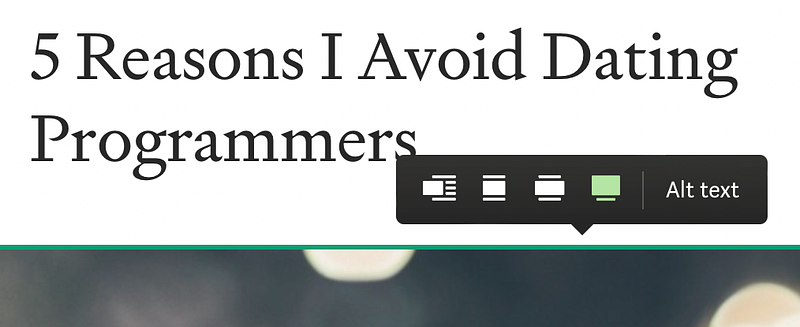
Illustrate your point if you can. A picture’s worth a 1000 words. Well, maybe not quite 1000, but it helps. Don’t overdo it, though, it will get distracting quickly. Caption whenever you can and makes sense, and add an alt text. Here’s how:
If you can’t enjoy your own stories, why would anyone else do?
Write when you feel inspired
Unlike a full-time job where you’d get paid by the hour, writing here is something that should happen when you feel inspired. I have my process of how that works, and you’re welcome to check it out and use it, but it could also very well be unfit for your style.
Don’t think I didn’t try it before — writing on command. It tends not to work, regardless of how much I love writing. If I don’t feel it, it doesn’t happen. To date, my best performing stories were the ones I sat down and wrote on a whim. Not necessarily finished on the same day, but the main points were written within an hour of getting inspired. Here are a couple of examples:
This latter story I half-wrote in August, and only finished and published in November — that’s four months later — because I needed to fall back into that state of being inspired by the topic itself. Theoretically, there should be no pressure on this platform to either perform, write many articles or become a top writer (though I did become, twice in a month). I never had those goals, I still don’t. Removing the pressure leaves space to get inspired, and that’s when many of the great stories happen.
The bottom line
There is no “secret”, unless this somehow was one all along, and I never realised it was. Essentially, if you want me to be entirely reductionist, the only rule to getting curated is you. If you love writing, you will strive to write articles that read well, and you will enjoy reading them yourself and will want to avoid anything that takes away from your enjoyment; therefore you’ll put less pressure on yourself and allow inspiration to happen.
I never planned this story to happen. Kristina inspired me to look at my writing history and dig a little deeper than I did before, and here we are nearly 1800 words (thanks for counting, Ulysses) later getting a bit more understanding of where the success of being curated stems from. It’s no crazy mathematical formula, just good ol’ organic passion and age-old rules of writing that I would argue fall into the realm of common sense, but just in case I’m wrong or come less naturally to you, print Kristina’s rules out and stick them on the wall. Can’t hurt. 😃
Take a deep breath and write. What else are you gonna do, right?
Did you know that whenever you subscribe to become a Medium Member, us writers, get a cut? You get a ton of great articles, we get a coffee. Sounds like a fair deal to me…
Attila Vago — Software engineer, editor, writer, and occasional music critic. Pragmatic doer, Lego fan, Mac user, cool nerd. JS and Flutter enthusiast. Accessibility advocate.


