
SPORTS
How Climate Change Could Shake Up High School Football
And convince a new demographic that it’s for real
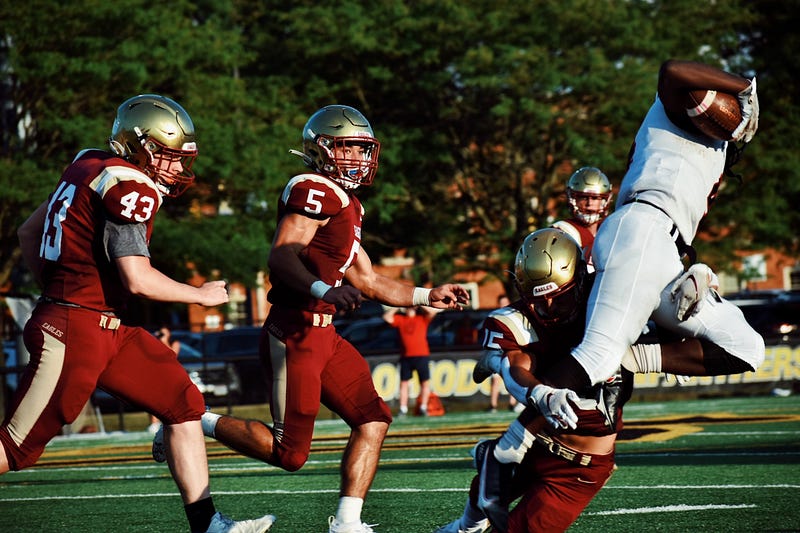
Does the heat get to you? Try putting on a helmet and 20 pounds of pads. Now run, throw, and tackle some big guys. Do it all on artificial turf fields up to 60 degrees hotter than the ambient air.
Add in humidity—a pinch of air pollution. Keep up the intensity for two hours or more. It can kill you. It’s also bringing climate change home to a Republican stronghold — the high school sports world.
The polar bears did it for me, but I’ll take what I can get.
Even today, you’ll see a familiar sight in the parking lot of any high school football game in small-town America. Trump bumper stickers. Let’s Go, Brandon decals. Nobody bothers to peel them off.
MAGA conservatism unites the citizenry, coaches, and players. They are among the last holdouts in accepting the reality of climate change; as a result, youth are dying. It’s an example of the intersection between sports and politics. There are many.
Let’s say you’re a lineman. You weigh 300 pounds, are eager to please your coaches, and make the team. That’s what killed Trey Laster, 17, of Jackson, Mississippi. He pushed himself through an August practice, vomited, and passed out.
The coaches gave Trey CPR while waiting for an ambulance. Somebody called his dad. He didn’t make it to the hospital on time to say goodbye to Trey.
The number of football players who have died from heat has increased dramatically over the last decade. Laster was the 14th player to suffer a heat-related death since 2020. All 14 were linemen. Black high school students are disproportionally affected.
Most died in August. Coaches subjected some to exercise as punishment. Laster’s family suspects the coaches made Trey run extra laps.
Coaches are likely to say, “Heat? Do you call this heat? I practiced in all kinds of weather when I was a kid. Toughen up, snowflake.” However, the past eIght years are the eight hottest on record.
Climate change is coming for high school sports. All anyone has to do is open their eyes and look. Stadiums and athletic complexes are flooding globally, not just in the United States. Will taxpayers pay for new ones? How much will it cost to flood-proof them?
Meanwhile, it’s inexcusable that any athlete dies from heat stroke.
So, what are some solutions? First, coaches should never use exercise as a punishment, especially in the heat.
Another possibility is shifting football from a fall to a winter sport. Players could train in January, February, and March and have games in April, May, and June. That way, they could get used to the heat gradually.
Some schools are shifting practices and games to early mornings or evenings when temperatures are cooler.
In 2009 the National Athletic Trainers’ Association (NATA) issued high school-specific guidelines to reduce the number of heat-related athletic injuries.
They recommend a 14-day heat acclimatization period before full-scale athletic participation. You can read their complete list of recommendations here.
As of April 2017, their seven key recommendations have been adopted by seventeen states (Connecticut, New Jersey, Texas, North Carolina, Georgia, Iowa, Arizona, Florida, Arkansas, Utah, Missouri, Mississippi, Alabama, Nebraska, Illinois, Rhode Island, and Hawaii).
That’s not good enough. In those states that have adopted the guidelines, there have been NO heat stroke deaths in high school athletics. The recommendations should be nationally mandated.
Parents, coaches, fans, and players must take climate change seriously. They should realize there’s nothing hypothetical about it. We are in the thick of it, and some still throw footballs around in dangerous heat.
Coaches and athletic trainers must recognize the signs and symptoms of heat stroke. Trey’s vomiting was a symptom. Other symptoms include:
- Body temperature of 104°F or higher as measured by a rectal thermometer
- Confusion, agitation, irritability, disorientation, delirium
- Slurred speech, staggering
- Seizures, coma
- Dry skin
- Headache
- Dizziness or lightheadedness
- Flushed or reddened skin
- Rapid breathing and heartbeat
- Muscle weakness or cramps
Coaches and athletic trainers must know how to respond to heat stroke while waiting for emergency help.
The first step is to call 911.
Next, cool the overheated athlete while waiting for emergency treatment.
- Get them indoors.
- Remove excess clothing.
- Cool them with whatever means available — like a tub of cool water. The quicker you get them cooled, the less organ damage there will be.
Nobody should die for a game. Trey’s father recently ran across a guide published by the Mississippi High School Activities Association. It called heat stroke “the leading preventable cause of death among young athletes.”
“We want to know why this wasn’t prevented in Trey’s case,” says Laster. He has consulted a lawyer about possible litigation.
I never want to appear as an opportunist here; it’s not about money. My child’s life is worth more than any dollar amount. … Awareness is what I want because I don’t want anybody else to go through what I’ve been through.