
How Churches Really Spend Their Money
The intersection between faith and finance

According to the National Study of Congregations’ Economic Practices, almost one-third of all charitable giving in the U.S.A. is directed to church congregations in the form of donations, tithes, and offerings. Despite the large amount of money entrusted to churches by individual givers, very little was known about their economic practices until recently.
However, in 2017 the Lake Institute on Faith & Giving launched an in-depth, national study about the ways that U.S. religious congregations connected their faith and finances and documented how congregations receive, and manage their financial resources. In this study, over 1200 U.S. churches participated in a survey providing a thorough insight into how churches spend their money.
The results of this study, published in 2019, makes for fascinating reading. If you’ve ever wondered what churches earn and what they do with all their money, here are a few facts that paint a picture of the financial landscape of the Christian church in the U.S.A.
How much money do churches earn?
According to the study, in 2017 U.S. churches received $124.52 billion in donations. Annual congregational revenue ranged from $3,000 to $41,000,000, with the median congregational revenue being $169,000.
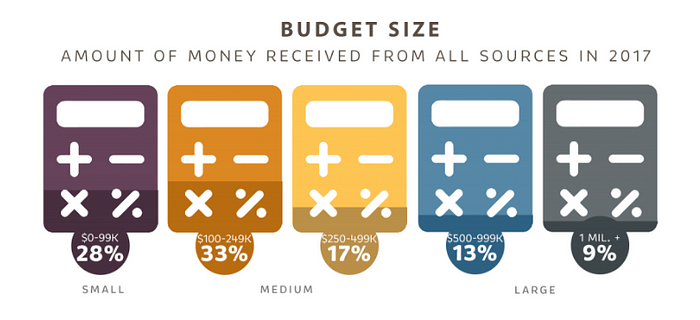
28% of overall church giving was made in small donations (under $100k per year), 33% came from medium-sized donations ($100k-$245k annually) and only 9% of church revenue came from large donations ($1M+)
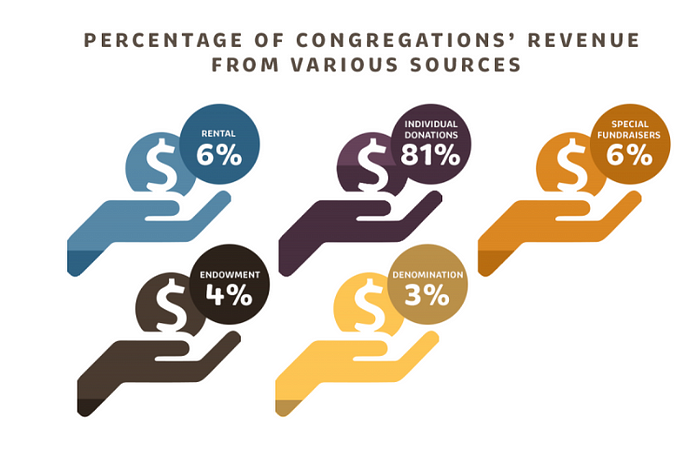
81% of church revenue came from individual donations. 34% of congregations have endowments, which constitute, on average, 4% of their revenue. Only 2% of churches received revenue from government grants; 12% received finance from non-government grants.
Factors that affect a church’s income
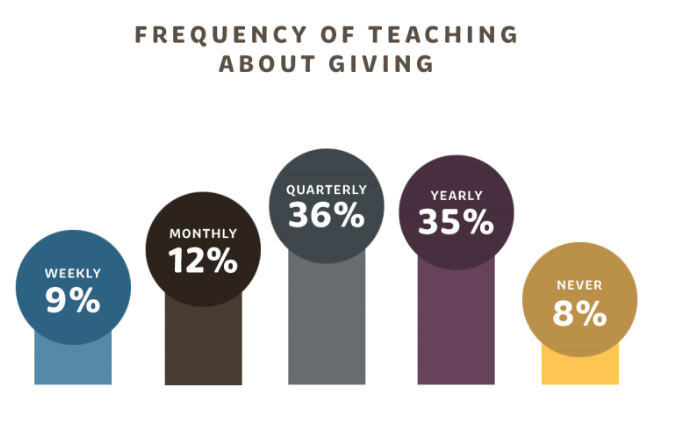
The more that a church explicitly teaches its congregants about giving to the church, the more likely it is to see an increase in donations. This is probably not surprising, especially if the teaching is accompanied by the promises of blessing and prosperity that are as common in churches as they are theological loose. Among congregations that teach on giving weekly (9%), 90% reported financial growth. Among churches that discuss giving monthly, reported financial growth was 73%.
If you’re looking for a church where money isn’t a constant focus, then don’t despair. Around 43% of congregations teach their congregants about giving either once per year or never — almost half of all churches.
The other factor present in churches where financial giving increased was the individual focus given to finances by the church leader. Among congregations whose clergy look at giving records, 58% report an increase in the amount of giving they received (42% of those churches report an increase of 10% or more). So, it turns out if the pastor is tracking your giving, it’s good for the church’s bottom dollar.
What do they spend their money on?
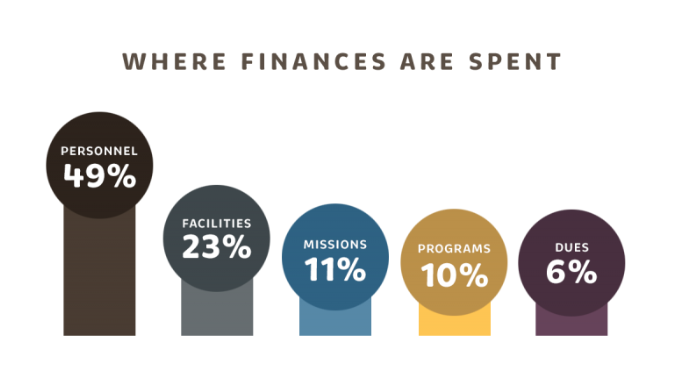
The average U.S. church spends the most significant portion of its finances on personnel. Wages accounted for around 49% of the collective U.S. church’s spending in 2018. The second greatest expense was building and maintaining buildings — 23% of the budget.
With around three-quarters of the church’s finances dedicated to wages and buildings, the remaining funds are distributed between missions (spreading the message of the church), programs (doing the work of ministry), and dues with 11%, 10%, and 6% respectively.
How would Jesus feel about the Church’s Spending?
As interesting as the raw data is, I can’t resist making some personal comments about the picture that the data paints. Author James W. Frick once said, “Don’t tell me where your priorities are. Show me where you spend your money, and I’ll tell you what your priorities are.”
If you asked the church what its primary interests are, you might expect them to say things like spreading the Gospel, developing mature followers of Christ, helping the poor and needy, and maybe even fighting against injustice. If this were actually true, you would expect the church’s spending actually reflect these priorities. So, do they? The answer must be a resounding “No!”
Churches spend much more money acquiring real estate and developing property than they do on helping the poor and needy. For every dollar spent helping the poor and needy, the church spends at least five dollars paying wages to its pastors and leaders. This represents a profound cognitive dissonance between the church’s stated values and its actual values. It all reeks of a system determined to preserve itself at all costs. The very idea must make Jesus turn over in his grave — if he were still in it.
To maintain the traditional model of church, where people turn up each Sunday, sit in a pew and hear a sermon from a paid ‘expert,’ is an expensive exercise with — one could argue — limited benefits in terms of real transformation and growth in an individual. In fact, according to Francis Chan, in his book Letters to the Church, it costs a church $1000 — $3000 per year for each person who attends a church in the traditional model. Let me explain. If you divide a church’s annual budget (say $100,000) by the number of members (say 100), it comes to $1000 per person. The number can be much higher (up to $3000) depending on location.
A new approach to church
What would it look like if Churches did away with their two greatest expenses — paid clergy and buildings? What would it look like if they redirected this money toward the actual work of the Christian faith?
The church I attend meets in the humble home of one of our members. We gather each week around their table and share a simple meal together where we intentionally remember Jesus. We catch up. We share our joys and struggles. We encourage each other and keep each other accountable. We pray and give. We do all of this without paying a person to lead it. When our church takes up offerings, 100% of the money is given back to bless and help needy and hurting people.
This model of church is reproducible, relocatable, virtually free to run, and, to be honest, much more enjoyable and life-giving than anything I’ve ever experienced in the institutionalized church. We all feel like we are growing emotionally, relationally, and spiritually.
Critics of this model — usually those who stand to lose the most from it — argue that such a model would proliferate false teaching and heresy because there may not be anyone in the room with the theological training to correct all the misguided others. Ironically though, small group meetings in individual homes were the traditional model of the early church in the Book of Acts and, so far as I know, none of Christ’s apostles had any kind of theological training. Notwithstanding the fact that they knew Jesus personally. That wouldn’t be possible now, though, would it? The sad reality is the institutionalized church is just as capable of producing its own kind of false teaching and heresy, with the added possibility of thrusting it onto a much bigger crowd.

Free the finances and change the world.
In 2017 U.S. churches received $124.52 billion in donations and spent around $90 billion paying staff wages, buying more land, and building more buildings. But what could the church achieve with that $90 billion if it were suddenly freed up? Well, it turns out the global impact would be massive.
Consider this. According to an article in Relevant Magazine:
- $25 billion could relieve global hunger, starvation, and deaths from preventable diseases within five years.
- $12 billion could eliminate illiteracy globally within five years.
- $15 billion could solve the world’s water and sanitation issues, specifically in places in the world where 1 billion people live on less than $1 per day.
- $1 billion could fully fund all overseas mission work
That would only leave the church a paltry $37 billion dollars for additional ministry expansion at a local level. How ever would the church cope with such small change?
It’s time for the church to literally put its money where its mouth is. The Church talks so much about changing the world and transforming people’s lives. Well, it turns out, it has the financial means actually to carry out this mission. However, it’s not going to happen until the institutionalized church surrenders its desire to build its own kingdom at the expense of God’s Kingdom. As for me, you can bet your bottom dollar that I will not be part of maintaining the status quo.
The Backyard Church is not just a blog. It’s a real online community for people who have faith but can’t, don’t, or won’t go to church. Join today.
New to Medium? Click here to become a Medium member and get access to all my articles and thousands of others.
For more articles on life, faith, and spirituality, Sign-up for my newsletter. Also, feel free to send questions and story ideas to [email protected]


