
How can you invest $1000 (or more) today
Tips to help you maximize your capital — whether it is $100, $1,000 or more
Many of you reading this might have more than $1,000, or much less than $1,000 to invest. Not to worry, I’m writing this post to give you the principles so that you can apply to investment whether you only have $50 or $500. Any amount less than $1,000 is still applicable to you, I’m using $1,000 as a round arbitrary number to make things more easy to visualize.
I take into account the current environment that we are in, a bearish January for the market with companies reporting earnings amid persistent supply chain shortage. With high recent inflation rate (7% in December 2021) and expected interest rates by the Federal Reserve, I will be including some good investments to hedge against these uncertainties.
There are two scenarios in this post. The first one is to invest $1,000 in myself, the second one is to invest $1,000 in an investment portfolio.
Scenario 1: Invest $1000 in yourself

Taking a page from Naval Ravikant, the best way to increase your initial $1,000 and grow it into a much larger sum is to invest in yourself. Naval is a successful entrepreneur who founded AngelList, a website who helps connect angel investors and early-stage startups. He also hosts his own podcast in which he spoke in length about how everybody can monetize their skill by becoming the best and the only few people in the world at that skill.
Build a unique character, a unique brand, a unique mindset where luck finds you. You put yourself in a position to be able to capitalize on that luck, to attract that luck — where nobody else has created that opportunity for themselves. — Naval Ravikant.
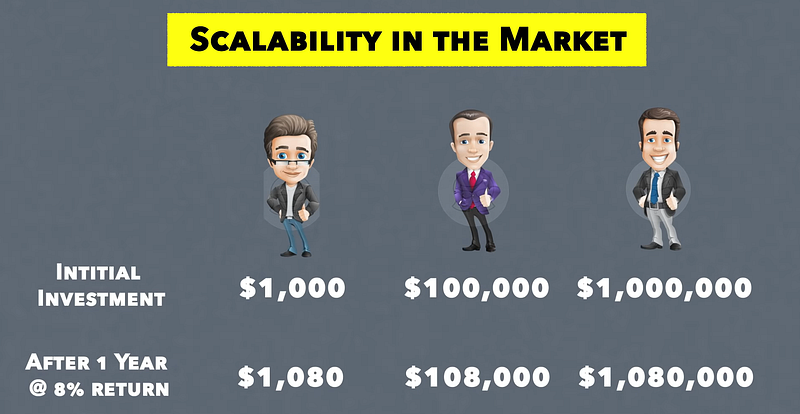
Wealth Capital scales
If you get a 8% return on your investment of $100,000, that is significant at $8,000. Similarly, that 8% return is $80,000 if your original investment is a million dollars. The market performs exactly the same in all of the scenarios. The difference is if you have more money invested, you can make much more money in an absolute basis.
Thus our goal should be to get to a sizable sum of cash invested so the money can start working for us. This is the quickest way to stop trading your time for money.
How should we invest in ourselves?
There are multiple ways, but the two most important things are interest and knowledge.
- Interest: You need to spend time doing things that you’re interested. If you aren’t investing in things that you are interested in, naturally you will lose your interest and in turn lose money. The more interested we are in the subject matter, the more likely we are to succeed.
- Specific Knowledge: Another thing you should invest in is knowledge. Knowledge is extremely powerful. If you have an intimate knowledge of a subject, you can trade that knowledge for money. Knowledge of how business and industry work is incredibly valuable in our society.
This is why having a skill and building knowledge is such a good investment in yourself. To my point earlier you want to be interested in whatever you are pursuing. It’s going to give you a higher chance of success because you are going to stick with it.
If you are already in a profession, what you can do is to pursue a certification or credentials that can instantly boost your salary. Monster.com, the global employment website, has published the top 10 certifications in many occupations here.
Scenario 2: Invest $1,000 in an investment portfolio
What if you have $1,000 saved and you want to invest in the stock market? Then this scenario will serve as a guide for you as you build a diversified portfolio. I followed Humphrey Yang, a personal finance YouTuber who provides great investment and finance education. And here is his recommendation on how to break up $1000 and build a balanced stock portfolio.
50% ($500) of your portfolio in total market ETFs (e.g: VTI, VOO)
An ETF, similar to a mutual fund, is diversified because it buys up a pool of assets and issue shares to investors. Thus, by buying ETF shares, small investors can have a small portion of the fund’s overall assets. More on ETF and how to invests in them, check my in-depth post here.
Notable ETFs: VTI is a total US stock market, and VOO tracks the S&P 500 stocks. They both perform quite similarly. You want to invest a large chunk of your money into ETF because they are passively managed. After you buy it you don’t have to do anything with it. It’s good for the invested I want to buy and hold for a long time.
Warren Buffett bet: Legendary investor, Warren Buffett, has amassed billions of wealth by consistently generate 22% returns compounded annually. He believes that index fund and ETFs are the best way for everyday investor to grow their money. Buffett’s regular recommendation has been a low-cost S&P 500 fund.
He was so confident in this strategy that in 2007, he famously made $1 million bet with a hedge fund manager. The wager was that his passively managed fund strategy would beat out any active hedge fund manager. And he won. Buffets S&P 500 returned 7.1% compounded annually over 10 years. The competing basket of funds picked by hedge fund managers returned an average of 2.2%. Basically Buffets did little due to the passive nature of the fund and still beat out active traders. He then donated the proceed to charity.
20% ($200) of your fund in a growth ETF (e.g: technology sector) or international stocks
This portion is the more riskier part of your $1,000 investment, having this 20% allocation into growth should give you the exposure you want to some of the best returning stocks of the past 10 years like Amazon and Tesla.
If you are not investing into growth, another option is international stocks. You can swap out your $200 of growth for international stocks. Many firms had an outlook for 2022 and they recommended to be underweight in US stocks and they’re putting more emphasis on emerging and European markets, simply due to the historical over-evaluation of American stocks.
Notable ETFs:
- QQQ tracks the top NASDAQ 100 index which includes a lot of top growth tech stocks Google, Apple and Microsoft, etc…
- Notable ETF international markets include VXUS or VEU. Both of them are Vanguard ETFs that give you exposure to international markets besides the US stock market.
There’s some general uncertainty among analysts and firms about the current interest rate and inflationary environment that we’re currently in. In the past, when there is that uncertainty, a lot of people solve that through diversification.
20% ($300) into high yield dividend ETF (e.g: SCHD, VYM)
For the remaining $300 left to allocate, Humphrey put $200 into a high yield dividend ETF. Since we experience a lot of high inflation this year, most experts point toward value stocks with strong cash flow, which typically outperformed during time of inflation. By owning a dividend ETF, every quarter, you should receive income payment in the form of dividends. The underlying companies that these ETFs hold are larger, more stable, positive cash flowing companies. Not only is this investment good for the long term it’s especially good this year in an uncertain environment.
Notable ETFs: In the last five year, SCHD (Schwab’s US dividend equity ETF) yields an average of 2.93%, VYM (Vanguard high dividend yield ETF) yields an average of 3.05%.
The last 10% ($100) is your play money
With this you can do whatever you want whether to invest in your favorite cryptocurrency or individual stock. Personally, I have been investing in stable coins to get high returns (19.5%) using DeFi on the Anchor Protocol platform.
Tips: Invest your investment portfolio in Roth IRA
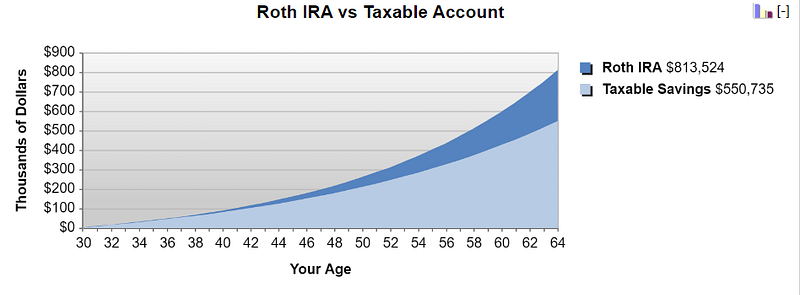
Roth IRA is an individual retirement account that you can start on your own. By investing in stock in that account, any gains that you get on your stocks are going to be tax-free.
The only catch is you are going to need to be a retirement age to withdraw, which is currently at 59.5 years old. This is the best account to invest for the long term. While all your contribution will be after-tax income (meaning it is not tax-deductible), your Roth IRA can grow tax-free with an compounded annual return of 7% if you are investing in a total stock market index fund or ETF. That investment can double every 10 years. Below is a growth visualization of a Roth IRA account, funded $5,500 per year starting at age 30 to age 65.
Thank you for reading my post, and I hope you enjoyed what I have laid out here. Please check out my other posts for more personal finance and self-improvement tips. As always, have a fulfilled day as you go out there and be your best self.


