How can you identify a credible nutrition blog post?
Checklists developed by researchers for lay readers
I was shocked when I read this article published on the Independent, dated 30th April 2019:
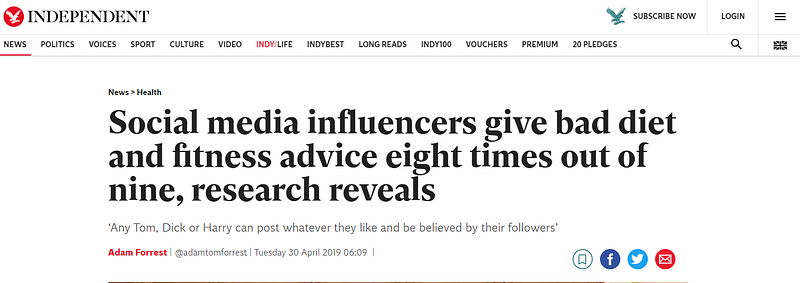
Source: The Independent
As a Nutrition Scientist myself, I understand that self-posting social media content and blog post are not the best sources of nutrition information. Many authors do not even have a qualification in a health- or medical-related degree. The lack of professional training in health or medical science is a big challenge to delivering accurate and non-bias nutrition information, in turn, posing a threat to the credibility of health professionals, if the public is continuously bombarded by contradicting ideas.
I fear that one day, my clients may not believe in what I tell them after they have read some ‘primitive remedies’ that they believe to true through blog posts.
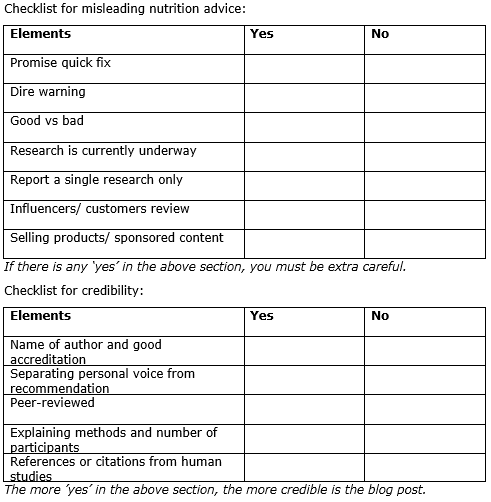
In this article, I compiled a checklist developed by researchers [1, 2, 3] on:
- How to identify misleading nutrition advice?
- How to identify a credible nutrition blog post?
- My personal top 3 reminders when reading nutrition information.

Checklist for identifying misleading nutrition advice
If you have identified any of the following elements, you must take extra care in assessing the information as they are very likely to be biased advice.
- Quick fix (e.g. Reverse diabetes in 7 days with this diet) My comment: This is too quick/good to be true?
- A dire warning of specific products or regimens (e.g. Do not eat red meat.) My comment: Nutritionists emphasise a balanced diet, not excluding any foods. Red meat is an excellent source of iron, but we must not consume more than 250g red meat per week to achieve balance.
- Lists of “good” vs “bad” foods (e.g. Good carb vs Bad carb) My comment: There is no absolute good or bad food, only better or worse, depends on the context. For example, whole grains are generally considered as a better carb than refined grains, but both types of grains are to be consumed in moderation. Whole grains provide dietary fibre, whereas refined grains provide glucose and energy. Nevertheless, in this modern world, there is a need to shift from refined grains to whole grains to achieve balance.
- Research is currently underway (e.g. Research is currently underway to show that the vegetarian diet is the best diet for longevity.) My comment: You should not take this as advice because the research outcome is not yet available.
- Advice based on single research (e.g. The study from the University of xxx found that high consumption of protein leads to a shorter life). My comment: You can take it as a piece of interesting information, but not as standard advice. An evidence-based recommendation is based upon the agreement of multiple independent research and takes years to establish.
- Advice from influencers or customers (e.g. I tried the keto diet, and I lost 10kg in 4 weeks! OR I tried the keto diet and it caused hair loss) My comment: Their success or failure do not automatically qualify them for giving advice. Personal success or failure is just a point of reference as everybody’s biology is different. Hence, this points towards personalised advice.
- Trying to sell products or the content is sponsored. My comment: The authors are never going to tell you anything negative to sell the products. As a result, this introduces bias. I recommend everyone to do our homework by checking whether the product received any approvals from any authorities and comments from an independent organisation that has no conflict of interest. The best way to know whether you require the product or not is to consult your doctor or a nutritionist.
Checklist for identifying credible nutrition blog posts:
- Name of author with appropriate accreditation, or was written by an independent institution, such as the World Health Organisation (WHO) and the European Food Safety Authority (EFSA).
- Separating personal voice or advertisement from general recommendations.
- A peer-reviewed article is likely to be more credible because it has been checked by independent experts. A self-managed blog post can sometimes be biased or contains some errors/misleading words.
- Explaining methods (how the research was done) and the number of participants involved in the study (normally the more the better).
- With references or citations from human clinical studies (not animals or in a test tube) or scientific reviews. Information about who conducted the study, where was the host institution, when it was published, and contact information, are equally important.
My top 3 reminders for you when reading nutrition information
Reminder 1: Nutrition is all about balance.
If anybody tells you to totally restrict any food because the food is “poisonous” or “toxic”, then that person is almost certainly not a qualified nutritionist/dietitian. Since almost every food has both positive sides and negative sides, this is why we have dietary guidelines to tell you what is a balanced diet. For example, when we say to limit sugar and fat, we are not telling you to have zero sugar or zero fat.
Reminder 2: There is no such thing call detox, cleansing or pH diet.
They are very popular headlines and pleased to read. Unfortunately, they do not exist in any peer-reviewed scientific articles evidenced by human clinical studies. Our body is capable of metabolising waste compounds away from the body through a healthy kidney and liver. We cannot find satisfactory evidence that any ‘superfoods’ may be able to add any measurable benefits to ‘detoxify’ yourself, except for drinking enough water to ensure you can urinate the ‘waste’ out from your body. Do also check out what happened to the author of pH diet.
Reminder 3: Associations do not mean causation, a problem with survey research.
If a survey shows that frequent egg consumers are more likely to have heart problems than infrequent egg consumers, it might be that the frequent egg consumers were also eating a greater amount of animal meat which is high in saturated fat, a type of fat that will also cause heart problems. Unfortunately, we are quite perplexed by whether eggs are ‘good’ or ‘bad’ due to its higher cholesterol content. The egg is not justified to be the ‘sole villain’. In fact, the one thing I reiterate quite often throughout this article is the need to advocate a balanced diet, for example, moderate in saturated fat consumption in this case. By eating fewer eggs but more fatty meat is not going to reduce the incidents of heart problems.
Bottom line: Go to see a health professional when you are in doubt, and ask many questions. Answering your health-related questions is what we are trained for.
Extra notes: I cannot deny that there were some nutrition experts believed that the current nutrition guidelines could be better [4, 5]. Nevertheless, as a lay reader, the following government or international websites were generally good sources of nutrition information and advice: