

How can we shift leadership energy to co-creative collaboration?
What is the energy of regenerative leadership?
When I started to curate the speaker team to deliver our next Connectle webinar on regenerative leadership, I had no shortage of wonderful speakers I wanted to invite to the conversation. There are so many wonderful leaders in this field; activists, entrepreneurs, biomimicry practitioners, consultants and coaches. What I had difficulty with was the question we would explore in the single hour in which we come together.
Although we’ve settled on ‘How can we shift leadership energy to co-creative collaboration?’ I’m still not sure it has captured what I hope we can discuss. Part of me wanted to call it ‘How can we activate the transformative power of women?’. Another idea was to name it ‘How can we bring the energy of the future we want into business?’. A third was ‘How can we defeat the energy of patriarchy?’
we have a paucity of language to describe this leadership energy
Many of these questions would have been distractions. To imply that this energy is more often found in women has already invited controversy — yet that is my personal experience . It is certainly not gender specific. It is only related to gender in that the terminology — like patriarchy — that surrounds the opposite kind of energy is something we are familiar with. We have an almost automatic sense of what the energy is that goes with the cultural metaphor of patriarchy. From top-down hierarchical design in organisations to everyday mansplaining.
The word ‘defeat’ is wrong as it suggests a battle and though this energy is fierce, the language of battle and arms belongs to the very energy we want to change. And we will still need the energy of patriarchy. It has a place. We just need to bring it into balance with its opposite. The question in my mind is whether the opposite of its energy needs to dominate in our design for the future for a short period before we arrive at a much needed balance of both energies, where we can come together in harmony and balance? Do we need to throw the baby out with the bathwater to change such a dominant paradigm or can we find a way to shift to a new energy without doing that?
So I settled on qualities that are almost always present in this kind of leadership — co-creative collaboration. The truth is we have a paucity of language to describe this leadership energy because we have been so dominated by what it isn’t for such a long time.
The energy I hope we will explore doesn’t really have a proper name yet (if it does please call it out). For now we call it regenerative leadership or conscious leadership. It’s almost easier to describe what it isn’t. It isn’t hierarchical. It isn’t command and control. It isn’t patriarchical. It isn’t competitive. It isn’t divisive or tribal — even though you could argue those a natural human qualities for human(un)kind. It isn’t the cultural energy that has shaped much of human life for the past 2000 years. It isn’t manthropocentric — to borrow a wonderful word I first heard from renegade economist Kate Raworth — or even anthropocentric.
Creating the conditions conducive to life
I can describe what it does. It creates the conditions conducive to life. If that sounds a bit too vague, let me try to be more specific. It doesn’t prioritise one life over another. It seeks not to cause harm but to create positive ways forward. It thinks holisitically and systemically. It sees interconnections. It is polymathic in one way, knowledgeable, considered, but not guru-like in its expertise. It isn’t protectionist; it shares openly with a will to support other life. It sees potential and opportunity for connections; between ideas, groups, people. It finds connections between opposing forces and finds a route to harmony through conflict and opposition. It helps to design organisations where people more easily find how to fulfil their own potential without trampling on others in the process. It helps to have difficult conversations in an atmosphere of psychological safety because it is not judgemental, fearful or cynical.
It is adaptable, able to cope with and integrate the unexpected. It can evolve, and reshuffle information creatively to keep moving forward. It’s responsive to what’s going on around it. It is able to listen deeply, see and sense and be locally atuned from moment to moment. It values diversity and creativity. It doesn’t seek to centralise power but to distribute it. It creates resilience through compassionate understanding of the cycle of life which includes redundancy, variation and death.
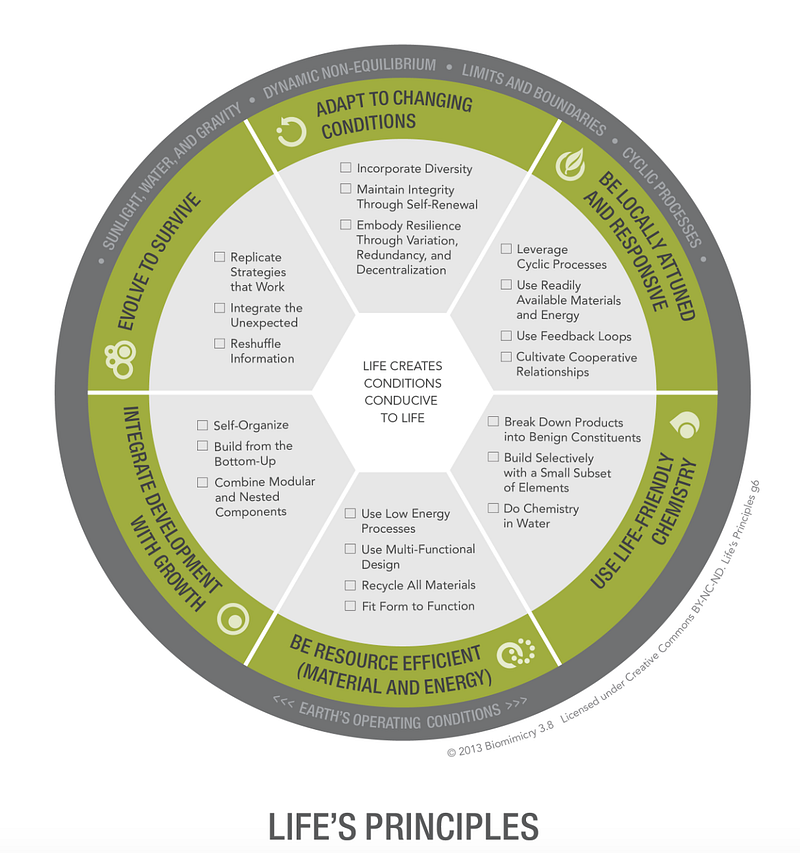
It is collaborative, able to cultivate cooperative relationships. It finds and takes advantage of the energy that is readily available; it finds the edges of the fire where creativity and innovation burns brightest. It builds from the bottom up, not the top down; it’s grassroots in its feel, and self-organising.
But it’s not passive. It can be fierce; it has the transformative power of fire in a forest which changes the landscape and yet still renews life. It is strong and steadfast in its defence of life. It is not extractive, it’s contributive. It’s not degenerative, its regenerative (obviously!). It begs the question ‘what is my licence to operate in a world which desperately needs renewal — of both our natural resources and the brightness of the human spirit?’
Why is a change in leadership energy so important now?
We’re stuck.
We’re stuck in an extractive and degenerative economy which requires constant extraction and consumption we can no longer afford.
We’re stuck in an ownership model for organisations that demands constant exponential growth and profit for shareholders that is no longer possible to deliver.
We’re stuck in organisations that have constrained the creativity and innovation desperately needed.
We’re stuck in the politics of divide and rule that smokescreen and distract from the real hard work of transformation.
We’re stuck in a mindset of entitlement, individualism, me not we.
We’ve been stuck since 2008 when we first realised that the model of the world we’ve built just might not work any longer.
We’re stuck for a new story.
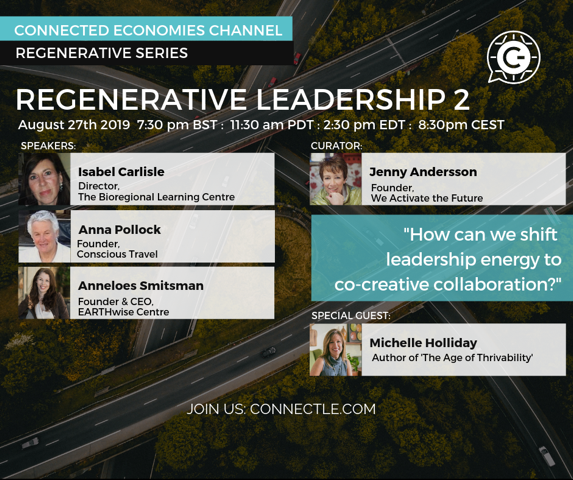
What is needed in leadership is a change of energy. From degenerative to regenerative. From extractive to contributive. From destructive to life-enhancing. And that’s what I hope the very find minds of Anneloes Smitsman, Michelle Holliday, Anna Pollock and Isabel Carlisle and I will explore on August 27th.
The webinar takes place at 7.30pm UK time. You can register here. There will be a recording so if you cannot attend live, do still register and we will send you a copy.


