How Can I Understand When to Use “There” vs. “Their” and “They’re”?
The confusing case homonyms

WriterThese words haunt writers causing confusion. However, simply by identifying the word within each word, a lifetime of clarity can be achieved.
When deciding which to use, ask these three questions.
- Is the word referencing a place?
- Does the word show ownership?
- Is the word a contraction, a combination of two words?
There has the word here in it.
The words here and there help the writer remember that this word should be used in sentences referring to a place. Often when this spelling is used the word here can be substituted.
- Place the book there on the shelf. (Place the book here on the shelf.) See it works!
- Your mother is over there. (Your mother is over here.)
Their has the word heir in it.
An heir is a person who inherits property when someone dies. For instance, if the king passes away, the prince inherits the kingdom; he is heir to the throne. Therefore, this word shows possession or ownership.
- Their house is on fire. (They possess/own the house.)
- My grandparents went to their cabin. (The grandparents possess/own the cabin.)
- The kids rode their bus. (The kids possess/own the bus.)
They’re is a contraction.
Contractions have apostrophes — flying commas (‘). Contractions are made of two words combined. They are pushed together tightly until letters pop out and an apostrophe (‘) drops in place of the missing letters. Think of it as an abbreviation, making the word shorter. Oh, and notice the apostrophe fills the place of the missing letter.
They are = They’re
So, if you struggle with which of these three homonyms to use. Ask the questions above to identify the purpose of the word.
Test your new knowledge:
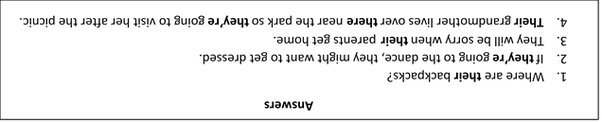
1. Where are ________ backpacks?
2. If _________ going to the dance, they might want to get dressed.
3. They will be sorry when ________ parents get home.
4. _____grandmother lives over _____ near the park so _____ going to visit her after the picnic.