
How Brands Can Gain Exposure and Sales From Writing on Medium
Short answer? Don’t sell your products here — sell your writing

If you’re a brand or company that isn’t currently writing on Medium, I hate to tell you, but you’re seriously missing out. Why? One reason: exposure.
Many indie authors make good money writing on Medium (myself included), but the benefit that brands get is not a dollar amount. It’s the sheer amount of readership on this platform.
For one, Medium is extremely highly ranked on Google. If I write the same blog post on Wordpress and on Medium, my Medium post gets far more hits from Google. This is because many people, especially respected domains, link back to Medium, granting it a high domain authority.
But even beyond the inbuilt Google advantage, Medium has two other things going for it. If you want to start leveraging Medium’s readership, these are the things you need to keep in mind: curation and publications.
Curation on Medium Isn’t Impossible for Brands
But it is tricky. Before I get into why, let’s back up. What is curation anyway?
Curation is Medium’s answer to garbage content. Medium curators go through the vast majority of every blog post published on the site every day and decide whether or not it’s “good.” This is inherently subjective, of course, but there are lots of good guides, both by Medium themselves as well as successful Medium writers, on how to play by their rules.
If your offering is deemed worthy, it’s distributed in one or more topics. This provides a huge boost to the in-Medium traffic to that post — even if you have zero followers, if your post is curated in a topic, it will be promoted to followers of that topic.
You should be starting to see the potential here.
Imagine you sell cat products. You write a blog post about a common problem cats face — say, dehydration. You provide a well-researched, well-written post about the ways to identify and deal with cat dehydration. Boom — you hit publish on a job well done.
Well, Medium curators agree. It’s distributed in the pets topic! Floods of traffic are directed to your post.
The problem arises when we go back to Medium’s definition of “good.” They’re trying really, really hard to be ad-free. In an age of clickbait and selfish content, they’re trying to promote the good stuff. I respect that, and you should, too.
For you, a brand, this makes your job a little harder. You can’t link to your products, you can’t end with a call-to-action, and you can’t include advertisements. In other words, your writing must stand on its own.
Despite being ad-free, there are still two ways you can use curation to boost traffic — and sales — of your own products.
Your profile matters when it comes to sales
While you can’t include ads on your post, you can include links throughout your story and profile, so long as it’s not an obvious ad.
In order to make the most of this, post as a person rather than a brand. When you’re creating your Medium profile, use your name rather than your company’s name. Upload a picture of your face, not your company’s logo. Feel free to say that you work for the company, or as CEO of that company, whatever the case may be. This will work in your favor, as it establishes you as a trusted authority in that area.
Make sure to add a link to wherever people can buy from you, and don’t forget to gently sprinkle your blog posts with links to your products or services. If you add too many, Medium may qualify it as an ad and decide not to curate it, so use your discretion. I’d advise one link to your own site per post, along with links to other authorities on the matter.
Medium allows you to become a trusted authority
The second method is old-fashioned trust. If you write every week about a problem cats face and how to solve it, people will start coming to you to fix their cat-related problems. As the owner of two cats, I can attest that they have a lot of problems.
Even if you’re not curated, you can create a repository of cat-related knowledge and help. Cat lovers like myself might find one of your posts through Google, and then see several others by you at the bottom of the article. I might choose to follow such a person in the hopes of seeing more of their cat-related work. I might read more of their stories. I might think of them next time I have a cat issue.
This is similar to any old Wordpress blog with one exception: publications. On Medium, you can create your own publication in addition to your author profile. This allows you to collect your stories about particular topics in publications. Readers can choose to follow publications, writers, both, or neither. Most writers I know have their own publications, as it just gives your related work a good home and a place for people to browse.
Here’s a Perfect Example of Everything I’ve Just Talked About
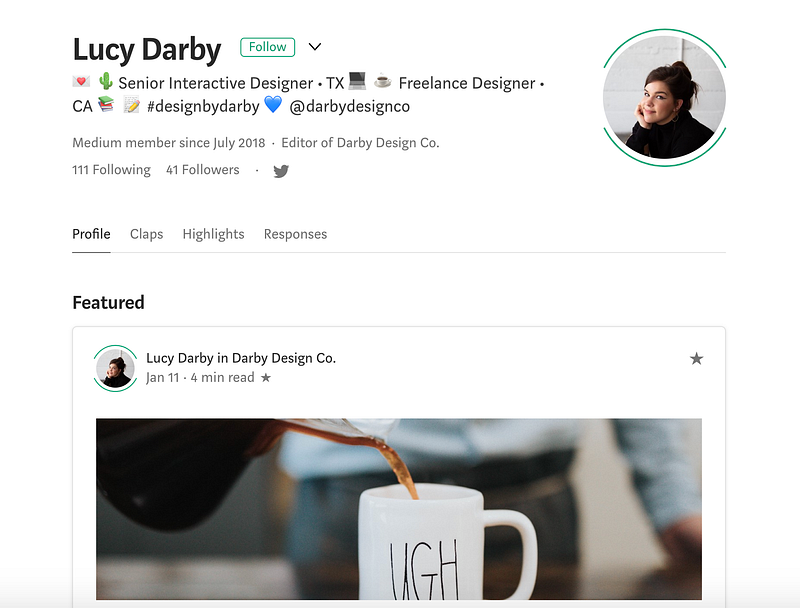
Lucy Darby here has her own profile and a publication for her company (Darby Design Co.). She was just curated in the Design topic. Her post isn’t trying to sell you on her services. Instead, she writes a great post on how to avoid bad clients, and then sits back and watches as people read her post, then potentially follow her profile, publication, hashtag, or even check out her Instagram profile. Done.
Publications on Medium Are a Great Springboard
Not only can you make use of your own publication, as Lucy did, but you can use others, too.
Medium has tons of active publications about nearly every topic under the sun, and many are accepting writers.
Let’s say you’re a new company selling cat brushes guaranteed to get tangles out. Cat brushes are a pretty niche topic — but startups are extremely broad and relevant to many, many people. How have you personally solved the struggles of your startup? What tools do you use, what marketing works for you? Strategy posts can go to The Startup. Marketing posts can go to Better Marketing. If you’ve had problems with co-worker relationships, P.S. I Love You might be a good place for your story.
Think outside the box. Medium is not a good home for your ads, but it is an exceptionally effective place to gain exposure.
Content Strategies for Brands on Medium
Let’s recap: You want to be curated, you want to post in your own publication, and you want to get into others’ publications, too. So what kind of content can you write about that will let you achieve all this?
You can determine this with three simple rules.
- Problem-based, not product-based. What this means is you don’t write an article about a fancy new cat water fountain your site has. Instead, you write about how cats don’t drink a lot of water, which causes health problems for them.
- Focus on immediate value. While readers will hopefully get value from buying whatever it is you’re selling, you want to create immediate and free value as well. You want to immediately solve their problems. This doesn't even have to be product-related. One of my favorite Twitter accounts, Steak-umm, has risen through the ranks of Brand Twitter just by being funny, but now when I think about dinner options, they come to mind. Value can be anything you make it.
- Evergreen content is best. I know, this tip is so old it creaks, but it’s true. You can get evergreen content ideas by noticing what you get asked all the time from your customers, your parents, and online. What questions do people have about your niche, brand, or service? Answer them in your blog posts.
All this is going to serve the purpose of making your content “good enough” for Medium — that is, ad-free and high-quality. It’s also just good practice. Nobody likes reading ads. We all like reading good content. When a brand tries to sell me something on Twitter, for example, I mute them. When a brand makes relevant and funny memes, I follow them. It’s that simple on Medium, too.
Medium is, in short, a place for good writing. If you want to make money writing about what you love, this is a great place to do so. If you want to use it as a springboard to gain attention for your company or brand, that’s definitely attainable — with a little strategy. For you, it’s not about the dollar amount each blog post earns.
It’s about the traffic you’ll be able to drive — and the reputation you establish.