
How Branding affects Information Architecture
Why do we want a good IA? So that users can get whatever they want in the easiest way possible. Coool!!
Is it the end of the story? I believe not!

A good Information Architecture is like a pathway for users to navigate easily and look at the content, the way we want them to perceive it. Branding certainly comes here to define this perception.
Let’s take an example -
Suppose a software company works for public safety. They have n number of products and you are required to design a website for that company.
These software products can detect events by analyzing images/videos. Some examples can be —

The challenge of building Information Architecture is in creating channels through which the content will go.
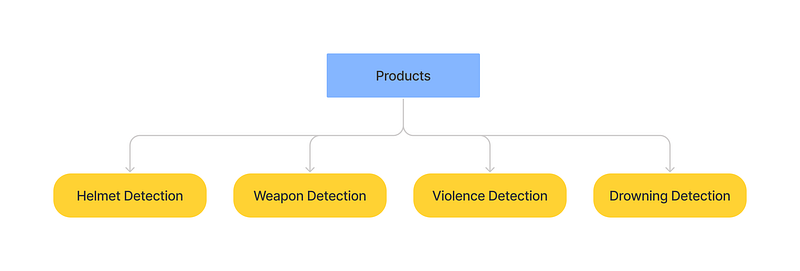
In our example, the simplest way is having one channel ‘Products’ only.(Fig 1) In this case, Branding strategy might be ‘we are the company who works for public safety’.
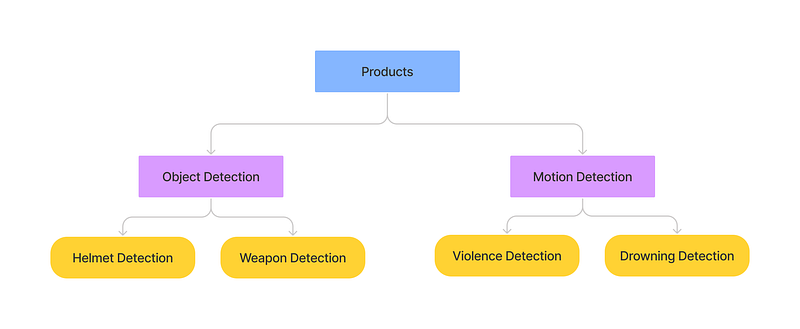
The other way, we can group them based on their functional similarities. (Fig 2), if the Branding strategy is ‘we are AI-powered company who can detect objects and motion’.
Here, weapons and Helmet are objects, and Violence and Drowning are human motion.
So categorization can be done in many ways. Business approach and Branding tagline actually guide here. They tell how they are reaching the users. For example- if they decide to reach users through industry verticals or use cases, we may consider — (Fig 3)
Helmet is related to Road and Transportation industry and Weapon is related to Law and administration.
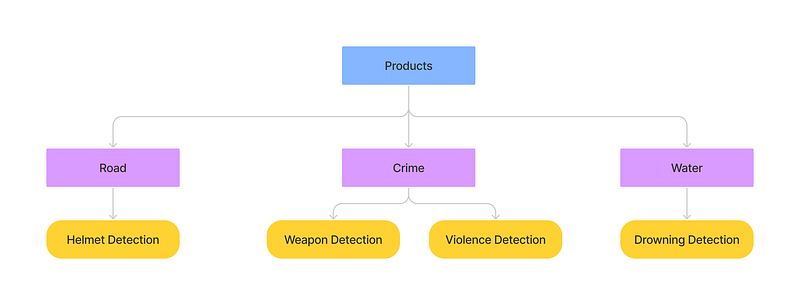
This way Branding and Marketing strategy affect Information Architecture significantly.
So how can we decide channels for IA? In my experience, I felt that there are two things that need to be kept in mind while working on IA-
1. Understand the goal of Branding-
Branding sets an organization apart from everyone else. It gives conceptual design. Structure and Visual design should adhere to this conceptual ground. So that it can convey the same message that the branding is setting.
2. Have a clear idea of User-Persona-
Ultimately, you are designing for the navigation ease of users, which should not be compromised. Branding insists you consider business requirements. Clarity of user-persona tells where business requirements and user needs fit together.
Thanks!!
Visit my work at — https://nigamarnav.github.io/


