
How “Big Magic” Helped Me Push Past My Fear of Failure with Writing, and How it Can Help You Too
Create because you love it, and know that success will find its way to you.
Being creative is hard, but being creative while being anxious and while having a deathly need to succeed is harder.
I’ve always loved writing, ever since I got the “Most Expressive Writer” award in kindergarten (even though I cried over not receiving “Most Friendly” instead) and ever since I wrote mystery stories about Cacktell Jones in my SpongeBob notebook.
But next to my love to write is my love to be successful, to be admired, to hear how much others love my work. I need external validation in order for me to feel internal validation. I know this isn’t necessarily healthy nor helpful, but it feels so ingrained in my brain.
I’ve finished a lot of articles and stories over the years, but I’ve also not finished others. I’ve either grown tired, worried the content was too awful to pursue or felt like the piece was pointless if it wasn’t going to bring me money or success.
And that’s not my favorite part of myself.
I want to write all day and enjoy every bit and not care about web analytics or others’ opinions. I want to paint because it can be relaxing, and realize my painting isn’t going to be perfect, nor does it need to be. I want to be successful writing, especially as I pursue being a freelance writer, but know that it’s okay if I need to work a side job.
I don’t want fear to get in the way of my creative living pursuits.
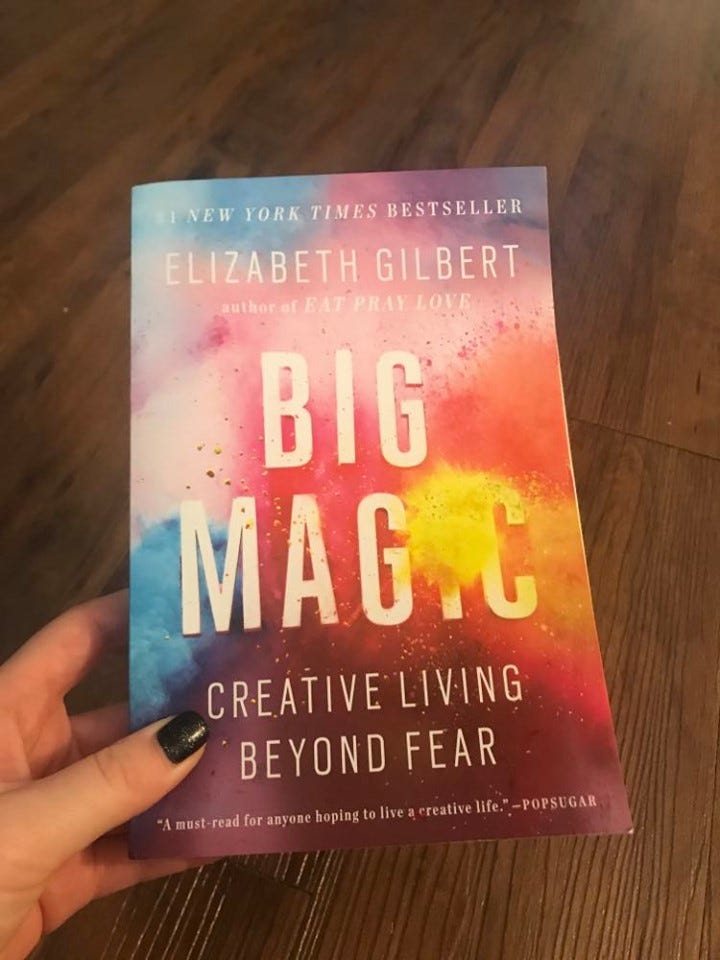
Elizabeth Gilbert’s “Big Magic” helped me with that.
I read the first couple chapters of “Big Magic” for a self-portrait photography class in college and became instantly enchanted by the discussion of bravery and how we must put ourselves “out there” if we want to have a chance to succeed.
I ended up buying the book and reading the whole thing twice.
“Big Magic” is divided into six parts plus a conclusion; below are the main points I learned from each section.
Courage
If we want to live big, fulfilling, successful lives, we have to be brave. We have to put ourselves out there — there’s no other way. We have the talent within us already; we just have to be courageous enough to let it out and trust that talent will make its way out as we create. We may be surprised by how successful we are in this journey — that’s Big Magic.
Our fear and our need to defend it is boring and unoriginal. We all have fear, and fear has only one message: stop. While fear can be helpful and is an evolutionary instinct, it can overgeneralize. Our creativity can be wide-reaching, but our fear should not. By leaving our fear alone, by acknowledging it but not letting it win, it will begin to relax and leave us alone. Don’t feed your fear.
Enchantment
Other people are also creative and will find success — and that’s okay. That doesn’t take away from anyone else’s creativity, success or potential. We can acknowledge and congratulate them without needing to be afraid that our time is running out or that our Big Magic isn’t coming. Focus less on success and more on dedication and faith.
Continue to be enchanted by creativity and the breadth of your abilities, heart and mind. Just like we can’t let our failures stop us, we can’t let our successes stop us either. The limit to what we can achieve doesn’t exist. Success isn’t the only reason to create, and our success can continue to reach higher heights. Don’t stop after you think you’ve done the best you can do, because you haven’t. And if your next pieces aren’t as successful, that’s normal and common. Keep creating. More creativity is coming, and we should try to enjoy the process. If we wait for Big Magic, we may be waiting a long time, keeping other interesting ideas and art from ourselves and the world.
Permission
Know that you and your creativity belong and deserve to exist and express yourselves, even when fear rears its ugly head. In order to live a creative life, we have to remind ourselves of the enjoyment we find in creativity and that we are helping ourselves through the expression of that enjoyment, curiosity and passion.
You are a child of God, and the creation of you as a human ensures you have a right to be here, to create, to share your voice. Your art and thoughts may be similar to someone else’s, but that’s okay — they haven’t been shared by you yet, and that’s a new level of creativity that no one but you can reach. You are unique in ways you don’t even realize because you’re so used to being yourself and thinking in the ways you do.
Don’t try to be authentic, just be authentic. Share what’s on your mind, share what you feel driven to share, share your curiosity. It’s okay if what you share doesn’t save the world, because that’s not the purpose. The purpose is to create and to enjoy it. Work hard, but also take care of yourself in the process.
Don’t let rejection take away the belonging you inherently have. Even the most successful people have been rejected in their creative pursuits. Think about the information the world is giving you, from customers’ comments to what you overhear someone say in the bathroom. Don’t be afraid to think about what you heard and create your own version of it. You have your whole life to create; don’t worry that you’re running out of time, but also don’t let that time delay your start.
Don’t let your work be stopped by one rejection. Send it in again or send it somewhere else. Your work and your success will eventually work out, even in the most surprising ways. I love the way Gilbert says it: “‘You think you can scare me off? I’ve got another eighty years to wear you down! There are people who haven’t even been born yet who are gonna reject me someday — that’s how long I plan to stick around.’”
While so many benefits come from creative living, you will struggle. Creating isn’t easy; creating is an art. But by complaining about creativity, or our lack of it, we scare it away. We make ourselves believe that creativity isn’t worth it, when it’s one of the few things that are. We have to find ways to enjoy our creativity.
We all have potential, but none of us knows how much. Let that encourage you to create, not stop you. Don’t let others’ unkind words stop you either; don’t even give them the time of day. People will take what they’re going to take — what they need to take — from your art, regardless of whether or not it’s true to you. They may or may not like it, and so what?
Persistence
Try to think of your rejections as a puzzle piece in which you have to figure out where your art goes, because it indeed goes somewhere. Try to think of your rejections as education for your future art, from how to do it best to where it will find its home. Try to think of rejections as simply one step in the process of finding success. Try to think of rejections as normal, because we can’t all succeed at every single thing we try.
Understand that your art may not be able to pay all of your bills right now, and understand that that isn’t a rejection of your art, just a reality. The most successful writers had to write on the side, either after or before their day job.
Fake it ’til you make it. If you run out of ideas, run with curiosity. Read more. Take a shower and dress for success. Creativity will find its way back to you.
Perfection is not the goal, nor is it attainable. Perfection is just another form of fear and how we try to fight against inevitable rejections. Not everything you create has to be your favorite creation, nor does it have to be good. We’re creating because we love it, after all. Know that no matter how much time you spend on something, somebody will find something wrong with it.
Do what you can reasonably do with your art and let it be, moving on to your next creative endeavor. Know that no one is paying you as much attention to you or judging you as much as you are. Know that success is largely out of your control, other than your level of dedication.
Let your creativity save you from the pain you’re dealing with in other areas of your life. Let your creativity serve as a distraction, a stress-reliever, a way to express how you’re feeling.


