
How Biases Drive Your Investments — Discover Your Type!
The emotional rollercoaster of investing

Buy high, sell low.
We’ve all been guilty of this at one point.
The average investor’s emotional journey goes something like this.
At first, you feel like you’re on top of the world. You made a couple of gains, maybe even picked a few winners. You feel invincible. But then comes a slight downturn. Panic starts to set in. The heart starts racing, your palms get sweaty, and you find yourself refreshing the stock prices every five seconds. You look at the charts in disbelief and see your precious gains evaporate like water in the desert.
At the top, you’ll think that you need to buy more quickly before you miss out. And at the bottom, you need to sell now before it gets even worse.
Welcome to the world of emotional investing where logic takes a backseat and Jesus (a.k.a. panic) takes the wheel.
Here’s how it looks.
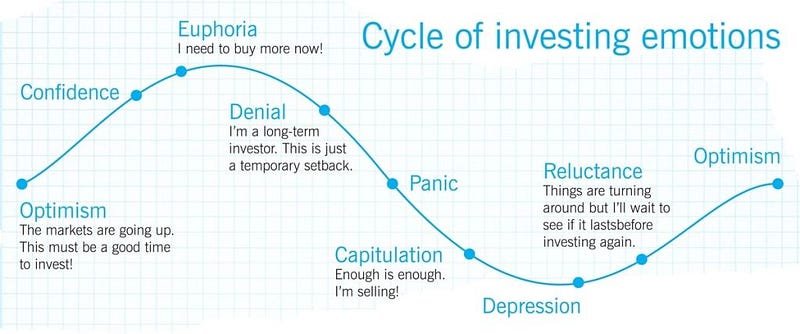
You’re no longer a calm, rational human being; instead, you’ve become an unpredictable, emotional creature, desperately reacting to every price swing.
Whether you’re riding the stock market bull or taking a spin on the crypto coaster, you’ll have an emotional journey. If you’re not prepared or at least aware of what’s happening you’ll let emotions drive you off the cliff.
But how can you take the reins of your investments and navigate the turbulent waters with logic and reason?
Realize what type of investor are you and learn the emotional and cognitive biases that drive your investments.
You’ll thank yourself later for doing the work.
What type of investor are you?
Michael Pompiane, the main consultant of Hammon Associates ($55 billion in assets under management), has developed a framework that looks at people’s investing behaviors and how to address their biases when investing.
He classified people into 4 categories, which are more of a guidepost than a rigid classification.
- Passive Preservers: They play it safe, low-risk tolerance, driven by emotional biases.
- Friendly Followers: Moderate risk tolerance, mainly affected by cognitive biases.
- Independent Individualists: Same as nº2, but with a higher risk tolerance.
- Active Accumulators: Risk-takers, high-risk tolerance, and emotional biases at play.
Let’s take a quick look at each behavioral investor type and identify the primary bias that influences their decisions, whether it’s cognitive (based on faulty reasoning) or emotional (driven by feelings).
Passive preservers
They’re all about preserving their wealth and avoiding risks, making security their top priority. They might have inherited their wealth or earned it conservatively through safe endeavors.
Passive Preservers can be worriers, obsessing over short-term performance and resisting change. They’re the type who’ll hold onto investments from previous generations, even if it doesn’t make financial sense.
Emotional biases play a significant role in their decision-making, and they might struggle with endowment bias, loss aversion, status quo, and regret.
They’ll resist changes to an investment plan because they’re stuck in the status quo. And when they do take action, they’ll be overly conservative, hindering their long-term performance.
They also cling to arbitrary price levels when making investment decisions. They’ll rely heavily on certain reference points or “anchor” prices that might not have any real significance or relevance to the current market conditions or the true value of an investment.
Friendly Followers
They’re also passive investors but they tend to follow the lead of their friends and colleagues when making investment decisions. This is because they tend to lack strong opinions or independent ideas about investing so they prefer to follow the crowd.
They prefer trendy investments without much regard for a long-term plan. However, they often overestimate their risk tolerance, which can lead to poor decision-making. They might feel confident and adventurous during times of market optimism and rising asset prices, but when faced with actual market turbulence or downturns, they can quickly become anxious and risk-averse.
They rely too heavily on recent events (i.e. recency bias) and they perceive past outcomes as predictable even when they weren’t (called hindsight bias). They also rationalize their decisions to avoid discomfort (i.e. cognitive dissonance), leading them to hold onto losing investments.
Friendly Followers tend to be open to learning and educating themselves financially but they might delay making investment decisions or even avoid taking any action without professional advice.
You’ll see them maintain high cash balances or hold on to underperforming investments, reluctant to make changes even when it might be in their best interest.
Independent Individualists
They have a strong-willed, independent mindset, trusting their gut when making decisions. However, sometimes they can be a little too self-assured, acting on their initial instincts without seeking validation from others.
They trust their instincts and are confident in their decision-making, often acting on initial information without seeking corroboration from other sources. They’ll enjoy the thrill of investing and often resist following a financial plan. This independent mindset can lead them to maintain their views even when market conditions change.
Their biases are more on the cognitive side. They may hold on to their initial views stubbornly, even when faced with new information. They tend to think what’s prevalent in their lives is more likely to happen, leading them to trust certain investment ideas just because they are more widely talked about.
And don’t forget the power of confirmation bias. They might only seek out information that confirms their beliefs while conveniently ignoring any dissenting voices.
Active Accumulator
They’re bold, aggressive, and have a high appetite for risk.
They’re often entrepreneurial, and if they’ve created wealth, they believe they can conquer anything, including investing. Their strong-willed and confident nature sometimes leads to overconfidence in their investment decisions. Left on their own, Active Accumulators may experience high portfolio turnover rates, which can hamper their overall performance.
They seek high returns and are comfortable with volatility, although they might not necessarily enjoy it. They’re quick decision-makers and may go after higher-risk investments compared to their peers.
Their biases are both emotional and cognitive, contributing to their unique investment behavior.
Overconfidence is a common trait, with some believing they have superior abilities in picking winning stocks, although evidence might prove otherwise. The illusion of control bias leads them to believe they have more influence over their investment outcomes than they actually do.
On the emotional side, self-control bias can cause them to spend too much in the present, leaving them vulnerable when market conditions take a downturn. Optimism bias, on the other hand, makes them overly positive about their investments, leading them to underestimate potential risks.
Final thoughts
Winning at the investing game means learning who you’re playing against: it’s you!
You are an accumulated bag of cognitive and emotional riches but also faults. And the latter can easily overpower the former. Emotions can drive you to buy high and sell low, sabotaging your returns.
But if you take a step back and see what’s driving your investments you can catch yourself before it’s too late. The biggest challenge is mastering your own emotions. Don’t trust too much any of the positive or negative emotions you encounter in your journey, whether it’s feeling invincible during gains or panic-stricken when markets dip.
The market may have its ups and downs, but it’s the emotional swings within yourself that can have the most significant impact on your wealth.
Nothing in this article should be considered financial advice. It was written for educational purposes only.
Consider signing up to become a Medium member. It’s just $5 a month, and you’ll have unlimited access to articles from amazing writers worldwide.
Subscribe to DDIntel Here.
DDIntel captures the more notable pieces from our main site and our popular DDI Medium publication. Check us out for more insightful work from our community.
Register on AItoolverse (alpha) to get 50 DDINs
Support DDI AI Art Series: https://heartq.net/collections/ddi-ai-art-series
Join our network here: https://datadriveninvestor.com/collaborate


