
How Beyond Meat Is Saving the World One Hamburger at a Time
Catering to tastebuds, health, and sustainability

Young Ethan Brown didn’t have to read Animal Farm or come across its phenomena quote, “All animals are equal, but some animals are more equal than others,” to know there was something wrong with the disparity in treatment between the dogs in his house and the cattle on the farm.
He sometimes wondered if their biological differences were reasons enough to merit the partial treatment. And even though young Ethan lived with his family in the city and only visited the farms during breaks, the thoughts never strayed far from him.
Young Ethan grew up and got a rewarding job in the energy sector. That career path exposed him to a lot of research and technology. But something didn’t feel right about working on projects that tackled climate change while indulging in perks (animal meat) that contributed to the problems they were trying to solve.
This disturbed Ethan. And even though he was doing well in his career, he felt a higher calling to make a positive impact on the Climate.
From his research, he figured as the global population rose, so would the demand for livestock production; further heightening climate change.
That was a problem.
But Ethan took a unique approach to address the problem. And his childhood dilemma served as the compass.
Instead of forcing people to sacrifice what they enjoyed eating for the concept of sustainability, he was going to offer a scaled-up version of meat, which was going to be exactly what they wanted, but from a healthier, non-ethical pressing, and more sustainable source — plants.
When he figured out the optimal solution to the problem, he turned to science to validate his proposed solution. Already, he had researched the components of meat and had verified that every composite nutrient of animal meat was also available in plants.
So, the question became, “Is it possible to build meat differently from plants?”
Ethan wasn’t searching for trade-ins. He wanted to deliver exactly on the full-experience, so meat-lovers didn’t feel conflicted in their choices between what felt good to them and what was good for the environment.
Since Ethan knew what he wanted to achieve, he set out on a quest to build meat independent of animals.
Ethan quit his job and went to work in the lab with Fu-hung Hiesh, a biomedical professor and food scientist, with a goal to build on the progress the scientist had made and then scale his idea to the level of starting a company.
It took years of research and experimenting, but in 2009 Ethan Brown launched Beyond Meat, a plant-based meat substitute food production company. With a mission to feed the future while making positive choices that impact human health, climate change, natural resources, and animal welfare.
Before we get into how that’s going, let’s try to understand the problem Ethan saw.
Livestock vs Climate Change
Livestock farming is a resource-heavy farming activity. It accounts for 14.5% of global greenhouse gases emission. And its production process wreaks the most havoc of all agricultural activities.
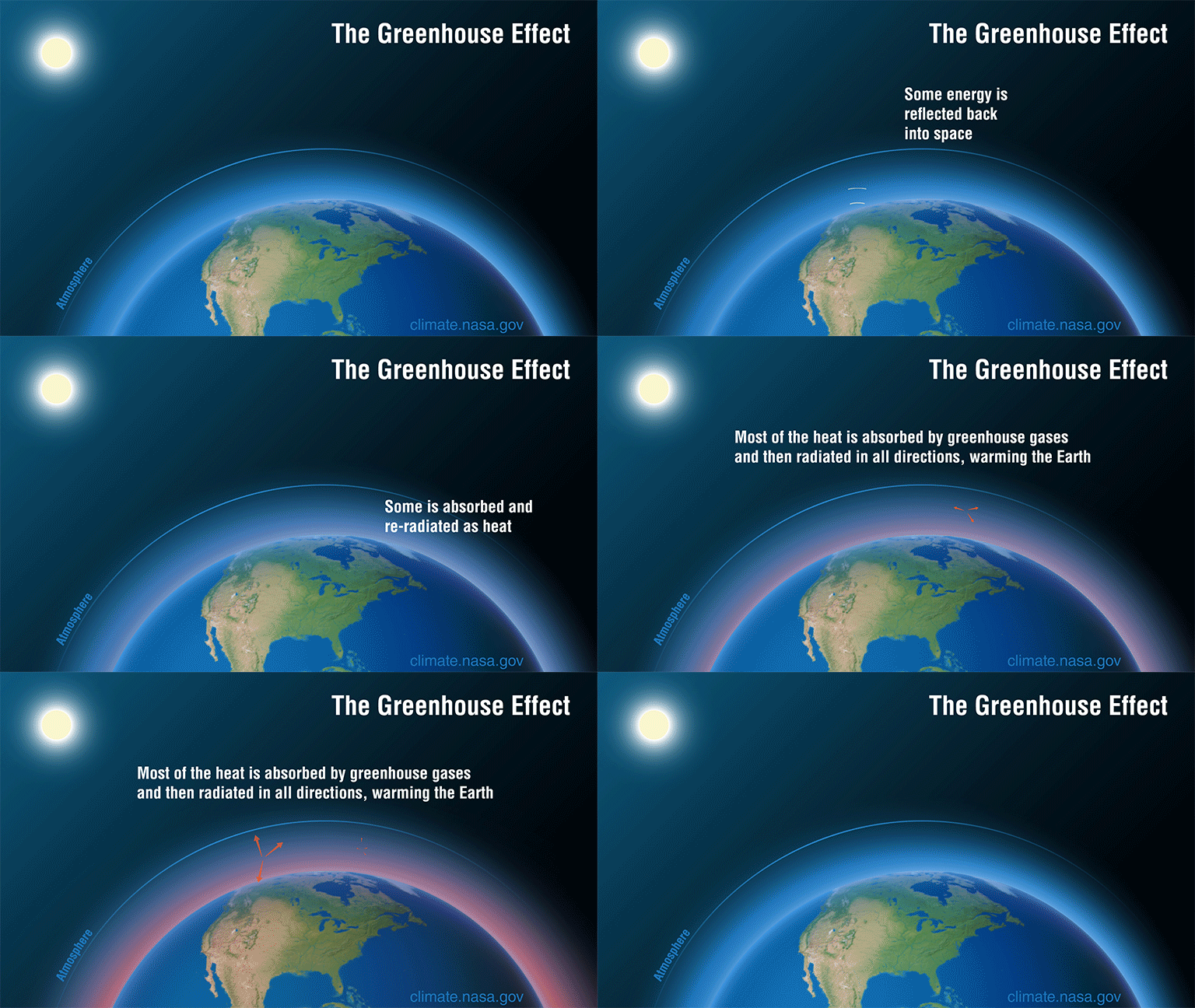
For context, greenhouse gases determine the Greenhouse effect. And the greenhouse effect is how the earth regulates temperature or manages the heat from the sun.
Approximately 70% of the Sun’s heat passes through the atmosphere, and while some of it makes it to the earth’s surface, greenhouse gasses trap most of the heat and acts as a buffer between Earth and space. This way we neither get burnt to powder from the intensity of the sun nor frozen to extinction from heat seeping into space.
Greenhouse gasses work by trapping heat from the Sun and distributing that heat. But the thing is, we only need so much heat to keep us comfortable and keep everything working fine. This implies we only need so many greenhouse gases, as well.
These gases include nitrous oxide, carbon dioxide, ozone, methane, and water vapor.
More greenhouse gases in the environment equal more heat-trapping. This is what we all know as Global Warming.
Scientists have placed the right amount of temperature needed for human comfort at 15 degrees Celsius or 59 degrees Fahrenheit. Any addition or reduction will mean tipping the scale.
And because it takes a lot of time — we are talking hundreds of years- for the gases to let go of their heat, the effect of our activities, while not immediately felt in our generation, would spell doom for posterity.
Mars, for example, is too cold because it has an insufficient amount of greenhouse gases, while Venus is too hot because it has an overabundance of greenhouse gases. But Earth, like Baby bear, has just the right amount — or it did. Because now it’s getting warmer. Studies show earth has been heated about 1.1 degrees Celsius more since the Industrial revolution.
Back to Cattle.
Cattle emit more greenhouse gases than other animals in the world because of enteric fermentation in their digestive process.
It works like this: Based on production expectations, cows are being fed certain kinds of food to enhance their productivity. But because ruminant animals have about 200 microbes in their stomach that process their food, it causes a digestive reaction that leads to an explosion of belches and farts; methane.
That’s one aspect of the production cycle.
Livestock production operations involve feed processing, use of organic and nitrogen-heavy fertilizers, burning of fossil fuel for transportation. And the consequences are land degradation, air pollution from concentrated storage of animal waste, loss in biodiversity from continued deforestation and overgrazing. All those contribute largely to the emission of nitrous oxide and methane.
Though methane occupies a lesser volume in the atmosphere, they have more effects on global warming than carbon dioxide (which makes up 76% of greenhouse gases). According to research, methane has 28x more effect on global warming than carbon dioxide, while Nitrous oxide has 265x more effect on global warming than carbon dioxide.
Not to mention the ludicrous amount of resources it takes in the production cycle of converting animal meat into a patty. A single beef patty takes about 2500 gallons of water!
A growing concern is the strain meat production has on the environment, especially regarding the global population. The world’s population is expected to grow to about 10billion in 2050, and their demand for meat and dairy products “ is projected to grow by 73 and 58 percent, respectively, from their levels in 2010.”
Scientists have estimated that by 2030, climate change will become irreversible, and we have to achieve zero carbon emission by 2050 so we don’t cross into the climate danger zone.
So the less carbon footprint we leave, the more time we buy.
Compared to animal meat production, a quantitative assessment on Beyond Burger’s production cycle, carried out by the University of Michigan’s Center for Sustainable systems showed, “Beyond Burger generates 90% less greenhouse gas emissions, requires 46% less energy, has over 99% less impact on water scarcity and 93% less impact on land use than a ¼ pound of U.S. beef.”
All We Need Exist in Nature
The UN’s Food and Agriculture Organization’s 2013 Tackling Climate Change through Livestock global assessment identified three concerns on the resource-heavy nature of livestock farming, and one of them was the efficiency at which farmers got protein from animals and plants. “Production of animal protein, particularly when fed on dedicated crops, is typically less efficient than the production of equivalent amounts of plant protein.” Their findings revealed we are better off getting our nutrients directly from plants.
For instance, 41% (654M acres of land) of the landscape in the United States is dedicated to rearing and feeding livestock, and food cultivated for human consumption takes only 77.3M acres. So while the average person needs about 10% grams of protein to supply their daily calorie intake, a small percentage could come from animal meat whereas plants such as legumes, nuts, and whole grains make up the remaining 90%.
It is absurd when we compare that to the magnitude of resources that go into making meat.
The result is similar to Ethan’s premise: If animals build muscles (meat) by eating plants, then why go through the “middleman” to get the goods when you could harness them directly?
When he found out meat was a composition of naturally existing nutrients such as water, amino acids, trace minerals, lipids, and vitamins, he focused on getting protein from the best plant sources and studying the arrangement of meat to deliver exactly on the human sensory experience of eating meat.
How It Is Going
In his interview with The Verge, Ethan explains that while there are over 4000 molecules that make “meat” taste like meat, what they do is understand what combination of the molecules drives most of the flavor and then combine them to deliver on the taste, aroma, and mouthfeel.
And even though they have made landslide progress — evident in Bill Gates’s “light-years” improvement commentary on the taste of Beyond burger — Ethan assures us that every single day, they work on making that experience even better.
Beyond Meat currently has over 150 scientists and engineers working to improve on their innovation. And while the thought of making plant-meat that looks, smells, and tastes exactly like meat, seems daunting — if not impossible — Beyond Meat is really living up to its name.
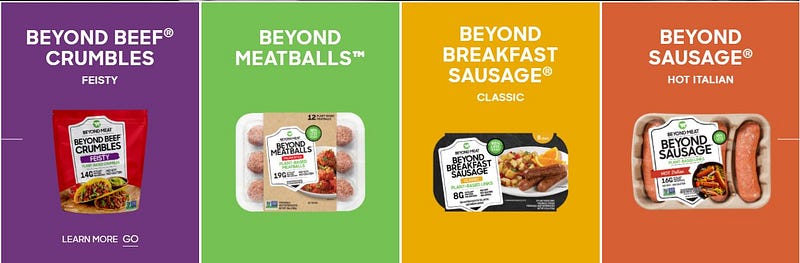
For ten years they have upgraded and diversified their meat options, and have grown from a big-name venture capitalist backed company to a $9billion publicly traded enterprise.
In November 2020, Beyond Meat announced their partnership with Pizza Hut — the largest restaurant chain in the world, making them the first company to offer a plant-based meat pizza option.
Already, they have their plant-based meat products in over 111, 000 grocery stores nationwide. And from their recent expansion moves, it looks like Beyond Meat is only getting started.
From the wholesome experience on their website, Ethan Brown seems to share the User-centric obsession with Business outliers like Jeff Bezos and Steve Jobs. You can tell from its dexterity to deliver a fluid user experience, and value-oriented service offering:
Transparency — they tell you exactly what’s contained in their products — no secret ingredient, no hidden process.
Accessibility — they provide free access to perks in purchasing their products like plant-based meat food recipes. And they make it easy for you to locate their stores wherever you are in the world.
Support — they not only provide customer service, they collaborate with top influencers and athletes whose experience with the product inspires confidence and trust.
Community — with their community-based initiative, they show that you are not just buying a product, but you are contributing to a greater cause. And when you sign up through their website, you have an option to join the online community so you don’t miss an update.
So not only do their products deliver on the best part of meat, they do so on a scaled-up version. This way, their plant-based meat isn’t just a substitute for meat, it is a better and cheaper alternative.
Best of all, Ethan is making zero compromises on authenticity. His Company culture extends his determination to create a solution solely from organic products — no genetic modifications, no external ingredient manipulation. In his words, “Should we genetically modify plant inputs to create products we want to create? We won’t do it. I refuse to allow it…I think everything we need is already in nature, we just have to go find it.”
The Symmetry Between Good Health and Good Earth
“I think if there’s a symmetry between doing something great for your body, and great for the Earth, it’s probably not a coincidence.” — Ethan Brown
With Beyond Meat, the equation gets really simple:
More plants = More plant-based meat options
More plant-based meat options = Increased good health practices for humans && Increased plant cultivation for humans and the environment
More plant-based meat options = Less demand for animal meat
Less demand for animal meat = Less emission of greenhouse gases and environmental pollution
Increased plant cultivation = Reduction in Greenhouse gases through carbon absorption qualities of trees
Now, people can enjoy meat without having to sacrifice their health by eating the irrelevant or harmful parts of meat; cholesterol, hormones, fats, and hem iron (all of which are biological adaptations for their survival). Also, they can enjoy eating what they love with the assurance that their actions do not negatively affect the environment.
Conclusion
Futurists in different sectors have tried to predict life in the future.
They explore the possibilities of the future, by factoring in the rapid growth in Artificial Intelligence, the global reaction to climate change, and the coming generation’s quick adoption of technology.
Though opinions differ, the truth remains that we are ushering in a new age of revolution. And if nothing, 2020 taught us two things:
- Change can happen really fast, and
- Humans will always adapt.
We don’t even have to go that far, most of the technology we use didn’t exist thirty years ago. Talk about 3D printing, Smartphones, Google, NASA’s Curiosity rover, VR & AR technology, Video conferencing, ATMs, Driverless cars, all of that.
Though the agricultural sector accounts for barely 10% of global greenhouse gases emission, and our success depends on combined effort with the other sectors, I appreciate the strides advanced food production companies like Beyond Meat are taking to mitigate the disasters that Global warming would cause.
It’s great that people are taking initiative and stepping out of the line to create solutions to problems that align with our health and our ecosystem.