
How Beautiful Does A Garden Need To Be To Save a Life?
Actually, it just has to feel like it’s yours
Trigger warning. This article contains descriptions of suicidal ideation. Please look after yourself and don’t read it if you think it will cause you harm.
They say your university years will be the best of your life, but mine nearly killed me.
The hall I was assigned to was a 1960s concrete block. It squatted malevolently on the flat ground outside of Reading town centre. In the large courtyard, bleach blondes in Gillettes and miniskirts hung on the bad jokes of floppy-haired boys in Hunter wellies. A brace of pheasants hung from an open window on the second floor. I didn’t know it when I arrived in the autumn of 2003 to study literature, but Reading University is known for its agriculture department. In fact, it’s the only place in the country where what’s left of the aristocracy can study land management.
On reflection, a better choice of university could have probably been made.
My room itself was rectangular with a single bed, a sink and a desk—all imitation wood. Being on the top floor, I overlooked the building’s courtyard, where scrubby bushes sheltered rats the size of ferrets. I’d have liked the room at the end of the corridor, which was bigger and had the advantage of only sharing one partition wall, but I lost out to a girl called Mary, with a snub nose and a mean streak.
As soon as I moved in, I cleaned until my fingertips stung. I tore fashion illustrations from magazines and blue-tacked them in a gallery wall before that was even a thing. I’d brought bedding from home: white Ikea sheets with a sprinkling of red flowers. I spent what little money I had on two enormous plants: an umbrella I named Sid and an anaemic-looking rubber.
None of this made my home safe. I didn’t know it yet, but I desperately needed a secret space of my own.
I could lock my door, but a skinny boy from down the hall would stand for hours bouncing a tennis ball against it like some modern form of Japanese water torture.
Sometimes Mary and a leggy brunette who “owned horses” would stand outside my room and gossip loudly about my weird clothes or annoying voice. They’d speculate as to what I did in there all day. They decided I masturbated, wrote whiny poetry and cried. They weren’t wrong on every count.
Once or twice, the boys stood in the corridor loudly rating the girls out of 10. I was a 7, “hot but downgraded for being f*cking weird”.
Most of the time, that room was a prison. I’d listen until the corridor was empty before running downstairs to do my washing or go to class. Sometimes, I’d take solace in the one group in the building that tolerated me: a handful of docile stoners on the ground floor.
These are the penalties of being physically suspended like a fly in amber in the in-crowd without being a part of it.
Once, one of them, a pale boy with elegant hands, turned up at my door in the middle of the night. I’d seen him watching me for weeks in the shared cafeteria, where I often sat alone. He told me I was beautiful. I said I’d noticed him too.
Our kiss was a mouthful of spun sugar; I wondered if I was falling in love. He asked to sleep in my room but I gently turned him away. I’ll see you tomorrow, I said. That night I couldn’t sleep. I thought about his almost colourless hair. I fantasized about how he’d listen to music in my room, head tipped back and eyes closed. I imagine us walking together to class, fingers interlaced.
But the next day, a rumour was being excitedly shared that I was frigid; frostier than an ice cube in a freezer on the north pole.
Nowhere was safe after that.
People would whisper “frigid bitch” as I walked past. A huge, close-eyed boy whose name I forget took to flashing whenever I went into the kitchen. I stopped cooking; I even avoided the canteen. I ate green pesto straight from the jar. I tipped back salt-crusted peanuts. I downed sickly cherry cola and got away with smoking inside by covering the alarm with a sock.
Then, I found it.
It was mid-summer and campus was arid. I was trudging around directionless after class, reluctant to go home, heat-slow and heavy.
I had decided I didn’t matter. That much was obvious. The world didn’t need me. If everyone hated me, it was because I was defective and frigid. I shouldn't exist.
I had begun thinking about tablets. I had begun thinking about buildings high enough to jump off. I had looked up at strong oaks and I had not seen the shape of their leaves or the patina of their bark; I had wondered how people hung themselves anyway. What did they use, and where did they get it? How did they find the courage to plunge into the cavernous dark?
I was lost in this emptiness when I walked around the side of some buildings just beyond the library, and suddenly there was a wide, low gate between tall trees. I’d never seen it before. I wondered if it was private property, but there wasn’t a “no entry” sign. I unlatched the heavy gate and stepped inside.
You will know your salvation when you see it, not in your mind but in your bones.
The garden was an inhale and an exhale all at once. It was so still you could only hear the breeze, but there were so many colours it dizzied you. It was so vast you could get lost in it, yet each interconnected space was comfortingly small.
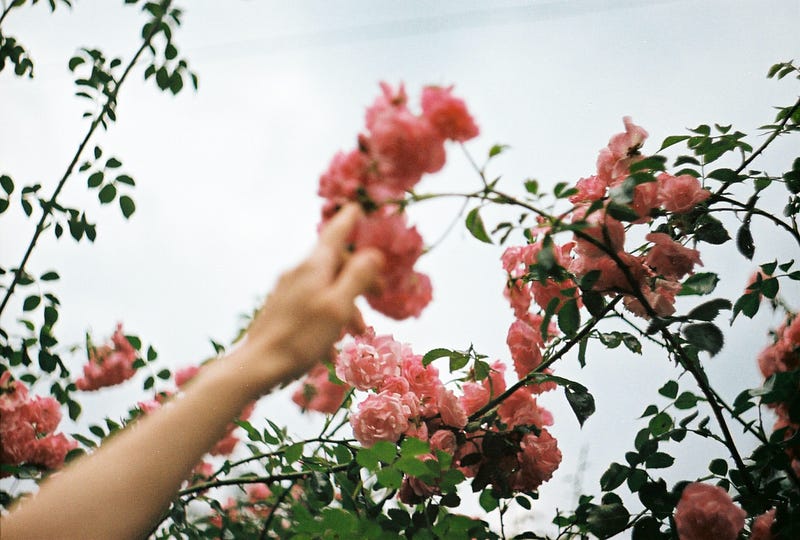
I tiptoed between manicured hedges and around shimmering ponds. I rested on benches cocooned by wildflowers. I found a rose garden not yet in bloom, its thorny rows full of promise. I lay under a monkey puzzle to watch drifting clouds dissected by its shards.
This hedge would hide that little spot from this tree, and this walkway would secret you away to a walled garden scented with herbs. There was everywhere to go and everywhere to hide.
I went every day after that, often staying until the sky turned peach pale and the birds grew still.
I started to call it paradise.
I never saw another student in that garden—not once. What I did see, was endless growth and change.
I watched as roses went from tight hard buds to blousy fistfuls of bloom. As cherry blossom proclaimed spring before scattering on the wind. As blackbirds investigated newly-turned soil for worms.
Does it make me naive to think it was my own miracle? That the universe gave me this garden? Probably, but it’s what I choose to believe.
Slowly, the suicidal thoughts lost their grip. Tentatively, I began to experiment with new ones. What if I wasn’t to blame for being bullied? What if I was actually pretty cool? What if the beauty of a garden could save a life? What if it could save mine?
Whoever we are and wherever we live, we all need a secret space; this is the hill I would die on, or rather decide not to die on.
It should be outside our home, to remind us we’re free.
It should have life, to remind us that everything changes and grows.
It should belong to no one, so it can never be taken away but simultaneously, it should feel like it’s only ours.
My secret spaces have not all been as grand as those botanical gardens back at Reading University. There was the worn bench overlooking a duck pond behind the community swimming pool. The cemetery, alive with faceless gothic angels and twisted vines. The long-abandoned allotment, where raspberry bushes still grew. Most recently, it’s the once-grand art deco buildings I wander between, running my hands over the giant daisies and unruly hyacinths that defy the manicured grounds.
Soon, I am moving. New city, new life. And though the secret space inside me grows stronger with every year that passes, I know I’ll always need a physical space too—somewhere I can breathe out, somewhere I can watch myself grow.


