
How Autonomous Cars Already Help Us Mitigate Climate Change
yes, it’s already happening!
While re-growing forests and restoring grasslands can certainly help with CO2 removal, we also need to understand which essential public sectors can cut down emissions, so we can get closer to reaching the goal of the carbon-neutral future.
One such critical to social and economic growth is the transportation sector. However, it’s predominantly fueled by fossils, making transportation account for 1/4 of greenhouse gas emissions (35% of U.S. Carbon Dioxide Emissions in 2019), making this sector the largest source of CO2 emissions.
This article will show that mitigating climate change effects with smart highway transport is not a futuristic idea from a distant future, but a reality that is already happening.
Firstly, let’s see the basic difference between Human Drivers and Smart Transport.
Human Drivers:
The nature of human driving has a reactive character. People’s behaviour highly depends on the situation on the road. This also means that people spend more greenhouse emissions on braking and speeding up. This is not considering substantial amounts of traffic congestion, noise pollution and road accidents.
Driverless Transport:
Today and in the future, AI-powered driverless systems will not only select the most fuel- and time-efficient routes, but also accelerate and brake evenly, which will contribute to the global goal of lowering emissions. By using digital maps, the car can automatically adjust its speed limits according to the data from these maps, recognizing speed limits and the gradients of the road. This feature would be mandatory in all newly produced cars in Europe starting from 2022.
→ To conclude, the essence of human driving appears to be an immediate reaction to the scenario on the road, rather than a thorough and always-on observation and analysis of the environment.
Self-driving cars operate with a variety of sensors that allow them to analyze their surroundings. The sensors are — radar, lidar, sonar, GPS, odometry, and inertial measurement units. Based on the data received from these sensors, the car chooses the best navigation routes, according to potential obstacles and relevant road information. This always-on observation and reaction to the data from digital maps have the potential to save up to 5% of fuel or lower battery drainage in electric highway vehicles.
When we think about autonomous cars, we probably think about level 5 of automation, which requires absolutely no human input.
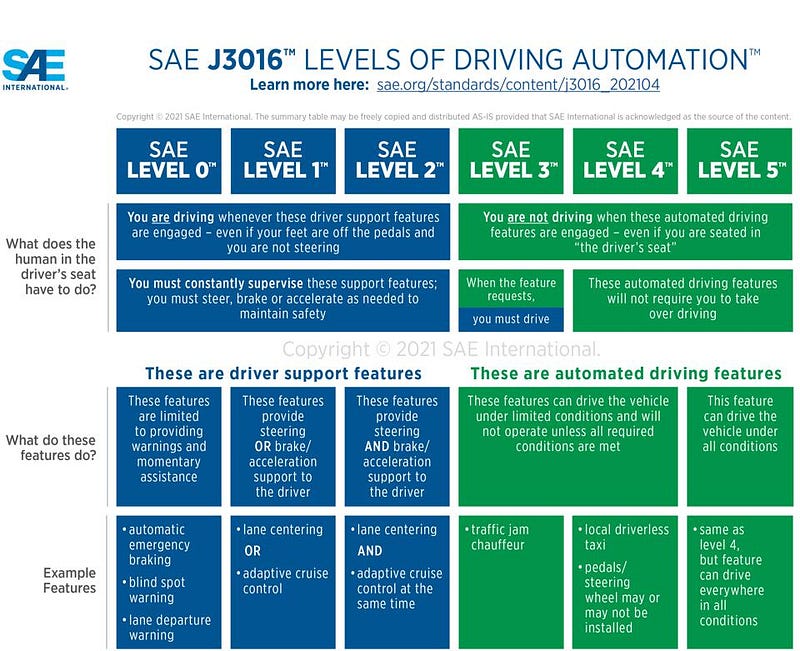
But even if we embrace autopilot even occasionally or in certain predictable environments like, for instance, highway traffic, like in levels 1, 2 and if possible by the state, 3, the toxic emissions already would be significantly reduced.
In the image above, it’s seen that L5 automation is still far from today. There are still many safety resolutions to govern before we are ready for level 5. According to the report made by Ponemon Institute, autonomous vehicles still have some gaps in digital security, which is as essential for connected cars as physical security like seatbelts or airbags. However, assisted driving (Level 1) and human-controlled partial automation (Level 2), where human drivers require monitoring of the situation on the road and if the response of the car is correct, would be already a good practical step towards mitigating climate change effects with smart transport.


