
Technology
How Artificial Intelligence Changes the Way We Live
The advancement of AI indeed has the potential to disrupt the labour markets, albeit it will never replace the love & care of our families and friends.
Four years ago, the world was taken aback when the world Go champion, Ke Jie, lost his battle. He lost the fight against an AI algorithm candidly named AlpaGo.
It heralded an era in which machines have transcended human abilities to comprehend and process the information around us. Although Machine Learning has been around for a few decades, our computing power could not handle the massive amount of data back then.
The third industrial revolution utilised electronics and information technology to automate the labour-intensive tasks from the previous industrial revolution.
The current industrial revolution — or better known as Industry 4.0 — has the potential to deepen the chasm between the rich and poor. It will eventually blur the line between what is natural and artificial.
Before we assess the repercussions of AI advancements, we have to understand the different eras of AI. Please note that I will be using AI as an umbrella term for Deep Learning, Machine Learning, and Artificial Intelligence.
1. The Four AI Eras
In Dr Lee Kai Fu bestseller book, “AI Superpowers: China, Silicon Valley, and the New World Order”, he broke down the advancement of AI into four stages:
Internet AI
This wave of AI is pretty prevalent in our current society. It comes in the form of recommendation algorithms that can surreptitiously know the things we are looking for. It could be something that we might want to buy or watch.
For instance, we might not have the faintest idea of why some seemingly random videos keep on popping out on our Youtube main page. Underneath the hood, it is an intricate algorithm that assesses variables, including our watch time, the videos we clicked on, etc.
It compiles all this data so that they can predict our future behaviour. The more we use the website/application, the more accurate the prediction will be.

Business AI
Business AI made use of the labelled data from the previous era. Suffice it to say that these labelled data points are mappings between some inputs to some outputs. For instance, we could map symptoms A, B, C to a disease. This mapping will enable our Machine Learning Model to diagnose a disease even on datasets that it has not seen before.
It uses the massive amount of labelled data from the previous era to start making sense / looking for the hidden connections between the data.
The main difference between a machine and a human is that there is no limit in the amount of past knowledge or data an algorithm can draw from. Hence, the machine’s ability to diagnose a disease, detect fraud or bad loan will transcend humans’ abilities one day.

Perception AI
Some of us might have noticed that we have started to equip AI with its own “ears” and “eyes”. Back then, we could not make sense of the video, audio, or even picture in our harddrive. To our computers, they are just a whole bunch of 0s and 1s that are somehow similar to the other files in our system.
The smart refrigerator that can warn us when our cokes are running low and even place an order at the nearest supermarket is a manifestation of perception AI.
Smart speakers, smart lamposts, and even smart cities are some of the applications of Perception AI. We have also started seeing cashless and cashier-less supermarkets around us.
However, experts have also raised concerns about the massive collection of personal data. Frankly, there is no one-size-fits-all kind of panacea to this issue. We need to weigh in the boons and banes and decide whether we need to prioritise Convenience & Safety / Privacy.
Autonomous AI
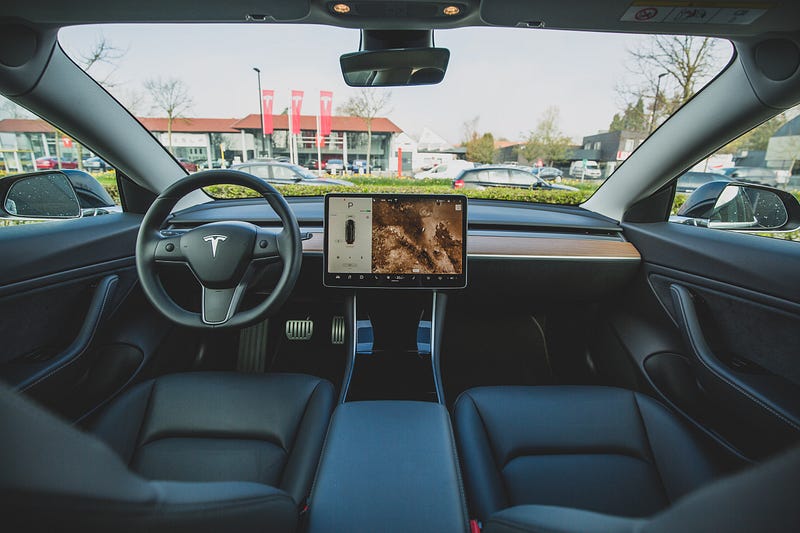
Autonomous AI is an era that harnesses all of the existing knowledge of AI. It is an AI that is not merely able to comprehend what’s happening in their vicinity but also respond to them. Self-driving cars are armed with sensors and cameras that help them slow down when there is a car/pedestrian nearby.
This kind of autonomous vehicle raises another ethical concern in the event of an unavoidable accident. Will the car hit the pedestrians to save the driver or the other way around?
We know that the more data we have, the better the AI algorithm becomes. While the autonomous vehicle is still in its infancy, it might not outperform a human driver just yet. As it garners more data, it will be a safer alternative.
2. The Utopian and Dystopian Camps
There are two different schools of thoughts when it comes to predicting the future of AI. One of the camps believes that AI will change the way we live. But, the right-wing thinks that there will be a cornucopia of adverse effects on our lives.
Utopian Camp
This camp vehemently believes that we should not fall into the Luddite Fallacy. They assume that jobs are not going to disappear. There will be more new jobs in the future. For instance, those people who just got retrenched can work as a ride-hailing driver. They could do this before they get themselves another job. Some even chose to be full-time driver.
When we automate our current processes, prices are going to drop. Subsequently, people will have more money to spend on other things. Hence, an entirely new job market will be created. Yet, some might also argue that inflation is going to zero out this positive effect.
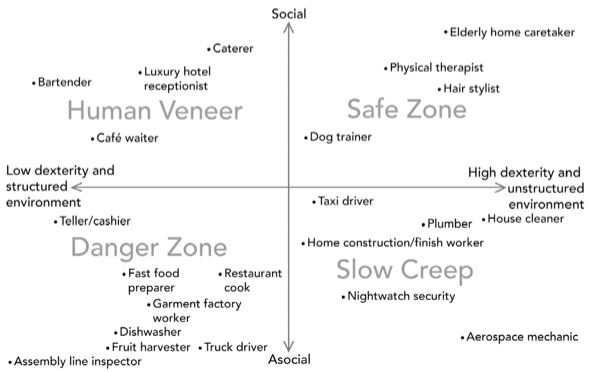
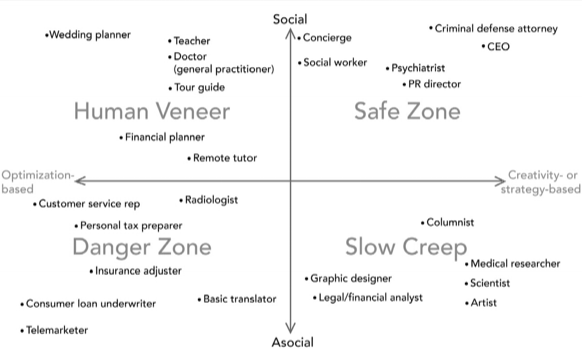
Dr Lee Kai-Fu argued that not all jobs are going to be displaced by AI. Works in the danger zone have the potential to be replaced by AI. However, the ones in the slow creep zone might take AI awhile before it can completely substitute humans.
As you might have already realised, the more social interaction and creativity a task needs, the harder it is to be substituted by AI. In other words, empathy, compassion, and respect are not qualities that can be easily encoded on AI.
As shown by the graph below, the risk of displacement will not just affect physical labour, but it will also affect cognitive jobs.
Dystopian Camp
This camp comprises people who believe that robots will conquer our world and start wiping out humanity.
Artificial General Intelligence (AGI) / Master Algorithm is a hypothetical scenario in which AI can comprehend and execute intellectual tasks just like humans. However, the biggest challenge in achieving that is the fact that human’s consciousness remains to be an unfathomable area of neuroscience.
The biggest challenge here is that we can not observe consciousness by merely putting someone’s head under Magnetic Resonance Imaging (MRI) or Electrocardiography (ECG). Hence, coming up with AGI is still a mirage hitherto.
On the other hand, we know that the entity or individual with the most amount of data will trump the ones who have little to no data. Hence, making it virtually impossible for SMEs to dethrone the juggernauts who have monopolised the market. Although, you might argue that the antitrust laws will prevent this nightmare from happening.

3. What AI Cannot Do
It will not eliminate doctors entirely.
We have started to see the rise of real-world application of AI in the healthcare sectors. AI’s ability to diagnose certain diseases are improving by leaps and bounds. However, it is not going to eliminate the need for doctors.
There is no doubt that AI diagnosis will transcend the accuracy of the diagnosis that we, humans, make one day. Nonetheless, doctors cannot be entirely replaced by AI because it lacks that very human aspect.
Dr Lee Kai Fu argued that future doctors could play a role as a “compassionate caregiver”. It means that the doctors are going to be the ones giving emotional supports to the patient. Although the AI algorithm makes the prediction, the doctors still have the final say.
It will never be able to replace human-to-human interactions.
AI will never be able to replicate — at least for the foreseeable future — one thing that only human beings can create and share among one another, which is love.
Our current AI technology is merely good at tackling very well-defined problems. However, it is still not able to have emotions, albeit it is already able to mimic humans’ emotions.
We cannot use a robot to look after infants and older folks because they tend to yearn for human interactions and connections. As our population ages, we need to rethink how we could look after our senior citizens. AI is out of the equations because it is not able to replace human attention and love.

4. What’s next?
There are currently ongoing debates about whether the Universal Basic Income (UBI) or Guaranteed Minimum Income (GMI) could truly eradicate poverty. These social welfare systems won’t come without additional costs. These costs manifest themselves in the form of higher taxes for middle-income and higher-income families.
We have seen how the ASEAN nations approach this issue differently. For instance, Singapore’s government is leaning more towards investing more money in the public school system. Yet, Indonesia’s government has plans to adopt the UBI welfare system.
We shall not forget that AI might progress at a speed that is faster than our ability to catch up. Retraining workers alone might not be a viable long-term solution. Hence, our critical thinking skills, creativity, and compassion will save us from mass job displacement. At least, these are some of the traits that AI is not able to learn in the foreseeable future.
“According to Darwin’s Origin of Species, it is not the most intellectual of the species that survives; it is not the strongest that survives; but the species that survives is the one that is able best to adapt and adjust to the changing environment in which it finds itself.” — Leon C. Megginson, Civilisation Past and Present, 1963
Building a more compassionate society
Dr Kai Fu ended his book with a proposal for what he called the Social Investment Stipend. Intrinsically, it is a stipend awarded by the government to individuals who have invested their time and energy to promote a kind, compassionate, and creative society.
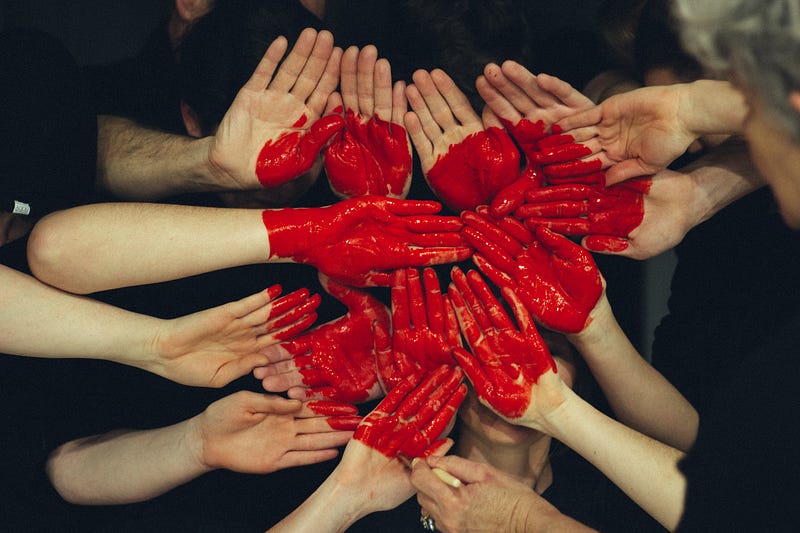
Not everyone is willing to devote their “precious time” to these causes. It is because these tasks are still considered pro-bono works. Dr Kai Fu argued that these stipends could potentially create new jobs that could make this society a better place to live in. It is just like killing two birds with one stone!
These incentives will make seemingly lacklustre jobs like taking care of the younger children, looking after elderlies, attending to bedridden families or friends or assisting someone with physical/mental disabilities much more pleasant.
Lastly, let’s strive to build a more caring and compassionate society in this increasingly automated and egocentric world!


