
How Archery Brings Out a Better Version of You
A journey to a better self through archery
Archery can help you become a better version of yourself. It’s a great sports activity for both in- and outdoor settings, and it helps train both your body and mind. In this article, I’m sharing with you my journey on the road to becoming an archer and what I’ve picked up along the way.
The Initiation
My relationship with archery started with an excursion organized by the department of chemistry at the university I was teaching. We went out of town for a few days, and, on our way back, stopped at a recreation park. At the park, I was drawn to an archery booth where I could rent a wooden bow and shoot some light-weight aluminum arrows. That looked to be a lot of fun. I paid the money, grabbed the gears, and didn’t think much more than wanting to try my hands on this curious (and cool) outdoor activity. I let some arrows fly toward the target face, which was a set of blue, red, and yellow circles printed on paper, stuck on a compressed haystack.
I don’t remember how I scored that day, but I do remember having feelings not dissimilar to ‘excitement, fun, and liberating’ from every shot I made. I paid more to shoot some more rounds. I carried that feeling with me coming back to the university.
The Foundation
Shortly after getting back, I joined a group of archery enthusiasts at the university. The group would shoot every evening at an empty plot of land in the uni’s area. It was there that I started training my archery skills.
An experienced member of the group showed me how to shoot. He became my unofficial instructor and a friend. He did show, but he didn’t tell. I watched him getting to the shooting line, standing in position, knocking an arrow on the bowstring, raising his arms, aiming while drawing the string, and letting the arrow fly to the target. I watched the other members too. Then I tried those steps myself.
I made a wrong decision by picking up a 35 lbs wooden bow. It’s not like the one at the recreation park. It was just too heavy for a beginner like me, but I kept using it anyway. It was out of the vain thought that I was ‘macho’ enough to shoot with that bow. I also got a misconception that heavier bows would shoot straighter than lighter ones.
In my first trials, I tried to shoot some arrows at a target face only 5 meters away. I failed miserably. The arrows scattered throughout the thick neoprene backstop, known in the archery circle as the ‘boss.’ There’s neither precision nor accuracy.
Without any protective gear (armguard, chestguard), my first trials were a little scary and painful, too. Because of the relatively heavy draw weight of the bow, I was afraid that the strig would collide with my arm like a whip when released, or I would lose grip of the bow, or the string might break altogether at full draw. No such thing happened except the string hit my arm many times. It was painful. As a righty, I got whipped hard on my left arm, also known as the bow arm, by the string almost every shot I made. The inner area of my bow arm became bruised and bloodied, and I had to call it a day.
The instructor didn’t allow me to use an armguard at first. He reasoned that the process of getting whipped would teach me how to adjust the position of my bow arm correctly. He was right. After a week or so, I could put my bow arm out of the string’s way. I also managed to shoot smaller groups of arrows on the boss. Higher precision! That’s an improvement. I was pleased with my progress. I also enjoyed all the fun in the process.
The Competition
Months had passed, and, after much concentration and training, I got better at archery. A set of movement sequences was burned into every fiber of my muscle necessary for archery. This new muscle memory was adept. Shooting with a relatively heavy bow became a frictionless routine.
I switched to shooting with a modern recurve bow equipped with sight and stabilizing rods. My shooting range extended to 18 meters, the standard distance for indoor archery competitions in the ‘modern recurve’ category. At this time, there were more people in our group than when I first joined. We decided that we would register our group with the university and became its first official archery club. We held archery competition every weekend and, within our small circle, celebrated the winner with small gifts and a shared trophy. We had fun, but, at the same time, something seemed a bit off with me.
I didn’t enjoy shooting as much as before. I just tried to score better than my competitors. There were competitions outside our shooting range, too. Some members started to compare their equipment with that of the others and kept upgrading to gain some advantage edges. During a shooting session, mocking about one’s shooing style, equipment, and scores became a norm. I was among them in everything. This was not the archery I looked up to before I learned to shoot. I didn’t want to walk this path.
I became obsessed with scores, winning, losing, game rules, and equipment. In that self-oblivious process, I started to drift away from archery.
During this time, I managed to enter a couple of bigger tournaments in the country. I managed to get myself a slot in the semifinal round in one of the tournaments. However, I was frequently gripped by ‘target panic.’ I was just shooting to score. I didn’t shoot for that liberating joy or for the sake of shooting anymore. The fear of not being able to score well and potentially humiliating myself in front of my peers and competitors caused the panic.
After had been trying hard to improve, my motivation dropped. It kept dropping for some time. I had every necessary piece of high-end equipment but I lost more matches and duels than I won. The panic grew out of control. At a point, I did not feel motivated to shoot, and I eventually filled my regular archery time with some other activities.
The Realization
One day after a long break from archery, a friend asked me to shoot with her. I accepted the invitation, thinking that it couldn’t hurt having an evening exercise in archery, even it might mean starting again from zero.
It couldn’t hurt. I didn’t care. I just wanted to enjoy shooting arrows and a quality time with my friend.
To my surprise, I did much better than I thought I could in terms of arrow grouping and scoring on that day. It seemed that my muscles still remembered their movement sequences. Talking about muscle memory!
I went back to shooting regularly again. I tried to avoid the crowd. This time I became much calmer and more ‘carefree.’ I didn’t think much about hitting the target, the score, the style, or the equipment anymore. It came to me naturally. I just did what I knew to do: shoot.
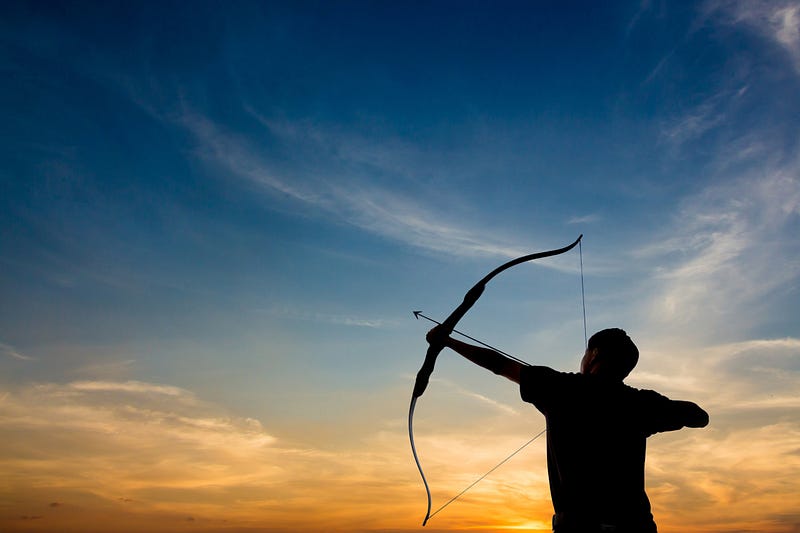
I stood firmly at the shooting line, knocked, raised the bow up, drew, aimed. I did all this while breathing deeply and consciously. When the moment came, I let the arrow fly together with my out-breath. The experience was almost relaxing.
There were still days that I came to the shooting range, stressed, and stirred from work. Although I was pretty well in control both mentally and physically, I noticed that the bugging thoughts and emotions subtly influenced my shooting result, very subtly that it took me a while to recognize this pattern.
This was because the influences of thoughts or emotions on the physical body were very hard to detect in this specific scenario. The shooting result must be changed by something tangible, like muscle strength or the change in pose. My stress-infested thoughts and agitated emotions must somehow disrupt the consistency in either or both of those without my knowledge. At least for a while.
Sometimes, just before the point of releasing the string, I would know whether or not the arrow would hit the spot I aimed at. This was almost like magic, but it’s merely the result of a few years of training. This situation struck me as profound. I would not be able to do anything to alter the course of the arrow after this point. I would have absolutely none whatsoever influence on it, no matter where it would hit.
Sometimes we make decisions we have to make. Worrying about the result too much will not help with anything.
One might ask what I did to alleviate undesirable situations during a shooting session. As I no longer aimed for the middle of the target, or for the highest possible score, ‘nothing’ would be my answer. I did nothing. I just acknowledged the existence of the situation and kept on shooting in the direction of the target. Things would fall back to their proper places again in no time, including the arrows. I just had to be consciously aware of this fact. There was no competitor in any tournament, but myself.
Realizing that archery was not so much about tying hard to hit the center or score high marks from every shot, it became a joyful liberating experience for me once again.
The Conclusion
Archery has given me physical fitness and has taught me lessons. It taught me discipline, humility, letting go, and a way of meditation. What I learned from these lessons can also be applied in various life situations. I have become significantly more flexible, humble, compassionate, and patient. Archery has brought out a better version of me. Everyone can benefit from these lessons. It’s exciting and fun, too. Don’t forget the pure joy of shooting an arrow, just for the sake of shooting.