How (And Why) To Teach Yourself Dutch
Or any other language…

Why would anyone want to learn Dutch?
Goedemorgen! My name is Elisabeth, with an “s” not a “z.” I’m from Belgium and Dutch is my first language. Dutch, or Nederlands, is not just the language of the Netherlands, but that of Flanders, the northern region of Belgium, as well. It is also a national language in Suriname, Aruba, and the Netherlands Antilles. Worldwide, Dutch is spoken as a first language by 23 million people, and by another 4 million as a second language.
Small potatoes, you say, compared to English, Chinese, or Spanish. However, you’d be surprised how many Dutch learners I’ve heard complain that, as soon as they try out their Dutch in a city like Amsterdam, the natives will answer them in English. But that’s a story for another day.
Now, if you’re really in a big hurry to get to the practical advice, you can scroll down to the last section of this post (“Let’s get started already”). But if you enjoy my stories, read on at your leisure!
Learning a new language is easier than it’s ever been!
So who are these people, so eager to speak Dutch? A good number of them are foreign students, undergraduate and graduate; postgraduate scholars and professors enrolled or employed in Dutch and Belgian universities. My husband, who is from India, once did such a stint in Wageningen, The Netherlands, on a postgrad grant, after obtaining his PhD in Ghent, Belgium.
Others are diplomats, business people, immigrants or expats working or seeking a job in these two countries. And some are language nuts like yours truly, who just learn languages for the heck of it.
But isn’t that hard? I hear you ask. Not necessarily. Even if you’re not born with a natural affinity for languages, learning a new language is easier than it’s ever been. And the sooner you start, the easier it will be.
Starting young: it should be fun!
Do you remember your first world language class in school? I do. In my case, it was French. I was one of the lucky few fourth-graders, in 1964, to have a progressive teacher who used a forerunner of the audiovisual courses that would soon flourish.
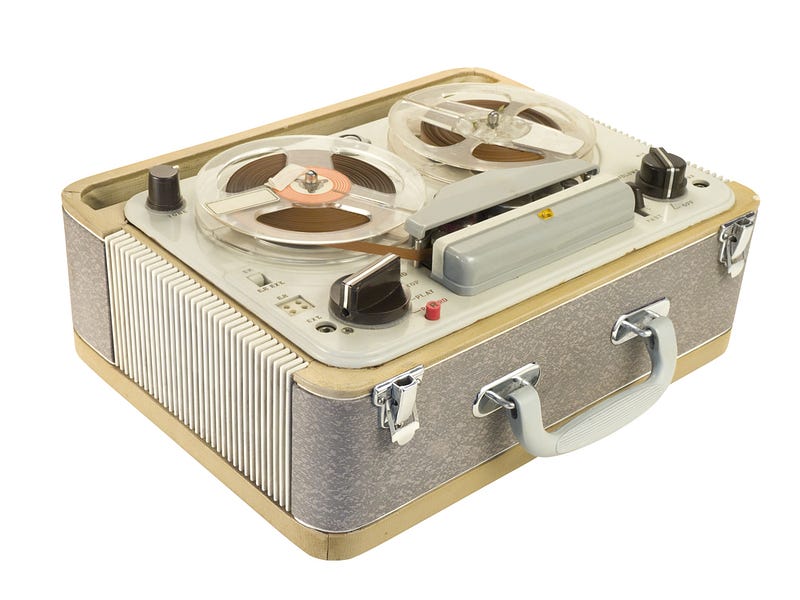
Our method was audio only, with mimeographed handouts, but it was exceptionally well designed. Before we could start, the teacher had to lug a portable tape recorder into the room and fiddle with the mysterious reels and tape for a few minutes, all the while admonishing the tittering class to be quiet. The tape recorder was compact but quite heavy. In case you’ve never seen one, here’s a picture of something similar.
The recording began with the voice of a young man, Paul, singing in the shower (“Je chante, le jour et la nuit!”), and followed him through his day: having breakfast, interacting with Maman, with his sister (Julie?), and with the family pet, Poussy (a perfectly generic name for a French cat!). These were all things we could relate to. We were told to practice at home, and the following day we would role play, first reading the dialogues aloud and then enacting the scenes in front of our classmates. It was exhilarating!
Luckily the all-important foundation had been laid: we knew that French could be fun!
Alas, it turned out to be no more than an experiment, and the following school year it was back to the drudgery of textbooks and memorizing conjugations. In those days French was compulsory through high school, as it is the language of Belgium’s other half (with exception of a tiny German-speaking area in the east). Mastering French was not just useful; it was essential in order to land a good job. Luckily the all-important foundation had been laid: we knew that French could be fun!
Immersion (even substitute immersion) puts you on the fast track
When my mother was barely nine years old, my grandmother, a career teacher and rural school principal, sent her off to boarding school in Wallonia, the French-speaking South of Belgium, so she could become perfectly bilingual. Grandma meant well, and it did work, but at what cost?!
School started in September and the boarders could not go home until Christmas break. Imagine the little girl’s loneliness in a place where she knew nobody, and where nobody understood her language!
My mom finished that school year at the top of her class and would speak French like a native till the day she died, but after hearing her stories about that traumatic first trimester with the nuns at the pensionnat of Le Rœulx, I knew I could never do that to my own kid.
However, by the time I was twelve, that same grandmother came up with a great substitute immersion experience for her eldest granddaughters: she invited the monolingual daughter of a Francophone family she had befriended to spend the summer vacation with us, at her house.
Watching serials in a foreign language, with or without subtitles, is a great substitute immersion experience.
A vivacious redhead, Fabienne was one or two years older than I, and a ballet dancer. Within days, my sister Anne and I absolutely worshipped her. From her we learned, among other grownup skills, to apply nail polish (in French!) and that The Flintstones, subtitled in our part of the country but dubbed in hers, were called Les Pierrafeu in French.

Instead of watching the youth programs of the BRT (Dutch-language national TV) we now watched its French-language counterpart, RTB, every afternoon, with Fabienne as our guide. I became hooked on Thierry la Fronde (a French period drama reminiscent of Ivanhoe, with the dashing Jean-Claude Drouot as the equivalent to young Roger Moore). Long after Fabienne had left us, I continued to watch it, and my grasp of French kept getting better. Watching movies or serials in a foreign language, with or without subtitles, is a great substitute immersion experience.
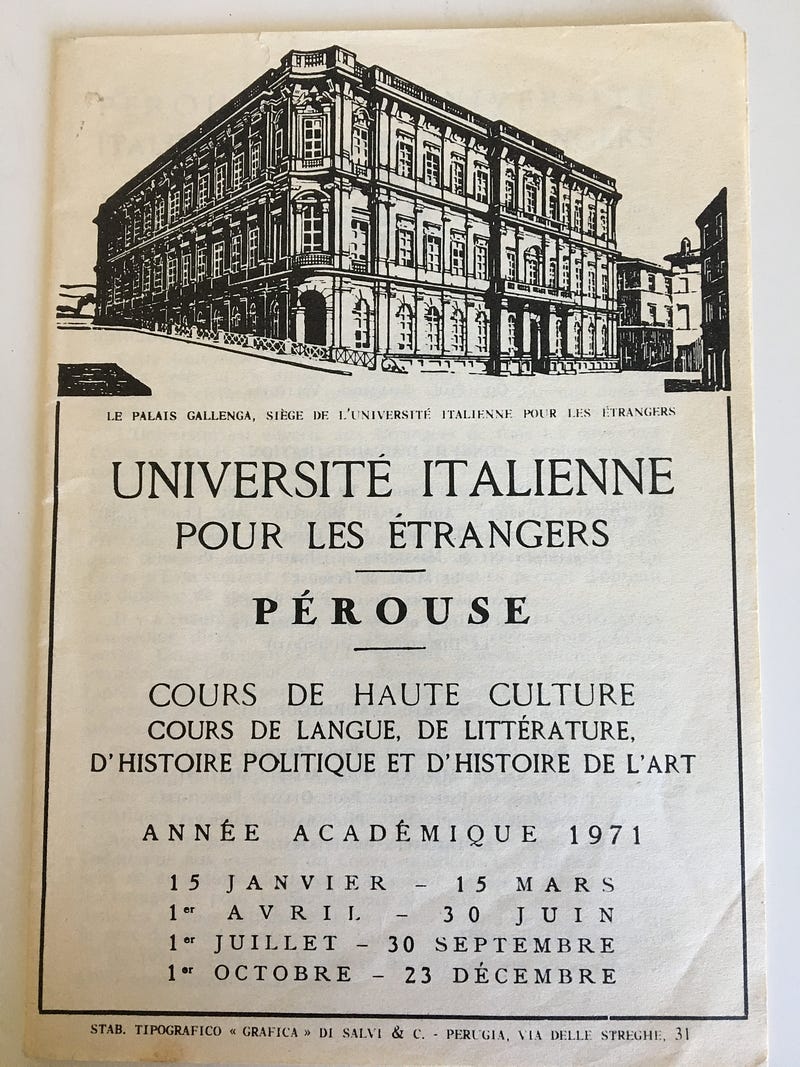
We shed tears when Fabienne left. And when Mom suggested French language camp the summer after, and a ten-day stay in the Vosges mountains in winter, with only French kids in the group, I jumped at it both times. A few years later I would beg her to let me travel to Perugia by myself to learn Italian in my summer vacation. I had not even heard the word “immersion” at that point, but I craved it.
Do you need a reason? Fall in love.
On Quora.com, I often get asked questions like, “What is the easiest language to learn for a speaker of English/Hindi/Klingon?” or “What is the best language to learn so I will find a well-paid job?” and “Which language is harder, X or Z?” These questions make no sense. The best language for you is the one you want to learn. As someone quipped: Chinese can’t be that hard if all the little kids in China can speak it! And no single language can guarantee you a job unless you’re otherwise qualified for it. There are many different reasons to learn a language but, in my opinion, the two worst ones are probably: “because I have to”, or “to get a (better) job.”
A language is only as hard as your resistance to it.
The best reason, hands down, is: “because I want to.” Which brings me to all the reasons why you might feel that way. From liking the sound of a language, to loving the food or wine of a country, to the mystique of its culture, to falling in love with a speaker of it. And doubtless there are many more potential triggers. Wanting to learn a language will make it much easier.
It’s equally important to ask yourself why you are not attracted to a certain language. Examine the reason(s) for your resistance. Is it because you have been told this language is too difficult? Could it be that you suffer from a misconception (or just a lack of curiosity) about a part of the world? Or a prejudice against a country or a population group? A language is only as hard as your resistance to it. And it could be just as easy, depending on your desire to learn it.
Let’s get started already!
The following is based on my Quora answer to “What’s the best app to learn Dutch?” but it goes beyond apps, and beyond Dutch.
Since Dutch is my mother tongue, I have not tried out any apps to learn it. However, as a multilingual person, I can give you some pointers.
One important thing to know about Dutch:
Although written Dutch is identical in the North (The Netherlands) and the South (Belgium) of the language territory, the pronunciation, or rather the way of enunciating, can vary significantly between the two countries. In fact, this difference is just superficial, but it can be disconcerting to a new learner. Figure out what your needs are (who you will be interacting with) and — if possible — find out which regional pronunciation is used in the app. Then you can decide to expose yourself to one variant, or both.
The list of learning options is endless: List of language self-study programs — Wikipedia.
Do keep in mind that not everybody has the same learning style.
All methods, app-based or not, will have their strengths and weaknesses. And personally I’m a fan of the good old classroom experience (including language schools like Berlitz, etc.). However, of the other methods I have personally used, Assimil and Pimsleur left the best impression on me. I could not stand either Rosetta Stone or Duolingo (the free version of Duolingo — you can advance faster if you pay), because they started off on what I considered an “infantile” level and moved slowly. Maybe it gets better, but I did not have the patience to stick around. Do keep in mind that not everybody has the same learning style.
Assimil, a tried and trusted method that started out — waaay back — with lessons on 78rpm shellac records, still gets high marks. They introduced their app last year, but as of this writing, the Dutch course was not yet available on it.
Babbel (a German product) also scores well in reviews. However, in a Reddit thread I found some serious criticism of their Dutch course. They might be working out the kinks as I write this, though.
As David Hofhuis points out, immersion is the key to true fluency. And even when you are not (yet) in the country, you can try and create an immersion experience for yourself.
My advice
- Start (or get your children started) as early as you can. Kids absorb language like a sponge. The younger they are, the more perfectly they will pronounce the new language. After a certain age, our ability to identify and reproduce unfamiliar phonemes begins to wane.
- Don’t despair if you’re over twelve. Your mind will retain the capability to learn languages for a long time to come. In fact, as an adult you could benefit from already knowing another language in the same language family. Dutch, for example, is closely related to Afrikaans, German, and even English.
- Fall in love, with a culture, a language, or a person who represents both. It does not have to be a real person. The hero of a Korean drama will do nicely! My husband and I fell in love with the stars of Dae Jang Geum. Even though he’s not a language nut, he can quote a few words in Korean now.
- Find a course, any course. In her junior year of college, my youngest daughter opted for a semester in Paris and came back fluent. Afterwards she found herself a course in conversational Urdu (her dad’s language) and, recently, a similar one for Emirati Arabic. Although languages are not her field, she enjoyed them both.
- Try out a few language learning apps to see what suits you. Most have a free trial period. Here’s a top 10 (and there are many other lists to be explored online):
- YouTube has hundreds of free language tutorials for just about every language under the sun! Topics range from the alphabet to the intricacies of syntax.
- Supplement your main method with other materials, including some reading matter, wherever possible (in print or online, e.g. Taalblad.be for Dutch), subtitled movies, and audio resources (e.g. News in slow Dutch — Learn Any Languages) to create a personal immersion experience. The above link will take you to multiple language options, not just Dutch. Again, YouTube also has thousands of songs with translated lyrics from and to many languages. Like this one with Dutch translation:
- Check if your city has a cultural institute that offers lessons or activities, like Alliance Française for French, Società Dante Alighieri for Italian, or Instituto Cervantes and Instituto Hispania for Spanish.
- Find a language buddy. An interesting option is to converse with a native speaker via FaceTime or Skype: Language learning with native speakers. This can be a paid activity or a mutual exchange.
- Pretend you’re a toddler. We already know that kids learn quickly. But another important factor is that in small children, the urge to communicate is much stronger than the fear of making a mistake. In fact, self-consciousness and perfectionism inhibit adults the most when they try to learn a new language. At university in Belgium, I read Hindi literature, but I could not begin to have an everyday conversation until years later, when professor Mahavir Saran Jain advised me to read children’s books and comics, and learn from the bottom up instead of top down. He also told me: “Talk like a two-year-old, without self-consciousness. If you don’t know a word, just insert the English word. If you mix up the gender, they’ll still get it. Allow yourself to make mistakes.” It was exactly what I needed to start joining the conversation instead of trying to form a perfect sentence in my head first.
- Never give up. Another typical Quora question is, “How long does it take to become fluent in Dutch/ Mandarin/High Valyrian?” And the answer is… (drumroll): It depends!!! Not so much on aptitude as on how much time and effort you invest in it. Even “getting by” in a new language is rewarding. You know, native speakers don’t know every word or grammar rule of their own language, and they misspeak, too. The coolest experience in language learning happens when you realize you are talking without translating in your head. Congratulations! You have now reached fluency. It’s not about your grammar being 100% correct or not. It simply means you have started thinking in the new language. And we never know at what point that breakthrough will arrive, but perseverance is the secret!
Even native speakers don’t know every word or grammar rule of their own language, and they misspeak, too.
YOU CAN DO IT!