
How An Ordinary Journal Can Help You Reach Extraordinary Life Goals
The 4-step guide to better organization in your life.
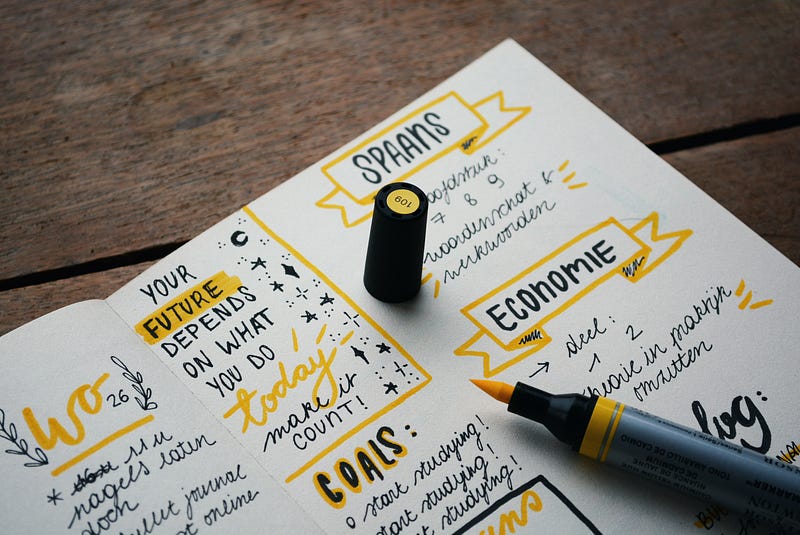
James Clear, the author of Atomic Habits, wrote that you don’t rise to the level of your goals but fall to the level of your systems. So the best systems aren’t the most sophisticated ones, but the methods you consistently stick to. Only implemented systems can catch you if you fall.
The Bullet Journal system is almost too easy to implement to be true.
In 2017, lying in my student apartment in Santiago de Chile and staring at the method’s description, I almost closed the tab. I felt Cal Newport was clearly overarching writing about the Bullet Journal, “it will not only help you get more organized but will also help you become a better person.”
Turns out my skepticism was misplaced.
Three years and 14 bullet journals later, I can confidently say this method can improve any life. The system helped me establish an NGO, thrive in self-employment, read 52 books a year, run a weekly podcast, and write 100 Medium articles within five months while living in a flourishing partnership.
Your Bullet Journal will be a system that catches you if you fall and support your way to reaching your goals. Here’s how you can use it.
1.) Start with a double page for your life goals.
This one is crucial, as it will serve as a lighthouse for all that follows. If you get this right, your journal will pull you towards your dream life. So, get yourself into a higher mental state, and think about what you want to achieve or experience in your life.
I found these six categories most useful to think about: relationships, health, wealth, work, purpose, and growth. In each category, you’ll have your own subcategories. For example, for relationships, it could be partner, family, friends; for health, it would be physical, mental, spiritual; for wealth, earning, spending, investing; and so on.
You’re the master of your life, so you pick your categories and goals.
Plus, your goals are dynamic. As life goes on, your goals can change. With every new journal, you’ll be able to adapt to your goals.
When I started my first bullet journal in 2017, one of my growth goals was to know 5000 Spanish words. In 2018, this goal evolved to speaking fluently with locals while traveling South America. In 2020, I read a Spanish book from time to time, but the language isn’t on my growth list anymore.
Goals are not static; they can evolve. The important thing is to write them in your first two journal pages. Done is better than perfect. You can rework them anytime.
2.) Break your goals down into a monthly plan.
Around the 30th of each month, you want to reflect on your past weeks and set your agenda for the new month. To do so, move from one lifegoal to the next and write down achievable milestones for the following weeks.
Here are three examples of how this breakdown could look like:
- If one of your purpose life goals is to help others through writing, you can set the specific milestone of writing and publishing four articles online.
- If your health lifegoal is to live in a strong and healthy body, you can set the specific milestones of doing yoga 8 times, running 6 times, and cooking 20 healthy meals.
- If your relationship lifegoal is to have deep friendships, you can set the specific milestone of having three memorable experiences with your loved ones next month.
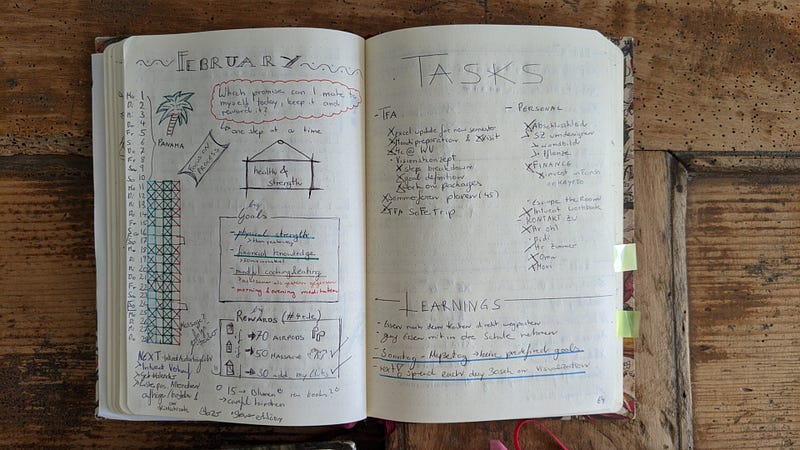
Again, your life, your rules. By breaking your life goals into actionable monthly milestones, you can’t help yourself but progress towards achieving them.
Plus, you’ll harvest the benefits from reflection. When planning the new month, you can look at the last month and ask yourself, “what went well” and “what do I need to change?”By integrating your past month's lessons into your new plan, you retrieve knowledge from an earlier memory and connect your experience to the future.
From a learning perspective, reflection is one of the most powerful tools you can use. In the words of American philosopher, psychologist, and educational reformer John Dewey:
“We do not learn from experience. We learn from reflecting on experience.”
3.) Break your months down into a weekly plan.
Every Sunday, you want to sit down and break your monthly goals further down. The result is actionable items for your next week, micro-steps towards your life goals.
For example, if your monthly goal was to do 8 yoga sessions, you’ll want to do yoga twice next week. If your monthly relationship goal was to create three memorable experiences, you add “schedule weekend hike with friends” to your week plan.
While many people design their weekly log beautifully, mine looks messy. I don’t want to spend hours on the perfect look. I just want a system that works. Here’s how my weekly plan looks like:
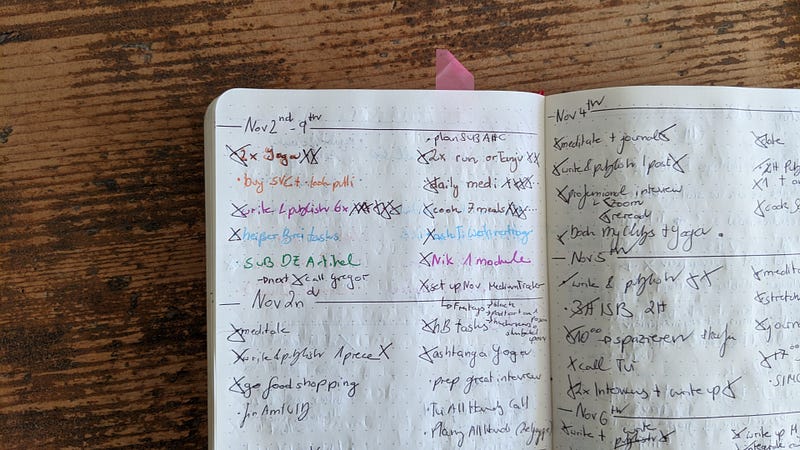
Again, sitting down every Sunday makes you reflect on the past week and help you evaluate whether you made a realistic estimation. If you find your goals not matching your behavior, it’s time to change your goals or change what you do.
4.) Break your weeks down into a daily to-do list.
Finally, you want to use your weekly list to plan your days. The best time to do so is before turning off your devices in the evening.
It’s a great feeling to end your day by ticking off everything you’ve achieved. With that momentum, you can create new To-Dos for the next day. And in case you didn’t achieve everything you wanted, simply rewrite the item on to the next day.
Whenever you find yourself dragging the same To-Do item from day to day, it’s a great signal. Do you really want to achieve the goal? Is the task unachievable, and do you need to break it further down? What does your resistance tell you? Do you need more courage to tackle it?
By planning out your day every evening, you’ve mastered using your journal. You’ve got a system in place. You’re making tiny steps towards achieving your life goals.
Bottom Line
A bullet journal is your life funnel: From life goals to monthly goals, to weekly goals, to daily to-do lists. When you implement this system, you’ll create your individualized roadmap to achieve any goal with patience and consistency.
Yet, your journal is no shortcut to happiness.
Since 2017, one of my life goals is a loving relationship with my sister. I’m not there yet. But keeping the goal in mind helps me to focus on what matters. And if it works for me, it can work for you. As Cal Newport put it:
“Who you are, what you think, feel, and do, what you love — is the sum of what you focus on.”
Do you want to connect? Join my E-Mail List.


