
How an Einstein-Rosen Bridge Could Allow for Time Travel to the Past
Explore why the secret to harnessing time may be learning how to harness space
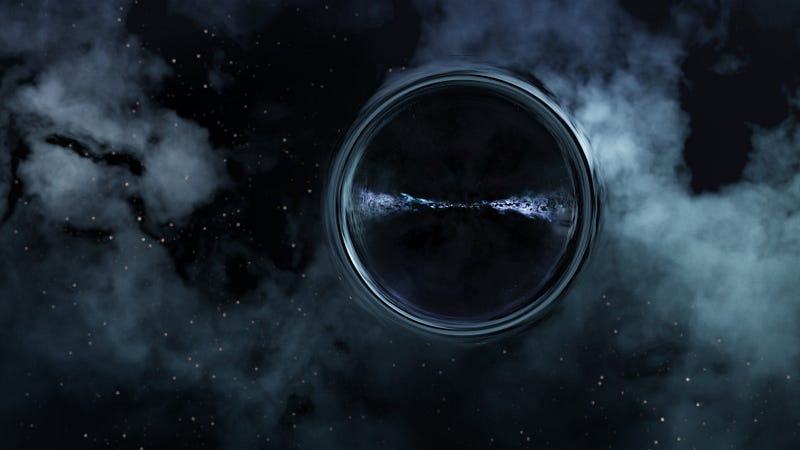
When it comes to space, there are no shortages of theories as to what may exist in the dark night. One of the more fascinating theories, particularly because it is depicted so often in science fiction, is that of the Einstein-Rosen bridge.
More commonly known as the wormhole theory, this topic of controversy has been around since 1916. The original person to present this theory was Ludwig Flamm, though his supposition was that something known as a “white hole” may exist which acts as the opposite of a black hole.
He theorized that both sides of a white hole could be connected via a space-time conduit, but his theory was met with criticism. In 1935, however, Albert Einstein and Nathan Rosen applied general relativity to his idea and proposed the idea of bridges scattered throughout space.
These Einstein-Rosen bridges are supposedly random shortcuts in space and time that could be used to reduce the distance between two points in the stars.
If one were to simplify the idea of a wormhole, imagine taking a flat piece of paper and drawing a straight line between two points. Now, take a pencil and stab directly through the two points. When traveling from one point to the other, you could either follow the straight line or go through the hole you just created.
Clearly, going through the new hole in the paper is a faster and easier way. That’s the idea of wormholes.
However, there has been no evidence of wormholes out in space despite them being allowed by general relativity. Given this, they’ve become something of science fiction even though they could theoretically be real.
With that in mind, let’s simply assume for a minute that the lack of definitive proof from our corner of the vast Universe doesn’t rule them out as a possibility.
A fascinating idea that goes along with the existence of wormholes is time travel. Unfortunately, time travel to the future and past are two very different things. Scientifically speaking, traveling into the future just isn’t possible through any science we know now.
However, traveling into the past could theoretically be done via wormholes. I want to note now that this entire supposition will be full of theories that build off of theories. For example, if wormholes do exist in space, scientists are fairly sure they would be incredibly small, which throws a wrench in the idea of traveling through them.
Creating a wormhole that would be both stable and large enough for a human to pass through would involve discovering certain particles that have both a negative mass and energy. We would then need to create a supermassive black hole and an equally large counterpart made up of those negative particles.
Clearly, this is all theoretical and likely not possible for many years, if at all. For the sake of the overarching theory, let’s assume all of that is possible and was done successfully.
Focusing on time and its movement, time travel is possible already, we just don’t have the means to achieve it. There is an effect known as time dilation which essentially dictates that the faster you move through space, the less you move through time. This is due to the fact that time itself is really measured via light.
Put simply, if you traveled at light speed somewhere far away from Earth and then return, more time would have passed here. Let’s apply this to wormholes for a second.
If one end of a wormhole is right next to Earth and relatively stable, but the other end travels through space at light speed, you could go through the wormhole at the moving end and be spit out at the stable end in a completely different time.
For example, if the wormhole was created in 1970, you could theoretically enter a wormhole now and be spit out only a few years after it was created due to time dilation.
While this would theoretically allow time travel to the past, going the opposite way would not take you into the future. Traveling to the future would theoretically require taking time dilation to the extreme, but that’s a different topic entirely.
This theory also answers the question of why we have never seen any time travelers. Based on this theory, no one could come back in time until we actually create a stable wormhole today. When speaking in hypotheticals, this theory may be one of the most scientific ways we could travel through time but it would be extremely limited.
All of this doesn’t mention, of course, how difficult it would be to actually discover, stabilize, and then travel through a wormhole. This also doesn’t touch on the potential paradoxes that may occur from going back in time.
With all these uncertainties, do you think it’s possible to travel back in time through wormholes or do you think it’s impossible? Do you think there’s another way? Let me know your thoughts down below.