
How an E-Bike Got Me off the Couch and Back in Love with Exercise
And how you can get started with e-biking too
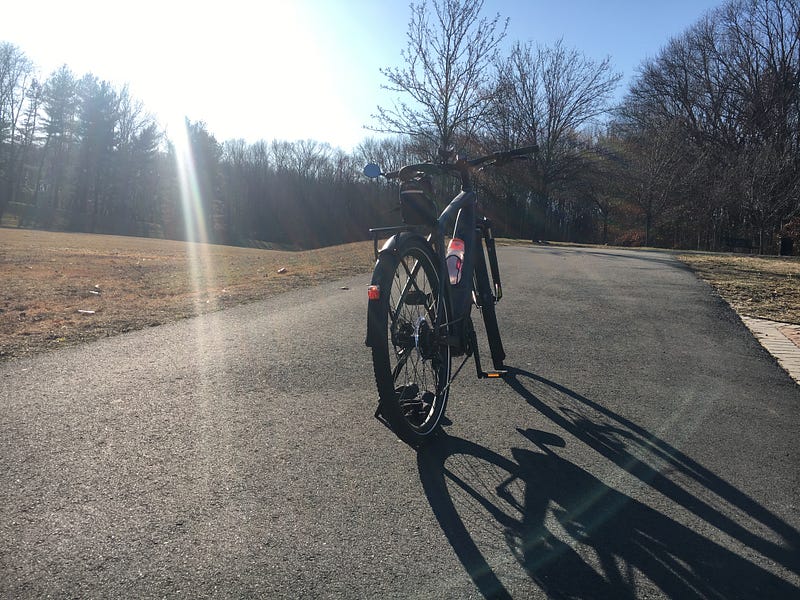
Let me stand up before this little corner of the web and testify: My name is Eric, I’m 53 years old, and I’m a couch potato. I do try and eat healthy. I take walks now and then. I even play the drums a little. But otherwise, I’m probably a lot like you. I sit at a desk for work, I watch too much TV, I’m addicted to my phone, and I’m worn out most of the time. My energy level stinks. I wake up tired. I’ve got the burned-out blues.
I know I need to exercise. Just about every year, right around January, I make an action plan. I join a gym. I get all fired up. I go a few times. I hate it. By April, I’m done.
I should be better. I’m just not.
My guess is, if you’re an athlete in awesome shape, you’ve probably stopped reading this by now. You’re out training for an IRONMAN. OK, good for you. I’m authentically jealous.
But if you’re like most people I know, you understand exactly what I’m talking about. You want to feel better and you want to exercise more, but you’re not motivated to do it.
The Breakthrough
One thing I do love, and have always loved, is riding a bicycle. Those first few cranks on the pedals as I leave the driveway have always fired me with joy. Then I hit the first hill, and I’m filled with regret. I start thinking about the end of the ride, rather than relishing the experience itself. It becomes a means to an end — an exercise. What an ugly word. It might as well be spelled with four letters.
It turns out, this makes me a perfect candidate for an electric bike.
I discovered e-bikes in a casual way, through a reference in a mainstream publication. It sounded almost too good to be true — a workout that included words like fun. So I set off on a deep exploration to learn all I could about what is still a somewhat nascent technology. After about nine months of intensive (some might say obsessive) research, careful savings, and possibly driving the people in my life a little crazy, I bought one.
And I just want to say: I’m in love. All I want to do is ride the thing. I’ve woken up at 5:45 (yes, that’s a.m.) just so I could. I have postponed coffee just so I could. I have left work early on false pretenses just to beat the February sunset home. I have frozen my ass off in the New Jersey winter for an extra 15 minutes of pedaling because I didn’t want to pull into the driveway yet. And I have not felt so energized in years — not since I was a kid, back when I used to ride a bike everywhere.
An e-bike is an absolute joy to ride. The day I got mine home and set the motor assist to Eco, which is the lowest level, and cruised down my street, I was smitten. Then I hit the hill that always makes me regret going for a bike ride. I popped it into turbo mode, the highest level of support — and I was the bionic man. I just spun right up the thing. So I headed to the other hill of misery in my neighborhood, which I used to try to avoid, but often could not — same thing. A complete blast. So I went looking for hills. I hit the biggest rise in the park, which forces most people off their bikes — and flew up as if going over flat ground.
I did seven miles that first ride. I did ten miles the next day. Seventeen miles of biking in one weekend. That’s more exercise, in two days, than I probably got over the whole winter. This can’t be a bad thing.
Since that first ride, I’ve been trying to find the words to explain what’s so compelling about an electric bike. What I’ve come down to is this: It feels like flying. That’s as close to the description I can offer. When you sense that gentle support of the motor—and it’s gentle, very subtle, not like an engine, more like a little push from a magical hand—the sensation is similar to taking off into air. I think it’s the reason people get hooked so quickly when they try one.
I believe if you ever rode one, you’d fall in love too. So allow me to dispel one of the biggest myths going.
Yes, E-Biking is Exercise
First, an electric bike is not a scooter or a moped. There are plenty of scooters and moped-type things out there. But an electric bike is a bicycle. It requires human pedal power. When I get back from a ten-mile cruise, I assure you, I’m both huffing and puffing. I promise, you’ll be tired when you’re done. You’ll have had a workout.
But what it offers, unlike a regular bicycle (sometimes referred to as an analog bike), is an intelligent, pedal-assist system that does one primary thing—it flattens out the road. It lets you pedal without the burden—and agony—of climbing. It turns a three- or four-mile effort into 10 or 20 miles of delight. And so you end up spinning perhaps five times as much as you might have otherwise. Instead of a 20-minute ride, you find yourself out for an hour. Or more.
Now, for some, this is the deal breaker. You want to climb mountains. You want to build muscle. You want to push your endurance to its limit.
Go ahead. E-bikes might not be for you.
But if you’re like every other couch potato out there, e-bikes are the perfect confluence of exercise and pleasure—two words which have never been used in a sentence that’s come out of my keyboard before.
E-bikes are essentially smart devices. They sense the effort you’re putting into them and give back just the amount of support you need. This mostly happens on hills, when you push harder on the pedals and need the help. When you’re on flat ground, and in a lower assist level, you feel like the wind is at your back. You’re working — but making tangible progress all the time. It’s the bionic-leg thing—you feel invincible. It is, in a word, spectacular. I wish you could ride one right now. I wish I could ride one right now. It’s that addictive.
And it’s good for you. I don’t want to bore you with statistical evidence; there are numerous studies proving the aerobic benefit of e-bikes compares favorably to analog biking. Like this one. I’m not saying one is better. Both have benefits. But beyond the research, what matters is how you feel, and for me, I’ve found an exercise that gets my heart rate moving and that I absolutely love doing. This is a remarkable discovery for an avowed couch potato.
Getting Started With Electric Bikes
OK, assuming I’ve won you over to the concept, it can be daunting — even overwhelming — to get started. So after spending way too many hours at forums, on Reddit, and with YouTube, here’s a starter set of basics I found helpful.
Pick your bike style
Just like any analog bike, e-bikes come in different flavors — mountain bikes, road bikes, racing bikes, hybrids, etc. This alone can be confusing, even before deciding on hub-motor vs. mid-drive, battery size, and the rest of the electronic decisions. To narrow this down, and given the cost of these things (more on that below), I decided to start with the most utilitarian type out there. For me, this meant something for the road but something that could also work on light paths and gravel.
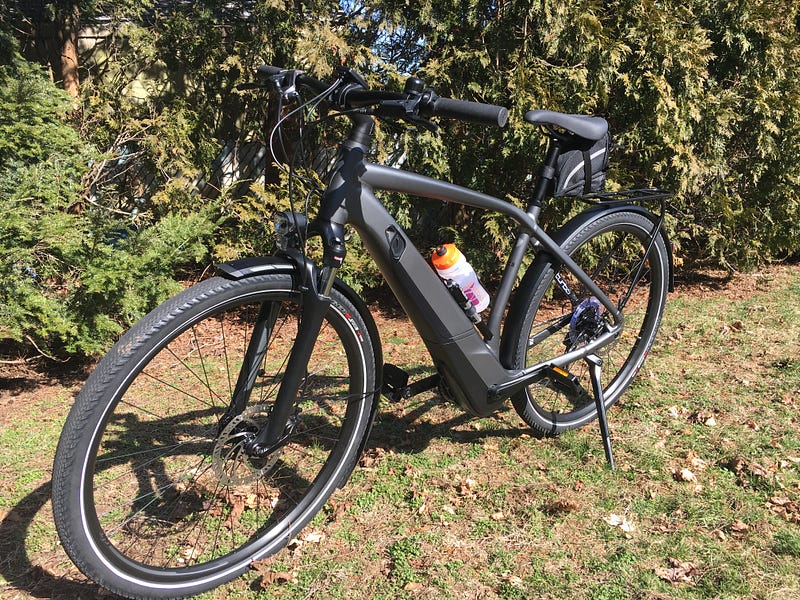
So I chose a commuter, or hybrid style: front shocks to lighten the ride, fenders for the rain, integrated lights for visibility to cars, 700c tires (these are in between fat tires for off-road and skinny tires for racing). This seemed like a good compromise that’d cover the majority of my rides — from the street to the towpath along the river and light trails through the park.
Stick to a budget — e-bikes are expensive
You can’t get past this one. A good bike, even without a motor, is a pricey proposition. Given the speeds you can go (up to 28 mph, in the U.S.), an e-bike needs to be substantial and reliably engineered with good components—and this means cost. Yes, you can take a DIY approach and build your own e-bike, but this wasn’t an option for a novice like me (though, it could be for you—more on that below).
And here’s where the overload of information can really make you crazy — because the more you read, the more you want. And you can easily spend five grand—or ten—for an e-bike. You can also spend $50,000 or $90,000 on a car, but many people buy Hondas or Fords (or whatever) and stick to a budget.
This is what I chose to do—and I forced myself to abide by it. For me, this meant $1,500 to $3,000. Still a lot of money, for sure. It took some time to save. But I chose to see this as a health enhancement, possibly even a life extender. This felt like a fair exchange of cost versus return.
Buy only what you can test ride
This was a tough one because there are some very compelling online, direct-to-consumer options that reduce the cost. And I was tempted because people on forums and Facebook groups truly seem to love them. Ultimately, it’s just not a route for me—but this is no knock on those options. This is a personal choice, and it doesn’t have to be yours.
I’m a complete novice—I both need and prefer a local bike shop (LBS, in the hipster parlance) to lean on for help. But beyond that, buying an e-bike, to my thinking, is a lot like buying a car — I wouldn’t do it without driving one first. And each e-bike has its own unique feel and style, which you discover as you start to test them.
For instance, do you want a mid-drive or a hub-drive? Cadence sensor or torque sensor? Mountain or road bike? Rigid or suspension fork? Upright or forward-leaning? These are all very different rides, even from the same manufacturer, and while there are guidelines, all the online forums on the internet won’t give you the hands-on experience to evaluate against your personal preference.
So I committed to choosing a bike I could actually ride — and to keep within about an hour’s car distance from the dealer. As I write this, e-bikes are still enough of a novelty that the local options can be limiting. For me, this narrowed the choice to the “Big Three” — Giant, Trek, and Specialized. If I were open to extending things past 90 minutes, it meant Bulls, Yamaha, Haibike, Pedego, and a few others. All good choices, it seems to me.
I’m not going to suggest which brand is better. People get very touchy about that. The one I ultimately chose hit all the right buttons: It’s an entry-level value e-bike with generally solid, though not top-end components; it has hydraulic brakes, which I felt were important for stopping power; it’s a mid-drive motor with torque assist (which centers the weight and some say gives a more bike-like feeling than cadence sensors or hub-drives in the rear wheel); at 54 lbs, it’s light enough to fit on most hitch-based car racks; it has a very quiet motor; it was under my budget (barely).
I couldn’t be happier — but there are lots of options, and this might not be the specific one for you. The point is, go test! The bike shops I visited were all very accommodating and let me ride and ride.
How about DIY?
I can’t offer any words of experience here because I’m not really a DIY kind of guy. That said, there are voluminous guides online (check the resources below) that help you take an analog bike and build an electronic system with motor, display, and the rest. It certainly reduces the cost. I’d argue there’s an extra value in a purposefully engineered, holistic system that justifies the higher cost of a mainstream, well-tested, manufactured e-bike. But I’m not advocating for the manufacturers; it just made sense for me.
Now, About that “Cheating” Thing
Inevitably, you are going to hear: “That’s cheating.” I’ve already heard it a bunch of times, and I’ve only been riding a few weeks. I try to laugh it off with some ruddy good cheer because in some ways I get it — and, more importantly, I want people to embrace the concept because there are both physical and planetary benefits to be had by the ubiquitous adoption of e-bikes. So friendly engagement seems like it has the best chance of opening someone’s mind.
But inside, a part of me wants to snarl, because calling an e-bike cheating is rather silly. Am I cheating myself? I’m getting more prolonged, intense, sustained aerobic exercise than I’ve gotten in decades. My energy level is through the roof, and I just feel full of—I don’t know—energy and peace, at the same time. Just having the motivation to write this article, for instance, is something that’s been lacking in my life, and I love words. I used to write all the time. So there’s no cheating myself here. On the contrary: I’ve experienced a profound life change.
Am I cheating you? If you want to run marathons, swim across the English Channel, or jump out of an airplane, go for it. It seems to me our exercise choices are personal, just like the diet we follow or where we live or our parenting philosophy or career choices.
Am I cheating other bikers? I guess if I was struggling up a mountain, and someone came buzzing along on an electric bike, I’d be a little ticked off. Because I’d be doing all this work. But again, someone chooses to struggle up a mountain. Am I cheating if I drive my car?
And besides, the biggest point here is there is no cheating going on. I’m riding a fabulous exercise bike, only instead of sitting still at the gym staring at CNN (which, taking my own argument, is perfectly fine for those who enjoy that), I’m out in the breeze and the sun and air.
And if you still insist I’m cheating, then I’ll pull over and let you take a spin. I promise you’ll fall in love — and quickly, too.
Further Resources
There’s a wealth of information online for e-bikes. Here’s where I’ve spent most of my time:
- Electric Bike Review (EBR): This fabulous resource is the one I swear by. It has in-depth, hands-on reviews, along with a fantastic forum of engaged and experienced e-bikers who just want to help each other. The bike reviews themselves are paid for by the manufacturer, but as the founder of the site insists on every video, they’re not endorsements — and I’ve found that to be true. It’s the Consumer Reports of e-bikes, and it’s free.
- r/ebikes at Reddit —Another deep source of helpful content. And a great place to ask a question. But like all forums, search first! Chances are, someone’s already asked what you’d like to know.
- Turn Your Bike into an Electric Bike — For the DIY crowd, a nice collection of information.
- How to Pick a Bike Type — It’s a foundational question. Here’s a good overview and place to start.
- Know Your Local Laws — E-bikes are still new and the rules about their acceptable use on public roads and parks are evolving. These tend to be based around speed limits — in the U.S., this means 20 or 28 mph, depending on your state. The good news is many regions are open to e-bikes and are setting standards, but they still vary from place to place.
- And Be Safe: I need to add that e-bikes pose risk. Batteries need to be handled with care. You’re traveling at high speeds, and you need a good helmet (as written elsewhere, the best helmet “is the one you’ll wear”) and commonsense safety precautions—reflective gear, front and rear lights, a good mirror, etc. Just like riding a motorcycle, assume you’re invisible to cars, and that every parked vehicle has a driver waiting to swing their door open into your lane. You need to take some time and get used to the more powerful brakes and heavier weight of an e-bike, which feels very different than the bikes we grew up with.
So be smart and be prepared. And have fun!