
How an All-Black Team Changed the Face of Professional Basketball
The NBA’s first Black players in 1950 came from the Harlem Globetrotters
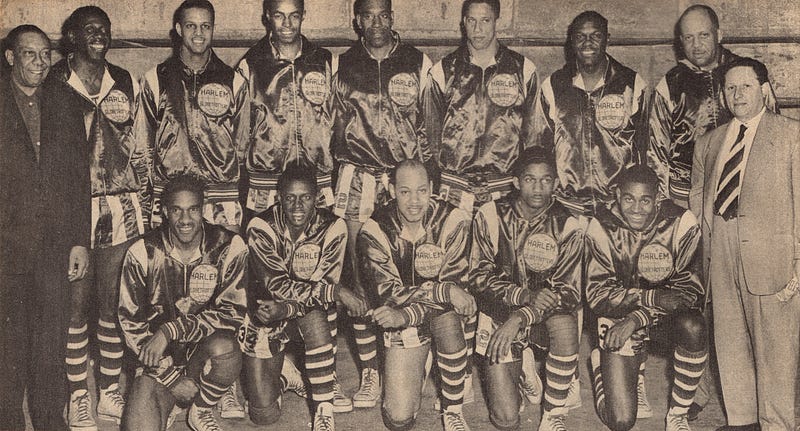
Today, it is common to see five Black players start for each team in an American professional basketball game. White players are a distinct minority on many US basketball teams. That wasn’t always the case. In fact, National Basketball Association (NBA) games were not integrated until the 1950–51 season.
Race has always been a complicated issue in America, and professional sports has not gone unscathed. Until the late 1940s, talented African American baseball players were excluded from the American and National Leagues of Major League Baseball. Jackie Robinson famously broke baseball’s color barrier when Branch Rickey offered him a contract in 1945 to be a player with the Brooklyn Dodgers.
It was much the same in professional basketball until 1950.
The Chicago team that changed everything
In 1926, a team called the Savoy Big Five got together in Chicago. The outstanding players, all of them Black, came from the South Side of the city. The team was essentially “discovered” by sports enthusiast and promoter Abe Saperstein, a white man who became the owner/manager.
Saperstein changed the team’s name to the Harlem Globetrotters in 1927. He chose the name because Harlem a neighborhood in Manhattan was considered the center of African American culture. “Globetrotters” was aspirational because Saperstein envisioned touring the world with the team.
For the next decade, these talented men played serious basketball. By 1940, the Harlem Globetrotters won the World Professional Basketball Tournament, beating the Chicago Bruins. An even more remarkable feat came eight years later, when the Harlem Globetrotters defeated the all-white Minneapolis Lakers, world champions of the fledgling NBA, not just once but twice, in 1948 and 1949.
The NBA took note of the exceptional ability and professional potential of Black basketball players. The Boston Celtics became the first NBA team to draft an African American player, Chuck Cooper, in April 1950. Soon after, Nate (Sweetwater) Clifton became the first Black player to sign an NBA contract with the New York Knicks in May 1950. Both Cooper and Clifton previously played for the Harlem Globetrotters.
A different path for the Harlem Globetrotters
Early on, Harlem Globetrotter games were more popular than NBA games — NBA teams sometimes scheduled doubleheaders with the Globetrotters to encourage attendance.
Still, the team chose to remain an independent basketball entity. In 1950, the Globetrotters embarked on its first international tour. The team played in front of their largest crowd ever — 75,000 fans in Berlin, Germany in 1951.
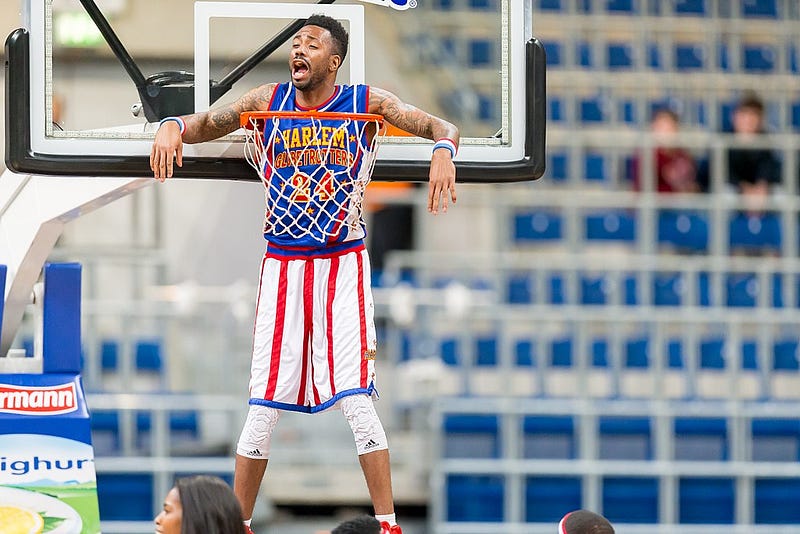
By the early 1950s, the Harlem Globetrotters had become known for their entertaining antics. They incorporated incredible ball handling, feats of athletic dexterity and comic bufoonery into their exhibition games. They were always accompanied by another team (usually the Washington Generals) whose role it was to play unadorned basketball and lose to the Harlem Globetrotters.
Legendary players
While the Harlem Globetrotters developed into a professional basketball team that played exhibition games to entertain spectators, the Globetrotter players were highly skilled athletes. Legendary players on the team have included:
Marques Haynes — Playing with the Globetrotters from 1947–1953 and 1972–1979, Haynes’ style of dribbling was one of the team’s most powerful weapons. He was the first player ever to be inducted into the Naismith Memorial Basketball Hall of Fame as a Globetrotter.
Reece “Goose” Tatum — In twelve seasons with the Globetrotters, Tatum was on the 1948–1949 teams that defeated the Minneapolis Lakers. He was considered one of the greatest basketball players of his time.
Meadowlark Lemon — Playing more than 7,500 consecutive games during his twenty-four seasons, Lemon was considered the “Clown Prince” of the Harlem Globetrotters.
Fred “Curly” Neal — One of the best dribblers and shooters in basketball history, Neal played twenty-two seasons in more than 6,000 games.
Wilt Chamberlain — Before becoming a legendary NBA star, Wilt “The Stilt” Chamberlain played with the Globetrotters. He was a member of the first-ever Globetrotter team to play in Moscow in 1959.
Criticism during the Civil Rights era
During the Civil Rights era, the Harlem Globetrotters were at times criticized. They were seen by some as reflecting poorly on Blacks because of their on-court comedy, and they were sometimes lambasted because they were managed by a white man. Referencing the novel, Uncle Tom’s Cabin, some activists accused the Globetrotter players of “Tommin’ for Abe.”
Interestingly, civil rights leader Rev. Jesse Jackson came to their defense. He said, “I think they’ve been a positive influence… They did not show Blacks as stupid. On the contrary, they were shown as superior.”
Over time, though, the Harlem Globetrotters retained their popularity. Two feature films about the team were made in 1951 and 1954. From 1970 to 1973, a Harlem Globetrotters children’s cartoon series ran on television, followed by a live-action Saturday morning show in 1974.
The Globetrotters also guest starred on Scooby Doo, and visited Gilligan’s Island for a TV movie. Other TV shows and made-for-TV movies have featured the Globetrotters, and Globetrotter games have appeared on national television.
A global brand
The Harlem Globetrotters have developed into a global entertainment brand that has lasted for nearly 100 years. The team has toured the United States and the world since their inception. As a kid, I remember being amazed and thrilled to see the Globetrotters perform at Madison Square Garden in New York.
The Harlem Globetrotters broke the color barrier in professional basketball. They broke another barrier by adding Olympic gold medalist Lynette Woodard to the team in 1985. She became the first female to play on a men’s professional basketball team, setting the stage for the foundation of the WNBA eleven years later.
In 1951, the U.S. State Department called the Harlem Globetrotters “ambassadors of extraordinary goodwill.” With performances that continue to delight audiences all over the world, that remains true to this day.
Sources
Klein, Christopher. 2023. “10 Things You May Not Know About the Harlem Globetrotters,” History, May 23, 2023
“Globetrotter History,” Harlem Globetrotters
“Legends,” Harlem Globetrotters


