
How AI is Changing the World We See!
Learn How GANs are a Threat to Our Security Standards

The image you are seeing is not of any human being. Yes! it definitely looks like one, and is quite deceiving, but it is actually generated by a GAN or Generative Adversarial Network ( StyleGAN 2 ). This is what makes one think about the credibility of data around us. Before diving into details let me tell you how and why we came this far.
Artificial Intelligence (AI) was first developed to make the machines able enough to behave intelligently, and undoubtedly, we bore a lot of fruits from it. Autonomous Driving, Virtual Agents, and Facial Recognition, to name a few. One might think, How does this thing work? We process a large amount of data to train a neural network. The neural network extracts information from it’s training data, and produces required results. Why we need GANs? The requirement of large training data opened way to GANs. These specific type of networks can generate fake data after training, which further can be used for training purposes. Over the years, we have perfected these networks so much, that it has become a difficult task to differentiate between real and fake data. This reduces the labour of collecting datasets for training.
Advancements in GANs
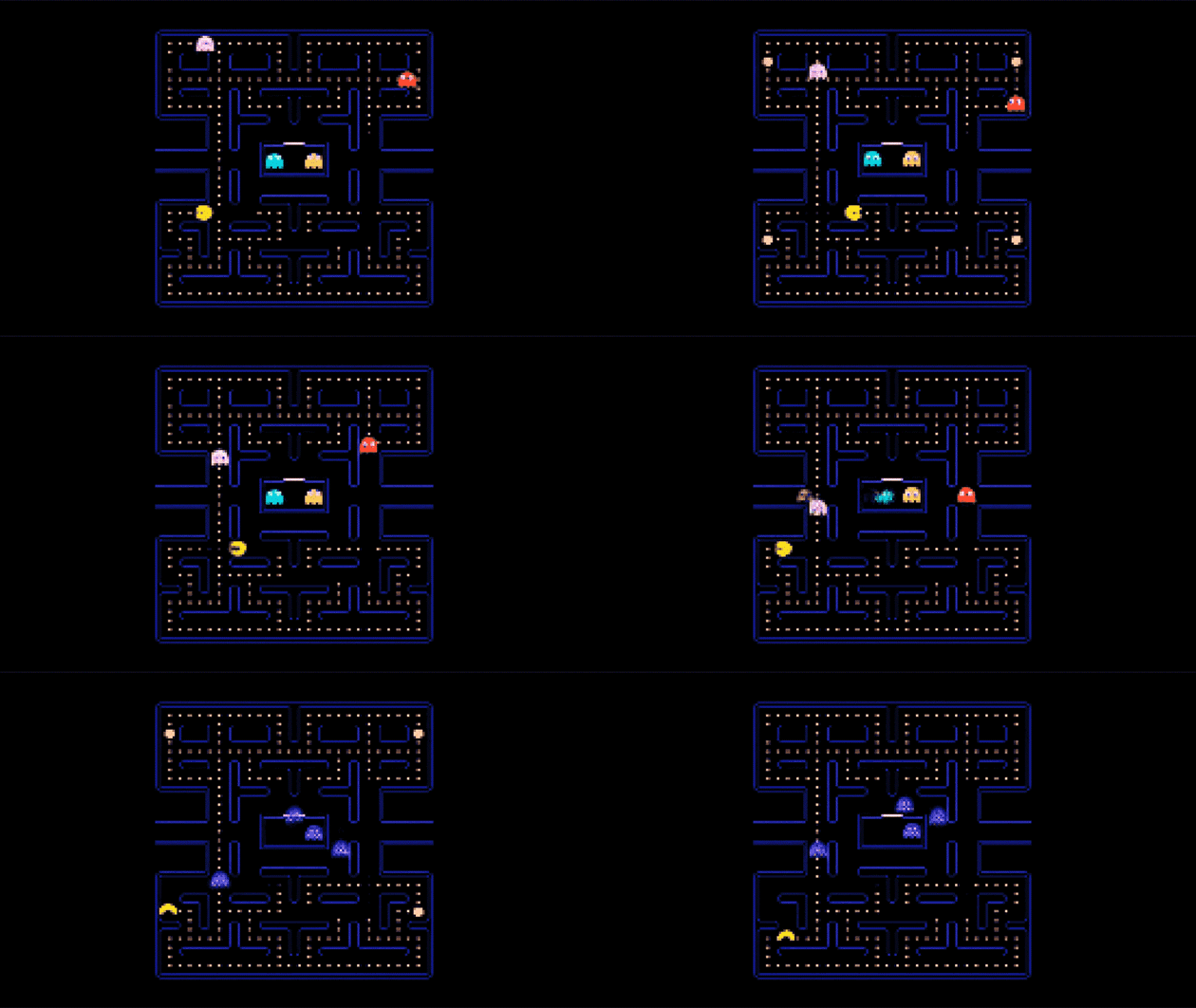
With the release of the first GAN, we have seen a new domain rising. Up till now, Nvidia has created multiple GANs, which have broken the ground for many. Consider the GameGAN, which can create a game without any game engine. It learns from the game, and produces its copy, without any game engine required.
Or consider the GauGAN, which can create photorealistic landscape images with a conventional looking paint tool.

These advancements have always been cherished by the tech enthusiasts, but we have also considered the well being of our society. Where these GANs are creating a new level of ease, some of them are also imposing a great threat to our security standards. To enjoy their benefits, we must take the necessary precautions.
Parallel Universe of GANs
With everyday advancements in GANs, we can no longer tell the difference between real and fake. If you doubt that, check this site. We hardly cleared our concerns about talking to strangers over the web. With these GANs, one can scam or catfish individuals over the internet, quite easily. You would never know who is behind those pretty, and actually fake faces. You can generate as many faces as you want with these GANs. If you are wondering that, the captcha won’t let the machine or AI pass the firewalls, then reconsider it, as they can also be outsmarted by AI. Moreover, we can create a fake fingerprint for our fake face. Finger-GAN can generate as many unique fingerprint patterns as you want. Hence, concluded that we can break into most of the sites with this much data. This can create a parallel universe of fake individuals, which carry their own unique identity, just like a normal human being.
Our Rusty Security Standards
We see leaks of data, and responses over social media, everyday. Many of us have accepted it as a price for our socialization, while some consider privacy their basic right. The threats GANs might impose on us are much more severe, and permanent. We all rely on some security standards for our privacy. Some use lengthy passwords, some prefer four digit pins, some consider fingerprints more secure, and the rest of us find ease, as well as security in facial recognition. But to our surprise, there are GANs for them too, which can clone our data. Up till now, GANs have not outsmarted fingerprints and facial recognition software completely, but they can generate photorealistic images of an individual in real time, with the input of a very small data. We can now clone someone’s voice as well as speech style, with the help of GANs. Consider the following video, in which an individual cloned Billie Eilish’s voice and speech style, with the help of AI.
This might not be the perfect clone, and one can easily tell it is fake, but we are not far from the day when we won’t be able to differentiate between real and fake. That day, consequences would be far beyond our thoughts. That day, video and audio evidence would no more remain credible.
EndNote
It is a reality, which we would face sooner or later. With every increasing pixel of our camera, there increases the probability of our data to clone perfectly. We need to devise a better and sustainable security measure. Something that could differ between what’s real and what’s not.
If you enjoyed reading the article consider following me on Medium, and stay updated with my fresh uploads. Don’t forget to give your feedback, it keeps me motivated.


