
How AI is Changing The Future of Writing (And How to Make Yourself Irreplaceable)
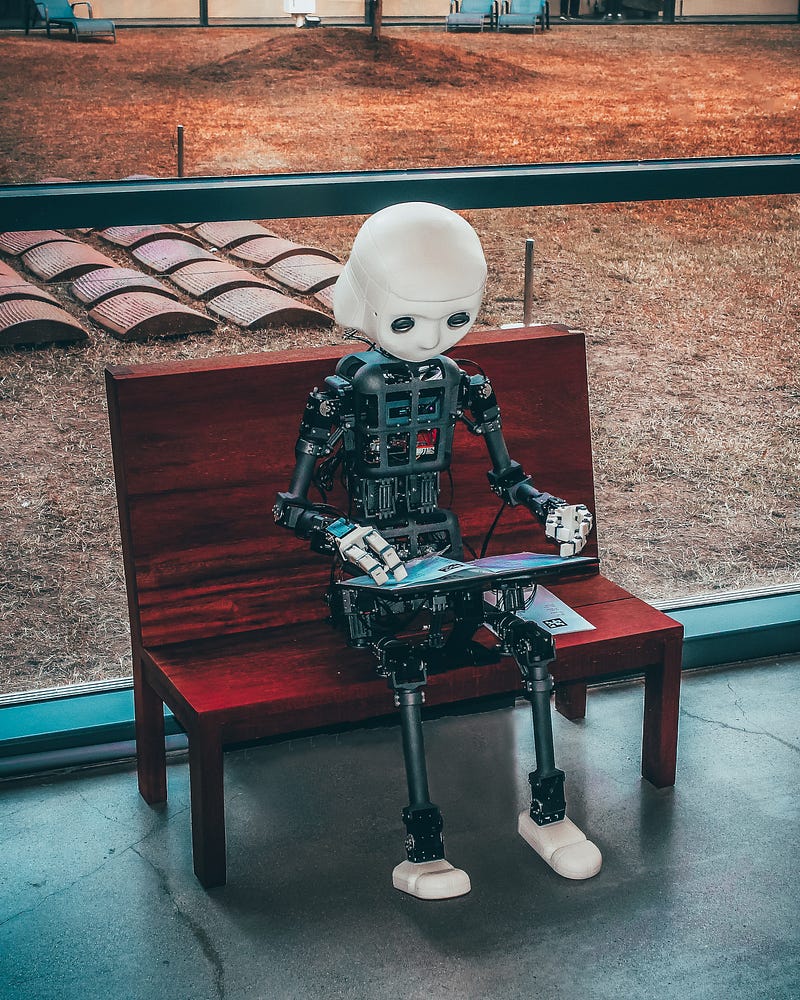
With AI becoming more intelligent every year, writers worldwide are panicking their jobs might be replaced.
As someone who’s been writing online for nearly ten years, this article discusses what I believe the future of writing looks like.
Before we start, let’s understand that the AI revolution is not new.
The history of AI writing experiments
AI started writing books years ago. The first successful attempt was in 2017.
Since then, several published and critically acclaimed novels have been written by AI.
But the initial AI writing attempts were mainly niche-specific and monotonous. No writer took it seriously, so you never heard about AI replacing writers in 2017.
What changed in 2022?
GPT-3 was born. ChatGPT is an example.
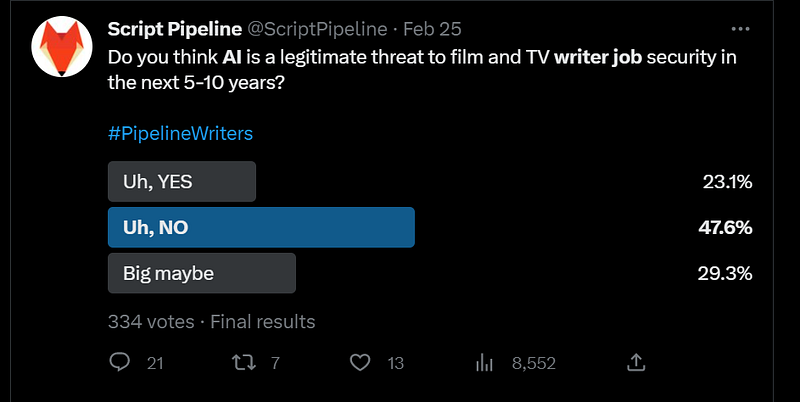
If you’ve been active on social media, you’ll know it took the writing world by storm.
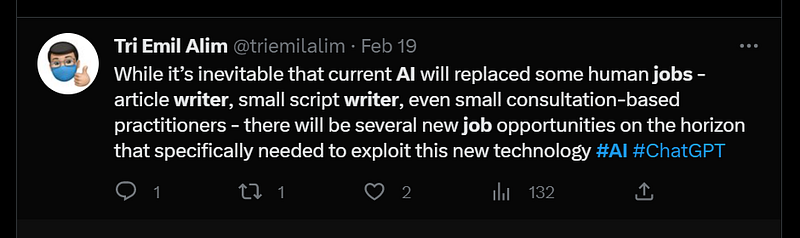
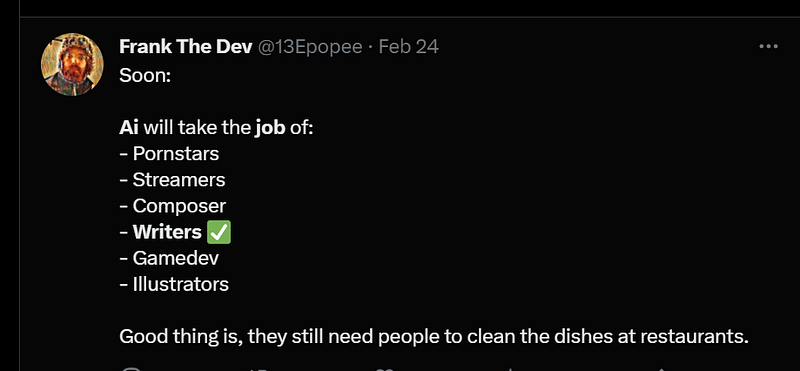
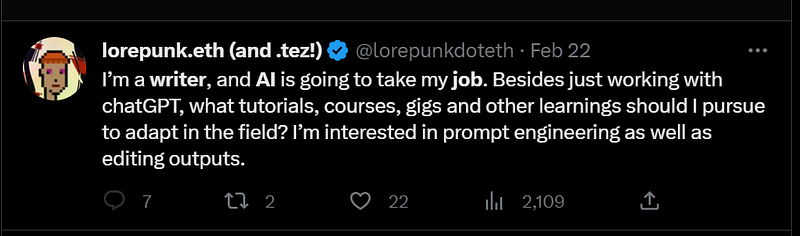
Microsoft is investing heavily in GPT-4 research, which will be released in 2023. Since it has 100x more training parameters than GPT-3, you can rest assured that the output will be even more nuanced and human-like than chatGPT.
But is the hype around GPT worth it?
Will it replace writers in the coming years?
Let’s dive in and take a deeper look.
AI vs. writers: The harsh truth
Here’s the harsh truth. Like it or not, the AI revolution in writing is here.
So what does it mean for writers?
AI doesn’t need willpower, unlike humans. It does the job: write.
An article that took you
- Two days of self-motivation,
- Six days of research,
- Two days of writing
…will take AI seconds!🤯
The bottom line: Content isn’t valuable anymore.
This raises a million-dollar question: Why would anyone pay writers if AI can write in 100x less time?
The answer: You’re a human, not a robot.
You have experiences that help you draw unique analogies. You can come up with figures of speech no AI can replicate.
Your stories have shaped your opinions which will uniquely mold your writing and research.
Robots can’t train themselves to do that, at least not the GPT-3 ones.
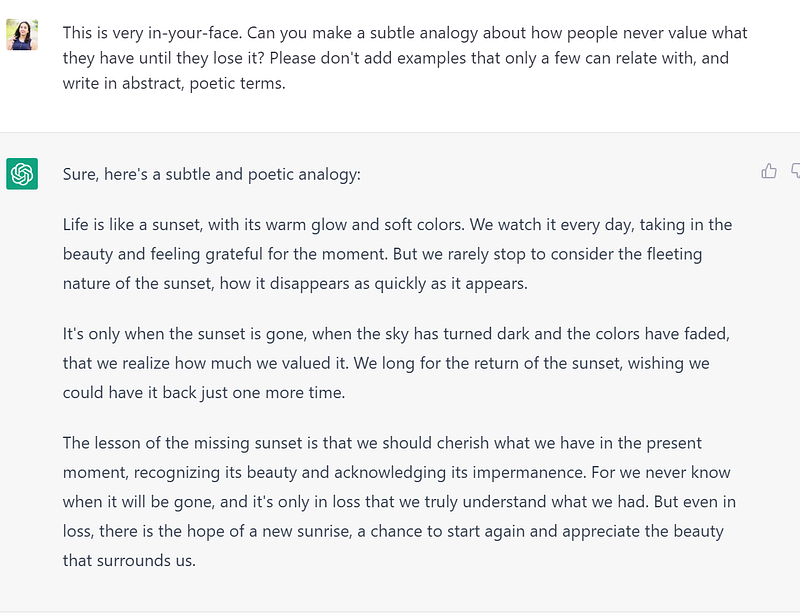
ChatGPT is useless when drawing analogies and writing meaningful metaphors. I asked it to explain how humans never value what they have until they lose it, and after about 20 tries, here’s what I got:
Life is like a sunset, with its warm glow and soft colors. We watch it every day, taking in the beauty and feeling grateful for the moment. But we rarely stop to consider the fleeting nature of the sunset, how it disappears as quickly as it appears.
It’s only when the sunset is gone, when the sky has turned dark and the colors have faded, that we realize how much we valued it. We long for the return of the sunset, wishing we could have it back just one more time.
The lesson of the missing sunset is that we should cherish what we have in the present moment, recognizing its beauty and acknowledging its impermanence. For we never know when it will be gone, and it’s only in loss that we truly understand what we had. But even in loss, there is the hope of a new sunrise, a chance to start again and appreciate the beauty that surrounds us.
What do you think is your unfair advantage? A secret superpower that only YOU can deliver to your readers?
Pepper your writing with that and build a tribe of loyal readers. Trust me, you’ll never have to worry about being replaced by AI.
What AI writing currently lacks
AI is trained on millions of online articles, books, and PDFs.
But you know what?
4 out of 5 articles you pick online will be trashy, clickbaity, and filled with cliches. Any average internet user would agree to that.
What does it mean for AI writing?
- It’s filled with cliches.
- The posts have a pattern — a discernible introduction, body, and conclusion. You can try asking it to write in the style of various creators, but the output ends up in the same digestible pattern.
- The analogies hardly have any evocative value, as they can impart information but rarely make the reader feel anything.
- After a point, it starts repeating itself.
AI vs. human writers: The verdict
Most AI writing sounds generic and flat. It doesn’t have a personality or human voice.
At least, not yet.
What can you do as a writer?
Look at AI as a writing tool & not as competition.
Use it to:
- Generate blog post ideas,
- Conduct keyword research,
- Create interesting titles or hooks,
- Outline articles, and
- Generate the first draft.
After that, generously pepper in your personality and make the writing sound like you. Being yourself is the biggest superpower you have. Why would you want to trade it for quicker articles if that makes you sound like a robot?
Tell a story; don’t aim only to state the facts and regurgitate information.
Final words
Here’s the harsh truth most writers wouldn’t admit regarding AI writing: You can’t stand out with generic writing.
Your writing must build connections with real people and foster a community to become irreplaceable. Tell a story; don’t aim only to state the facts and regurgitate information.
There’s no other way.
Writers without an X factor will get replaced. This X factor can be anything:
- Creative topic ideas,
- Unique writing style,
- A loyal community built over years
If you have an X factor, you can outperform the competition.
What do you think is your unfair advantage?
A secret superpower that only YOU can deliver to your readers?
Pepper your writing with that and build a tribe of loyal readers. Trust me, you’ll never have to worry about being replaced by AI.
You’re a human, not a robot. You have experiences that help you draw unique analogies. You can come up with figures of speech no AI can replicate.


