
How AI Conversations is Changing the World
Learn how Large Language Models(LLMs) are used to create more natural, engaging, and informative conversations with machines.
Are you intrigued by the buzz surrounding ChatGPT, Bard, LLMs, AI-powered conversations, and Prompt Engineering? Wondering how these cutting-edge technologies can revolutionize your daily life?
Look no further than this article, where we’ll delve into the fascinating world of AI conversations and unlock the secrets of LLMs. Discover how these powerful language models learn and how they can be leveraged to enhance your day-to-day experiences.
Get ready to unlock the full potential of AI effortlessly and join the conversation of the future…
What is LLM or Large Language Model?
A Large Language Model (LLM) is an incredibly intelligent machine that has been trained on a massive amount of text data. The training data includes a wide range of sources like books, articles, online content, and social media posts. and discussions. As a result, LLMs have a vast knowledge of the world.
Popular examples of LLMs are ChatGPT, Bard, Perplexity etc.
With an LLM, you can ask it to perform various tasks, such as answering questions on any topic based on its vast knowledge, summarizing lengthy texts into key points, translating texts from one language to another, and even analyze the sentiment of a text, which can help you understand the emotional tone of the text.
LLM is a powerful tool that can help you access and understand information quickly and easily
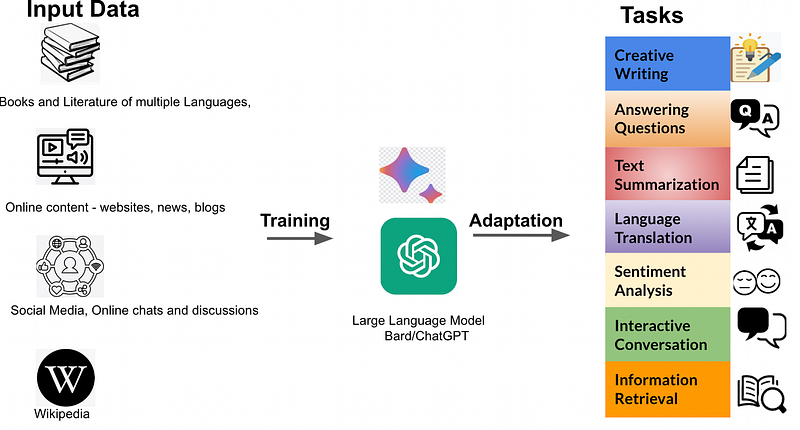
Here are some examples of how LLMs can be utilized:
- You can ask an LLM questions about climate change. It will provide you with answers based on the vast knowledge it has acquired.
- You can request a book summary or translate it from one language to another.
- If you have a lengthy piece of text, you can ask the LLM to summarize it in just a few key points.
- You can ask the LLM to analyze the sentiment expressed in a text, helping you understand the emotional tone conveyed.
Have you ever wondered how LLMs like ChatGPT learn?
The name “GPT” stands for Generative Pre-trained Transformers.
LLMs use a powerful deep-learning model called Transformers. Deep learning is a type of machine learning that uses artificial neural networks to learn from data.
LLMs learn by being trained on a massive amount of text data. This data includes books, articles, websites, social media posts, discussions and more. The LLM breaks down this text into smaller units called “tokens.” These tokens can be considered individual words or even smaller parts of words within a sentence.

By understanding the relationships between these tokens, the LLM learns to understand the context and long-term dependencies within a sentence. This allows the LLM to generate text that is both coherent and informative.

Transformers have an impressive ability to learn from an enormous amount of language data. They often train on much more data than most humans could ever read or hear. By training on this vast dataset, transformers gain a comprehensive understanding of language. They can then apply this knowledge to various contexts or situations.
In simple terms, Transformers are like sponges that can soak up a lot of information. They can learn from data can be many times more than what humans can hear or read in their lifetime. The more they learn, the better they understand language and the better they can generate text.
The crucial piece of Transformers is the Attention mechanism that helps LLMs understand and process language more effectively. The Attention mechanism allows the LLMs to assign different levels of importance or relevance to different parts of the input text when making predictions or generating output.
Imagine you are reading a book. You are not just reading the words on the page, you are also paying attention to the context of the words. You are paying attention to the meaning of the words, the tone of the writing, and the overall structure of the text.
The attention mechanism in transformers works in a similar way. It allows transformers to pay attention to different parts of the input text and to learn the relationships between these parts.
We learn new tasks in two ways: by trial and error, or by being taught by someone who provides an example and then gives feedback on our performance. LLMs combine these two approaches by using reinforcement learning with human feedback (RLHF).
In RLHF, the LLM is first given a task and a set of examples. The LLM then tries to complete the task by trial and error. After each attempt, the LLM receives feedback from a human on how well it performed. This feedback is used to update the LLM’s internal model of the task.
Human feedback is used in RLHF because it makes the learning process more efficient. This is because the LLM can learn from its mistakes, rather than having to learn everything from scratch. Additionally, human feedback makes the LLM’s output more transparent to understand. This is because human feedback provides information on how the LLM performs and what it needs to do to improve.
What are the different tasks LLMs can perform?
Large language models (LLMs) are a type of artificial intelligence (AI) that can be trained to perform a multitude of tasks.
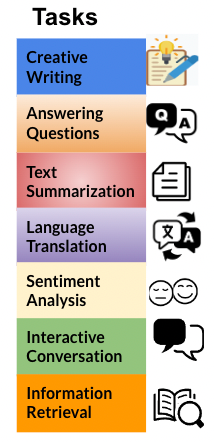
- Creative Writing: LLMs like ChatGPT and Bard can generate creative texts like poems, code snippets, musical pieces, essays, etc.
- Answering Questions: LLMs can understand and respond to questions by providing relevant answers by understanding the context, as in chatbots for customer service to be more engaging and informative.
- Text Summarization: LLMs can condense lengthy text into shorter summaries while preserving the crucial information present in the long text, like summarizing news articles, research papers, etc.
- Language Translation: LLMs translate text from one language to another to bridge the language barrier.
- Sentiment Analysis: LLMs are used to analyze the text data to determine the emotional tone of the text. It can be used for identifying customer feedback, product reviews, etc.
- Interactive conversation: LLM can be used to create interactive conversations that are both informative and engaging. In education, LLMs can be used to prompt the right questions and provide personalized feedback. The interactive discussions can help students to learn more effectively and efficiently. In marketing and sales, LLMs can be used to develop customer relationships by personalizing the interaction, generating leads, and closing sales.
- Information Retrieval: LLMs help with information retrieval by making it easier to find the information you need by providing more relevant, personalized, and engaging search results by understanding the context of the prompt.
Popular AI Conversation tools
OpenAI’s ChatGPT
Google’s Bard
Perplexity AI
What are Prompts?
A prompt is a text that instructs an LLM what to do. It can be a simple sentence or a more complex text, depending on the task you want the LLM to perform. The quality of the prompt determines the quality of the LLM’s output.
Clear and concise prompts are the input to LLMs to generate efficient and effective responses to achieve the desired objectives
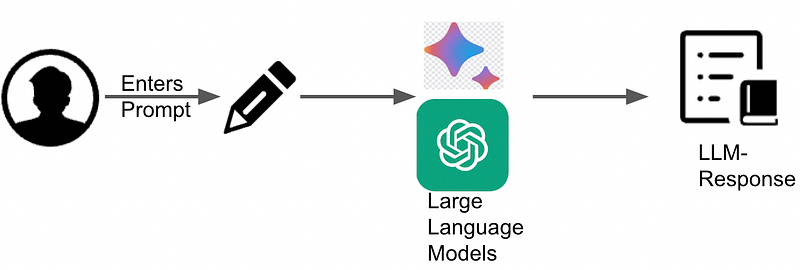
Examples of prompts
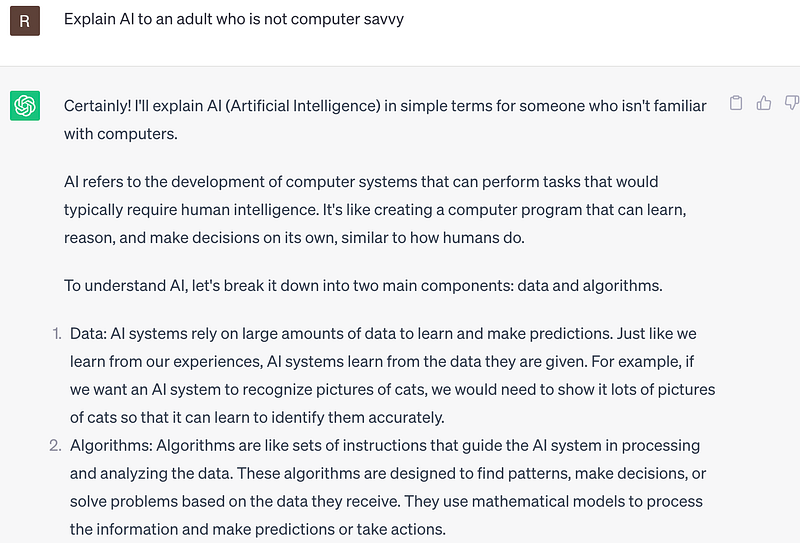
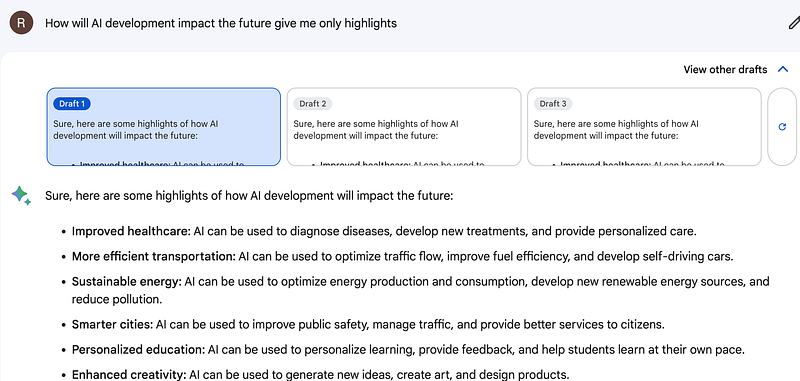
Remember, a poorly constructed prompt will result in generic and lackluster output. Therefore, knowing how to build an effective prompt is crucial to leveraging the power of LLMs.
Building Blocks of a Prompt
A prompt is a command to an LLM specifying what to do and how to do it. It comprises the elements: Instruction or Task, Context, Example, Input Data, and Output Indicator. Depending on the use case, not all elements may be required.

Instruction: Main instruction that tells the LLM the specific task to accomplish.
For example, if you want the LLM to write a code in Python using data frames, you would give it an instruction like “write a code in Python that will summarize and group the data in a data frame”
Context: Background information that may be relevant to the task. to steer the LLM for better responses.
For example, if you want the LLM to provide a response such that a 5-year-old can understand, then you would give it context like “Explain to a 5-year-old”
Example: An example of what the desired output should look like, you can give it examples.
For example, you could give the LLM examples of the output you need, like performing a task step by step.
Input Data: Input or question you are interested in finding a response for.
For example, if you want the LLM to write an essay about actions to slow down climate change, you would give it input data like “Give me step-by-step actions that anyone can take on a daily basis to slowdown climate change”
Output Indicator: Specify the output format or length you want the response, like a tabular output, JSON output, a poem, a code, a script, a musical piece, etc., or specify the response length.
For example, “Give me a detailed itinerary for a 3-day visit to SriLanka in a tabular format with places to visit, best hotels to stay with correct addresses, and places to eat.”
Best practices for writing Prompts
The responses generated by LLMs are as good as the prompts you provide. Hence there are best practices for the prompts.
The answer from the LLM is as good as the the input prompts
Best Practice 1: Write clear, specific, and unambiguous instructions.
- Clearly define the desired outcome.
- Be specific on the response that LLM should generate or answer a particular type of question.
- Remove any ambiguity to steer toward an accurate response.
- Provide examples of the output you expect from LLM, also called few-shot prompting.
- Check if the conditions are satisfied
Best Practice 2: Provide Context and clearly define the task
- State the context of the task clearly in simple and concise language by mentioning the topic or subject
- Specify any role or persona that you want the LLM to play
- Provide the LLM with additional data and background information to create a unique, relevant, high-quality output.
Best Practice 3: Chain of Thought(CoT)-specify the steps required to complete the task
- Instruct LLM to explain or reason the thought process involved in the task step by step
Features of a Good Prompt
A good prompt is one that:
- Meets the user’s intent or goal: The prompt should be clear and concise, providing the user with enough information to get the desired results.
For example, if the user wants to generate a list of 10 things to do in India ina tabular format day by day, the prompt should be specific enough to generate a list that is relevant to the user’s interests
- Requires minimal post-processing and review: The prompt should be easy to understand and generate results that are ready to use. User should not have to spend a lot of time editing or reviewing the results to make them usable.
- Creates unique and personalized content: The prompt should be able to generate unique content tailored to the user’s interests.
- Opens up new possibilities to explore: The prompt should be able to generate content that is creative and thought-provoking. The content should be something that the user has not seen before and that makes them think about things in a new way.
Conclusion:
Large language models (LLMs) are a powerful new technology that has the potential to revolutionize the way we communicate with machines. LLMs can be used to generate text, translate languages, write different kinds of creative content, and answer your questions in an informative way. LLMs will change the way we work, the way we learn, and the way we interact with the world around us.
References:
Large Language Models are Zero-Shot Reasoners
On the Opportunities and Risks of Foundation Models
icons-https://uxwing.com


