
The Reflective Eclectic
How Adversity Brings Out Your Potential
This plant in my office is one of my heroes
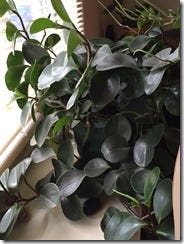
This jade plant, I think you will agree, is a beautiful specimen; as good as a house plant can be. It is lush and green and healthy. It propagates well. It’s lived a long time.
Let me show you another plant, a philodendron.
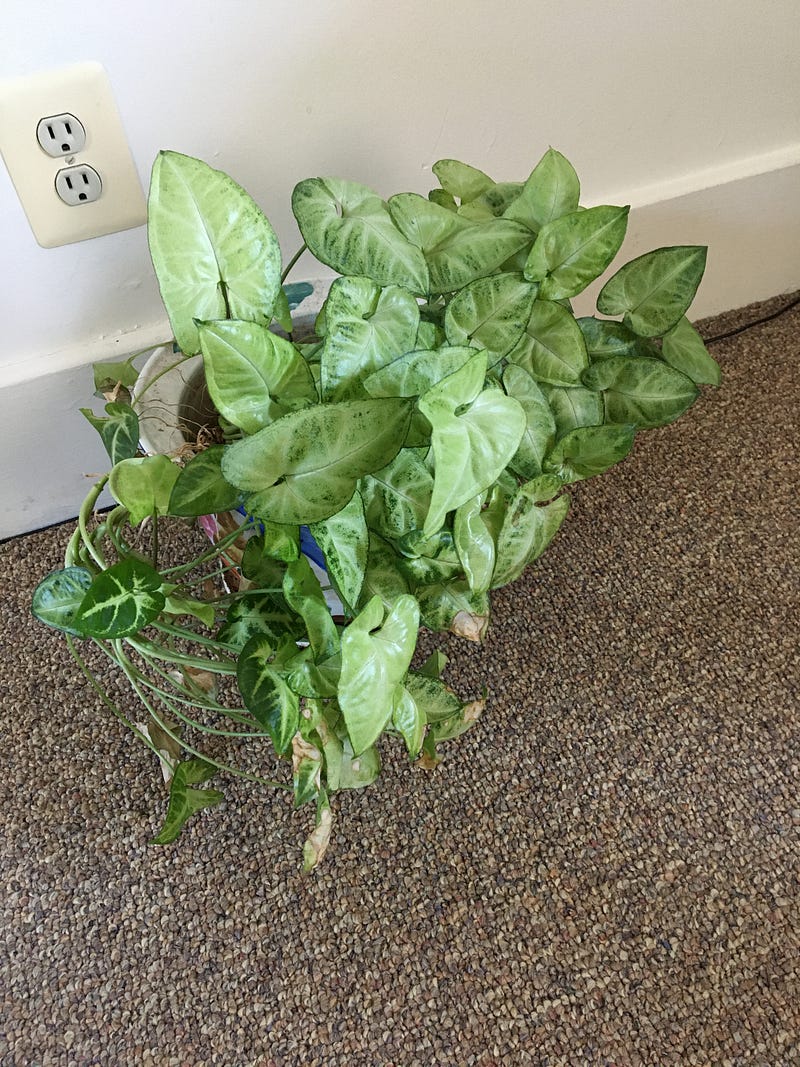
I think of these two plants whenever I think of the concept of teleos, defined as a thing’s design, meaning, purpose, or potential. All living things are programmed to fulfill their teleos and cannot rest until they do. The jade plant is living up to its teleos. It is being the best damn jade plant it can be. It’s everything that the original jade seed was programmed for when it began to grow. The philodendron: not so much. Something is standing in its way from being the best it can be.
Botanists say that it is a plant’s teleos will determine the shape and color of the leaves. All plants will grow towards the light. If you break off cuttings and put them in soil, they will grow roots; but these roots will limit in that they cannot ambulate anywhere. They are at the mercy of their circumstances and the water and sunlight available to them.
When a client decides to come to my office, they often look and feel more like the philodendron than the jade. Something is standing in the way of fulfillment. They are not living up to their potential and they feel a teleological imperative to do something about it, so that they can continue to grow.
Let me show you another picture. Someone who has never set foot in my office.

This is Cara Mund, Miss America of 2018. The Miss America judges thought she was very pretty; as beautiful, in her own way, as the jade plant in my office. Is she fulfilling her teleos, though? Is she living up to her potential? The teleos for people is different than it is for plants.
For one thing, all a plant has to do is sit there and look pretty. I guess all Miss America has to do is look pretty; so, as far as that goes, she’s fulfilling her teleos; but she’s not only the reigning Miss America: she’s human, too, and there’s a lot more to a human’s teleos than looking pretty.
Let me show you another image, a famous one this time, by Dorothea Lange.
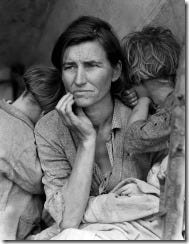
No judge at the Miss America contest would ever say that this woman was pretty. There are wrinkles and imperfections in her skin. Her hair is relatively lifeless. We can’t see her teeth, but, if we could, it would not be hard to imagine that they are bad. Her clothing is old and needs attention. Moreover, there is a general aspect of careworn worry. She does not have happy children. She is clearly not fulfilling her teleos. Or, is she?
To really understand how one is doing teleos-wise, we need to go further than to just look at images; you have to know the narrative. Let me show you what I mean with respect to the plants. Let me tell you something that’s not obvious when looking at the images I gave you.
The jade plant has a distinct advantage over the philodendron. It has a privileged position by a sunny window, while the philodendron has not been getting sun. The philodendron may be doing the best it can do with the resources given to it.
The same could be said of the woman in the Lange photograph. If you know the story behind it, you know that this woman was a migrant farm worker, living in a tent in California, a refugee from the dust bowl during the Great Depression. I think we can cut her some slack.
Let’s see if we can define a human’s teleos. A human embryo is programmed to grow two arms, two legs, a top-notch brain, and hands with opposable thumbs. It will eventually walk upright. Because a human can walk, she will move to another area if resources are lacking where she is. Because of the brain and thumbs, she will ingeniously adapt herself to every circumstance. She will care for her children longer than any other species, even when she barely has enough to care for herself.
You might even say that, just as a plant requires sunshine to fulfill its teleos, a human requires adversity to fulfill hers. She must not like it where she is, so she will move. She must encounter trouble, so she will change. She has to feel like a misfit, so she can adapt. If you look at the determination and dignity of the woman in the Lange photograph, you might say that she fulfills her teleos better, for all her trouble, than another who has enjoyed more advantages, even Miss America.


