
How About Buy Nothing November?
A refreshing change from consuming stuff from China.
Every time you buy something stamped with Made in China, you fuel their economy and not your own. I know it’s easy to buy something online; I’ve been there done that. It’s still tempting. But I don’t want to give Jeff Bezos any more of my money.
Do you remember how the communists invaded countries and inflicted their way of life on peaceful inhabitants? China might do it a little differently in that they keep to themselves. Nevertheless, they still live a communist lifestyle — a way of life distrusted by many American individuals — who believe they are free to do as they please.
The government controls businesses and citizens’ actions in China. That doesn’t sound too different from the way most countries work. However, Westerners have the right to choose how they live.
Communism is a system of government where there is collective ownership. The government collectively owns properties, businesses, and social infrastructures. In this system of government, the government shares resources to individuals based on the ability of the person. It also prohibits private ownership of property. Red Lasso
Think about your desire to buy stuff; it’s pretty powerful.
Can you believe Amazon is going to stop accepting payments by Visa because their charges are too high? That’s quite an inconvenience for customers. Do you have a Mastercard for all those Black Friday and Cyber Monday bargains you intend to buy?
I’ll bet you enjoy buying stuff online and having it appear on your doorstep 24 hours later.
The Black Friday feeding frenzy has already started. I abstain. Don’t get me wrong; I looked at that magical pot that does away with eight other pots in your kitchen. I noticed it on YouTube months ago. The marketing campaign did a great job of enticing me to their website this week and seriously considering buying the original One Pot and the One Pot you can put in the oven or use on the hob. Two pots, and you don’t need any others. Cool right?
As luck would have it, I didn’t have £180 for the reduced price set. I could have saved £85! My budget will not permit me to buy stuff I don’t need.
2020
For many, though, the temptation will be too great. And we will spend billions. According to Finances Online, Black Friday Statistics, Amazon took the largest share of online sales, 24.2%. Its closest competitor Best Buy took 7%. Last year 60.8% of shoppers planned against going to bricks and mortar shops because of overcrowding.
Only 9% look for items that are made in their country. Only 7% are looking for something sustainable. (IMI International, 2020)
According to Practical ECommerce in 2020, Salesforce reported:
Total digital sales for Cyber Week reached $270 billion globally and $60 billion in the U.S.
2021
Digital Commerce 360 predicts Cyber Monday 2021 will do better than Black Friday in terms of sales. Especially in physical shops because folks are looking forward to a day out. Oh, yes, I remember those zombie days in UK shopping malls. Ugh.
According to Mastercard, SpendingPulse forecasts retail sales will grow by over 20% on Black Friday thanks to door crasher deals where eager shoppers will queue for hours, even overnight, to grab the biggest discounts items. Seasonal window displays will help draw in buyers too.
Before you rush to buy anything online or at a shopping mall, will you consider The Story of Stuff email I received today? It prompted this article. You can read it below.
Dear Karen,
Our team at The Story of Stuff Project has been thinking a lot recently about what it means to act like a citizen, or a community member or human being, rather than a consumer. No doubt that’s because it’s that time of year when we’re pushed to flex our consumer muscles by spending a ton of money on things we don’t really need.
Maybe you’ve been asking yourself the same question: are we going to spend another holiday season buying more Stuff? Or might we say NO to a value system based on waste and overconsumption and focus instead on togetherness, sharing and hope?
In some ways, the global economy has answered that question for us.
As you’ve probably heard, we’re in the midst of a massive supply chain crisis, and everything from consumer goods like TVs and throw pillows to necessities like food and medicine are held up at ports and distribution centers for weeks, if not months. In fact, in the first half of 2021, global supply chain disruptions increased by a jaw-dropping 638%.
The coronavirus pandemic continues to teach us hard but important lessons: about the importance of public health, essential workers, social safety nets — and now, the fragility of a globalized economy dominated by multinational corporations trying to maximize profits at any cost.
While the media has been focused on the threat this poses to holiday shopping — the horror! — the real story is more complicated…and telling. Because the manufacturing and distribution of basic human necessities require many of the same resources as the consumer economy, and travel through the same shipping routes, we’re seeing priorities get all mixed up: our shopping habits are dictating which goods are allotted the limited space available on trucks and loading docks, edging out even the essential goods communities need.
It’s become all too clear that the instant gratification of online shopping and next-day delivery have steep costs, and our systems for moving Stuff around the world are not able to keep up. Costs are piling up on the other side of Stuff’s lifecycle, too: in 2021, the weight of discarded electronics will weigh more than the Great Wall of China — which just happens to be the heaviest man-made object on Earth.
The Story of Stuff pinpointed years ago that our sense of happiness and fulfillment doesn’t come from shopping. That’s a lie perpetuated by a market that gets you to spend money out of boredom, sadness, or obligation.
But it doesn’t have to be that way.
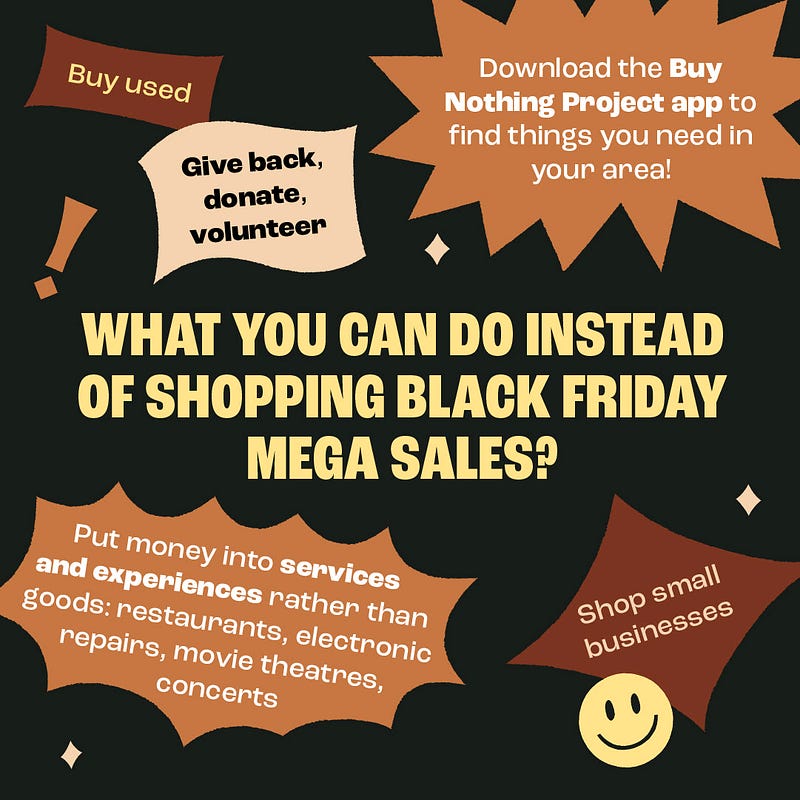
That’s why we’re expanding our annual Buy Nothing Day campaign to Buy Nothing November. Check out our campaigns on Facebook, Instagram, and Twitter and join us as we opt-out of shopping and opt-in to family, community, friends and neighbors. Write back, or leave us a comment on social media to share your favorite alternatives to shopping. We love hearing from you!
This holiday season, let’s ask ourselves how we show up in the world: are we consumers, or are we citizens?
Thankful for you,
The Story of Stuff Team
Thanks for reading.


