How a Whole Lot of Crunching and Sliding Beneath Us Turns into Fire and Rebellion
As we ride along on tectonic plates
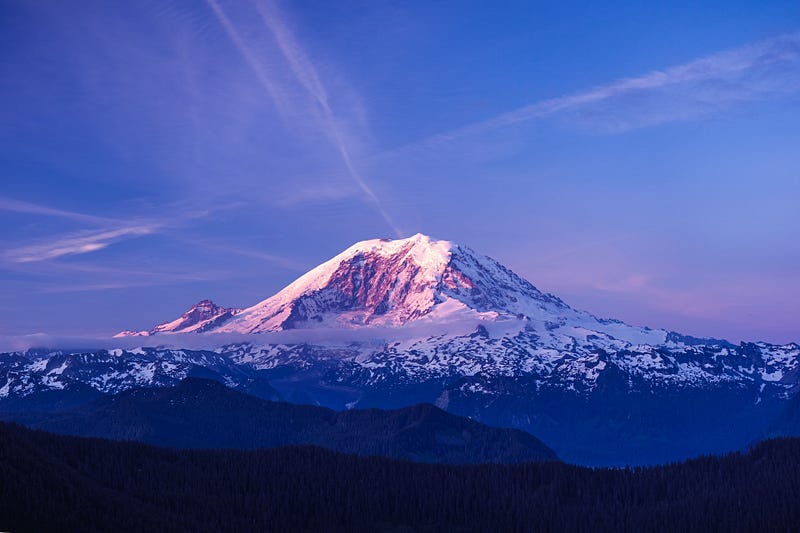
Plate tectonics brought me to Seattle. The metaphor of plate tectonics has kept me here for years. I thrive on the bipolar rhythms of geological repression and release. Polite appearances and secrets are undercut by socio-political explosions that distinguish Seattle. My history here has been both subdued and seismic. All of us who live in this city are equally intimately linked to the geomorphology of this region. We are physically impacted when the Juan de Fuca plate lurches.
But we don’t consider a violent street riot or a random act of violence as evidence of how our minds — individually and collectively linked — mirror the geology of our deeper landscape. Perhaps the emotions we suppress and pretend to forget are recycled like lithosphere, returning as fire.
Geologically speaking, Seattle sits on a hotbed of tectonic activity. Nerve lines of faults extend beneath us. Off the Puget Sound coast, one tectonic plate slowly slips — is subducted — beneath another and seems to disappear.
Instead, it changes the arrangement of its substance, pushing into the distant ghost of a volcano. On a clear day, from a distance, you can sometimes see a string of volcanoes stretching from north of Portland to the Canadian border. The layered landscape is always being scrunched and reshaped.
Dramatic motion is also evident on our surface. Seattle is a city of double lives and secrets where repression and darkness are matched with brilliant inventions and Victorian politeness and coldness.
I first encountered Seattle as a child on a rare family road trip. I remember spending time around the Space Needle and the permanent carnival at the base of that structure. I recall also being intrigued by all the curio shops at Pike Place Market.
Seattle revisited my life twenty years later in a church converted into a cinema in Santa Barbara. I was there with my husband, who was working on his Ph.D. in plate tectonics. We watched a documentary film, Streetwise, about homeless kids in Seattle with photographs by Mary Ellen Mark. Watching Streetwise, I sensed I would encounter those kids one day.
Two years passed. The University of Washington recruited my husband to be an associate professor of geophysics. We arrived in our new city in October 1987, on Black Tuesday, the day the stock market tanked.
I tried my hardest to be an ideal yuppie housewife. It wasn’t in the stars or the geophysics of destiny.
My husband left Seattle to go on a research excursion, mapping the seafloor off the coast of Ecuador. I remembered Street Wise and went to volunteer at a homeless youth center — The Orion Center. A few kids featured in the film still hung around, working on their GEDs. I was amazed by how emotionally direct and brutally honest the kids were. It was like being in a room with my raw, hidden emotions embodied and swearing in my face. Street kids seemed like hot spots, openings for liquid flames to burn through the polite Seattle surface.
One day, I was playing pool at the Orion Center with a young female. She was dressed-like and had the demeanor of James Dean. She intimidated me. It was my turn to play. As I bent down over the table, aiming for a solid ball, she leaned on her pool cue and said, “You know you’re a dyke, right?”
I missed my shot. “I’m married,” I snapped back.
“Whatever you say, Mrs. Dyke,” she said. She sank two stripes and took the game.
Her words set in motion the subterranean mechanics that cracked my façade and everything I was repressing — my homosexuality, my childhood shadows, and an array of intense emotions pushing up from the deep. I moved to San Francisco, where my former housewife self became the new secret.
My ex-husband had moved to Texas by the time I returned to Seattle to continue working with street kids and exploring the geo-tectonics of unspoken things.
For years, I was obsessed with how the city’s calm façade was broken by brilliant inventions and bursts of suppressed anger. Seattle had a history and rhythm of expansion and contractions.
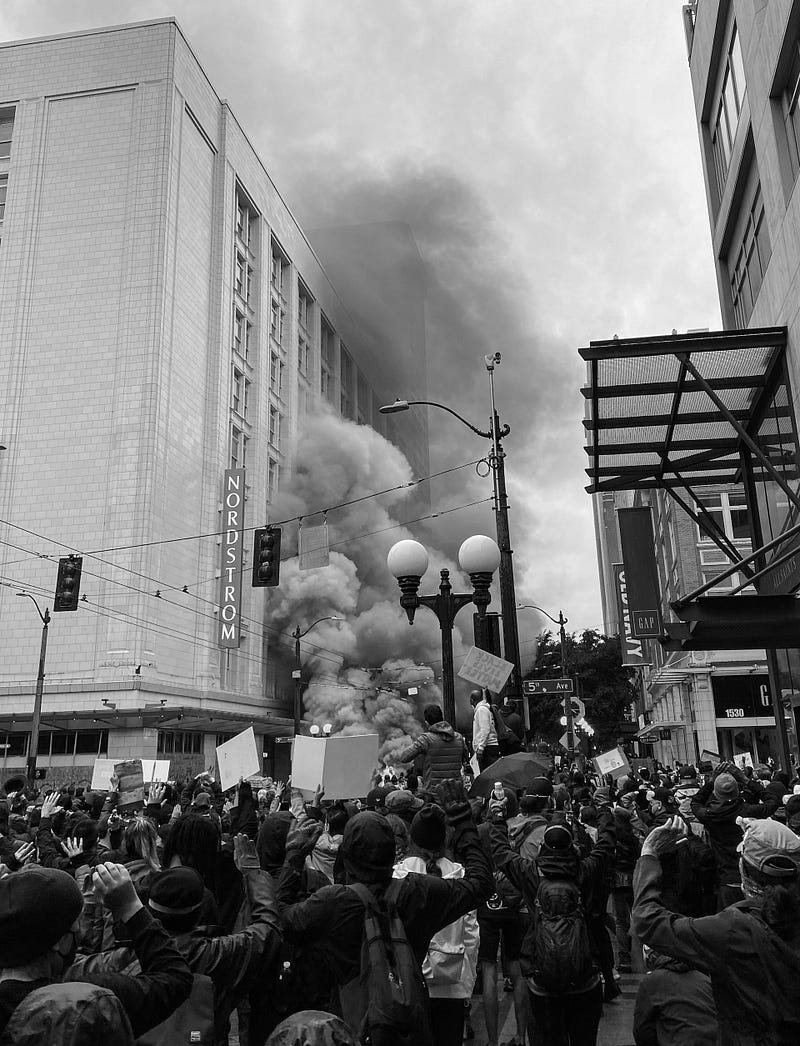
The city was called the Soviet of the West in the 1930s when radical labor leaned toward communism. In the ‘60s, there were frequent anti-war demonstrations. In the late ‘90s, WTO protests revealed more fractures in Seattle’s politics and history. On the eve of Seattle’s Nisqually Earthquake in 2001, there were riots in Pioneer Square. The riots were sparked by public anger regarding Seattle’s ongoing class wars.
In 2020, young Seattle activists tried to create a camp and a community across from the police station, eventually occupying the police station. One of the group’s main goals was to diminish police funding so more money could be focused on communities, outreach, and resources. There were big demonstrations downtown and throughout neighborhoods for the Black Lives Matter movement.
What we ignore and repress returns to haunt and undo us.
Thanks to Maryan Pelland and Andrew Rodwin for catching all the details.