
How a stick accurately measured the circumference of the Earth!
The earliest proof of a curved Earth
It is rightly said that to make big discoveries all you need is imagination and a curious mind. What happened around 245 BCE, Egypt, advocates this saying. It was during this time, that a Greek man named Eratosthenes successfully proved that the Earth is round and even went on to measure the circumference of the Earth with the help of just a stick!
Eratosthenes was an astronomer, historian, geographer, philosopher, poet, theatre critic, and a mathematician who lived in the Egyptian city of Alexandria, the then greatest city on Earth. He was also the director of the great library of Alexandria, a place which is considered to be the first-ever research institute in the history of the world. He once stumbled on a papyrus book which mentioned that on June 21, vertical sticks cast no shadows in Syene(city south to Alexandria). On this longest day of the year, as it reached midday, the shadows of temple columns grew shorter and at noon, were all gone. You could see the reflection of the Sun in the water at the bottom of a deep well as the sun was directly overhead.
Now this kind of information seems to be very trivial and would have been completely ignored by someone else. But Eratosthenes decided to conduct an experiment. He checked whether a stick in Alexandria (north of Syene) cast any shadow on June 21 at noon. Surprisingly for Eratosthenes, it did!
This got him wondering. Why was it, that a stick in Syene at noon on June 21 cast no shadow, but a stick in Alexandria (north to Syene), at the same time, cast a shadow? Let’s try to visualize this in the next section.
Proof of a curved Earth
If the Earth was flat, which was the idea predominant during that time, and considering the fact that sun rays are parallel when they reach Earth, both the sticks at Alexandria and Syene would cast either equal or no shadow at a particular point of time.
But Eratosthenes observed that a stick in Syene at 21 June noon did not cast a shadow but at the same time a stick in Alexandria did. This could mean just one thing.
The surface of the Earth is curved.
Measuring the size of the Earth
The Greeks before Eratosthenes had divided the circle in degrees and measured angle. He applied this knowledge with what he had discovered to measure the circumference of the Earth.
He first measured the angle of the sun's rays off the stick by dividing the length of shadow by the height of the stick. It came out to be roughly 7.2⁰.
Eratosthenes also knew that the distance between the two cities was approximately 5,000 stadia (unit of measure used in Egypt then), or about 800 kilometers (500 miles). How did he measure it? Guess what, he actually hired a man to pace it out!
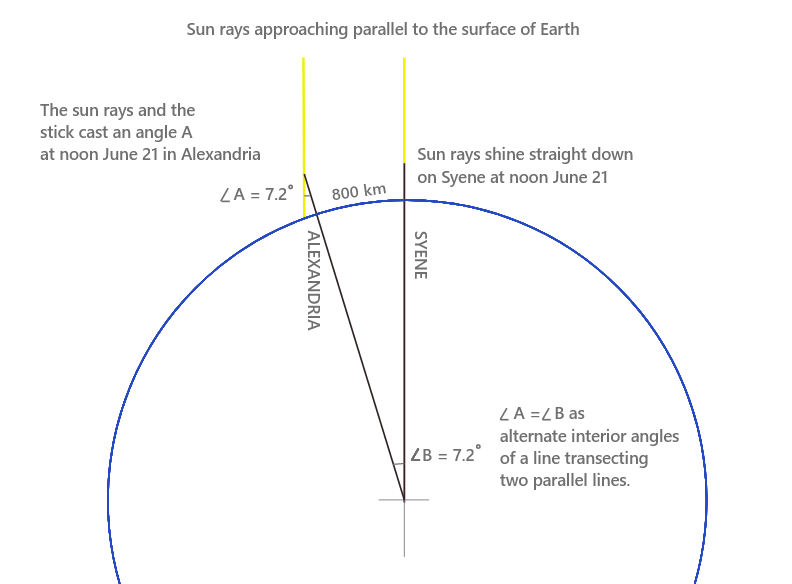
Eratosthenes was aware that the circumference of the Earth constituted a circle of 360⁰. That means that 7.2⁰ would be around 1/50th of the total circumference. And because he knew the distance between Alexandria and Syene, he came up with the following equations.
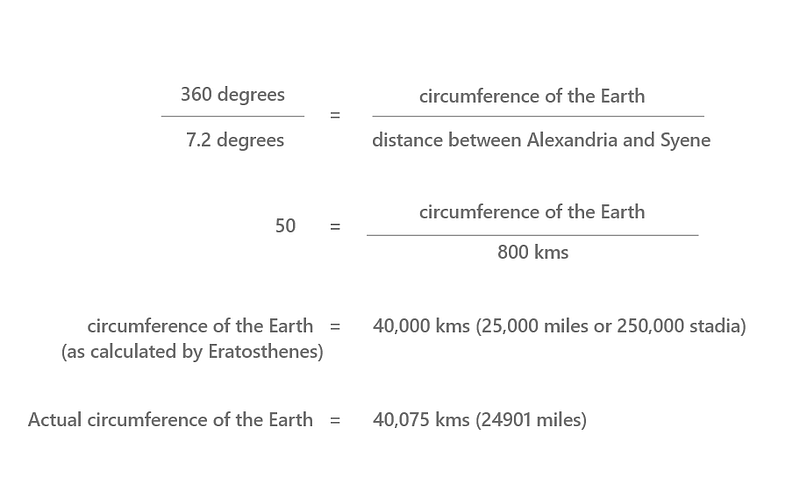
This shows that Eratosthenes was only 2 percent off from the actual circumference of the Earth! A remarkable achievement for 2,250 years ago. And what makes it even more remarkable is that the only tools used by Eratosthenes were a stick, a logical mind, and a taste for experiment.
This shows that Eratosthenes was only 2 percent off from the actual circumference of the Earth! A remarkable achievement for 2,250 years ago.
Thank you for reading!
If you wish to read more of such stories, feel free to follow and stay updated.
I also write about core topics related to Machine Learning/Artificial Intelligence!


