
TRAVEL.SWITZERLAND #HOMETOWNTOURIST
How a Small Swiss Town Became a Street Art Hot Spot
Take a walk through Le Locle and discover exciting new art
Quick — which cities do you think of when urban arts are mentioned? For me, the first ones to come to mind are Paris, London, New York, Berlin, Athens, and Barcelona. These places are known to show highly innovative and engaging graffiti and murals from both new and internationally known artists.
Now, I can add Le Locle, a small town in the Swiss Jura region close to the French border, to my list. Granted, Le Locle is not just any small town but the home of renowned luxury watch-brands such as Tissot and Montblanc. The contrast between the elitist heritage of the town and the provocative street art makes it all the more interesting.
The open-air street art museum is accessible to anyone. It is the brainchild of Sylvie and François Balmer who developed the “Open Sky Museum — ExoMuseum” concept. In the past two years, the two founders of the “Luxor Factory” have worked with internally renowned artists such as MonkeyBird, Nasty, James Colomina, Lunar, NesPoon, Ardif, and M.Chat, to name a few, on exciting new art on the previously empty walls of buildings and structures in town.
The project is ongoing but has slowed down somewhat due to Covid-19. Still, there is more exciting art to come in the next months until 2024, when Le Locle will have up to 50 works of street art.
While traditional museums have been closed for a good part of the year, the permanent “open-air” art exhibition in Le Locle is a perfect way to get your cultural fix if you visit or — like me — live in Switzerland as see Le Locle’s street art as a #hometowntourist.
If you are feeling adventurous, you can walk through town and discover the graffiti and murals by yourself in unexpected places, say on a wall in a small alleyway. But if you want to make sure you don’t miss a painting by your favorite street artist, you can follow a map provided on the Luxor Factory website.
Le Locle is a UNESCO World Heritage Site, together with the neighboring La Chaux-de-Fonds, and the walk through the Exomuseum takes 1–2 hours.
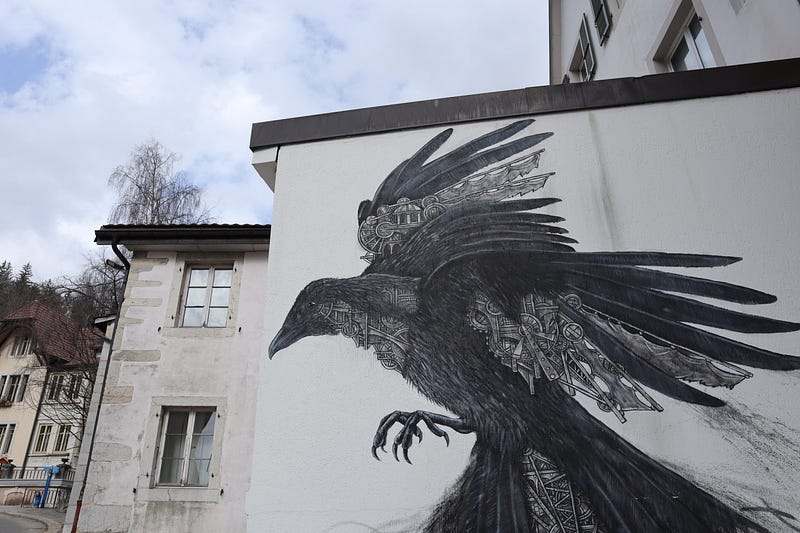
I was most impressed by the variety of styles and concepts you can find on the walls and in the streets of Le Locle. One of my favorite street artists, if I had to choose, is Ardif. The French artist explores the hybridization between machines and nature.
In Le Locle, he shows a raven that is part bird and part machine, contrasting scales, styles, and textures. The image invites reflections about the mechanization of nature and the natural spirit that exists despite the human efforts to tame and control it.
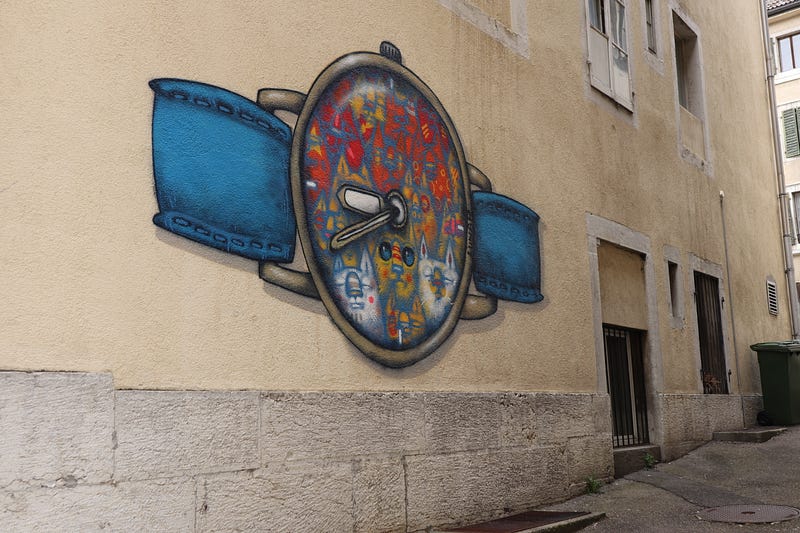
Lunar (Slaven Kosanovic) is a well-known street artist whose work in Le Locle references the city’s watch-making heritage. His “Doom Watch” is set to five minutes before midnight and left me with a feeling of an impending catastrophe and a surreal worldview.
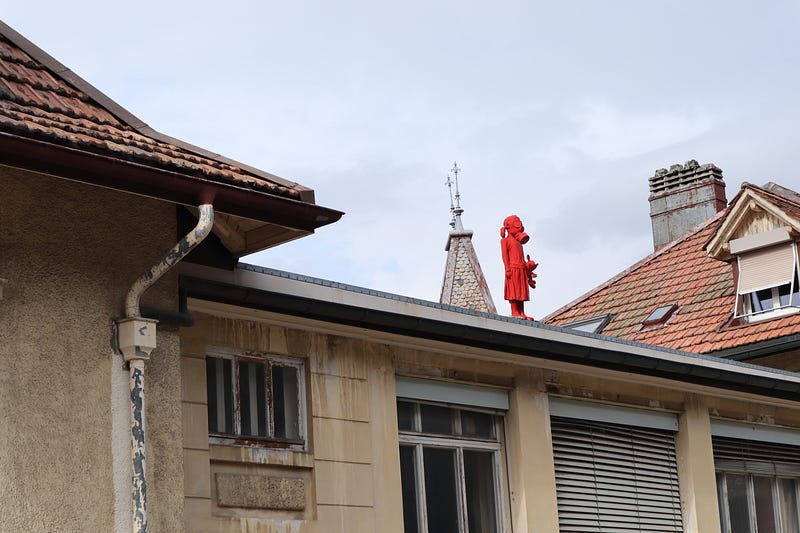
I found James Colomina’s sculptures equally intriguing and disturbing. The red sculptures on roofs and balconies show children wearing gas masks. The French artist’s sculptures that are usually seen in public places or renowned galleries in Paris are always political and point to social ills such as the treatment of minorities, the homeless, and the voiceless. Here in Le Locle, the red silhouettes are evocative of the next generation’s suffering from air pollution and environmental destruction.
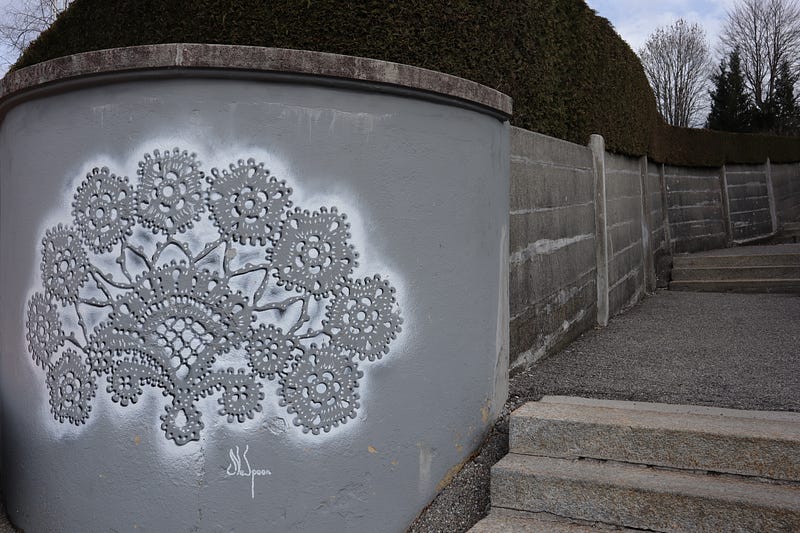
Very different in style are NeSpoon’s creations. The Polish artist incorporates the intricate structures of lace in her work. Her murals are a perfect fit for Le Locle, a town that looks back at a rich history of lace making. In 1766, Le Locle had around 3000 inhabitants and more than 750 lacemakers.
NeSpoon said in an interview with a French-language newspaper that her work is also a way to pay tribute to the women who worked in lace manufactures.
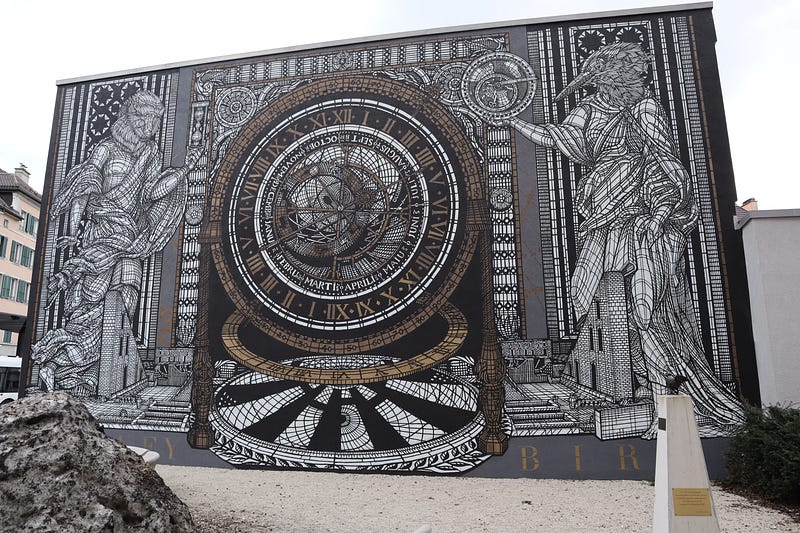
Intricate patterns and mind-blowing precision are the hallmarks of MonkeyBird’s work. The duo is formed by two artists from Bordeaux, Tremor and Blow the Bird. Their eye-catching mural is also evocative of the watch-making theme that is so present in Le Locle. It is inspired by geometry, mechanics, astronomy, and nature.
The work contrasts man-made structures and mythical creatures that are part human, part animal. The more I look at it, the more it draws me in. Even though a watch is featured prominently in the mural, it is easy to forget time and enter a dream-like state when contemplating it.
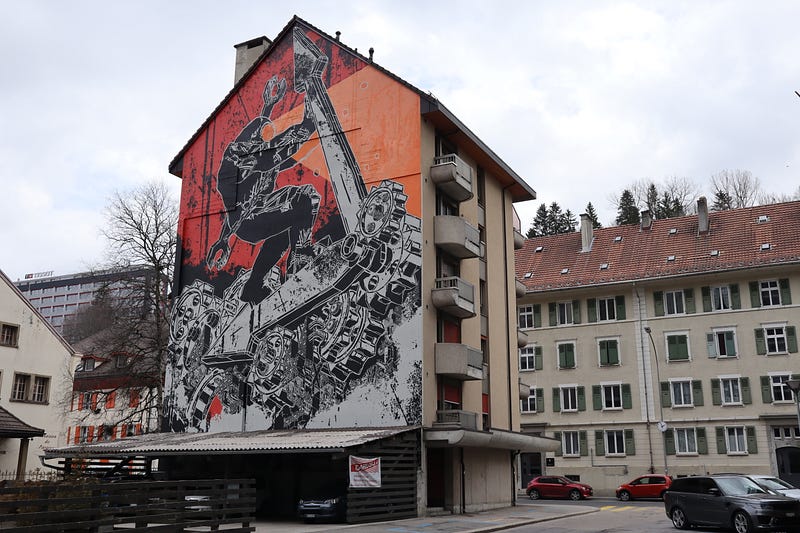
The stark geometric style and sparing use of colors are prominent features of Mariusz Waras, alias M-City’s, work in Le Locle. The murals with the industrial look seem to comment on themes like modern-day slavery, the pitfalls of human-machine relationships, and the exploitation of human labor.
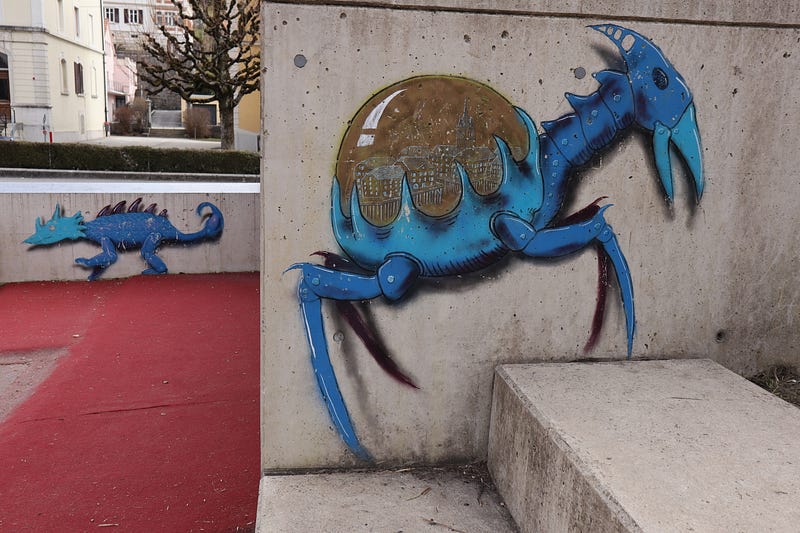
Hidden in a small square in Le Locle are the magical creatures by Codex Urbanus. Codex Urbanus is a street artist who has been painting mythical creatures on the walls of Paris since 2011.
Now, his work is not only seen in and around Montmartre but also in top street art galleries and museums. His magical animals are inspired by medieval texts, the Dutch 15th-century painter Hieronymus Bosch and French cartoon artists.
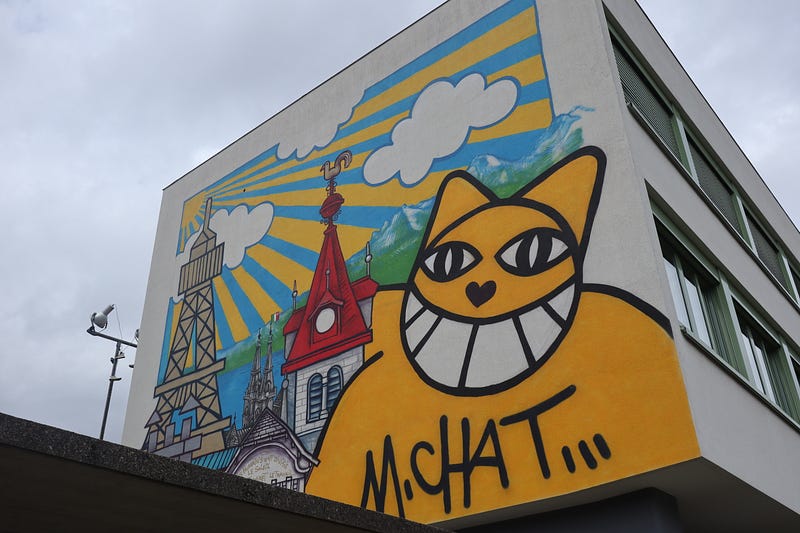
For Thoma Vuille, the artist known as M.Chat, painting the walls of a schoolhouse in Le Locle was almost a home match. The Swiss-French artist was born in Boudry, in the canton of Neuchâtel, about a 30-minute drive from Le Locle.
He has been painting his famous smiling yellow cat character since the late 1990s, first in Orleans and later in cities like Tours, Nantes, Saint-Étienne, Paris, London, Vienna, Geneva, and New York. His feline character often reminds me of Lewis Carroll’s grinning Cheshire Cat in Alice in Wonderland.
After looking at such a great collection of urban art, I was inspired but also a little tired. Since all the coffee places were closed, I went to the nearby hills for a walk in the forest and to reflect on the many associations and images that formed in my mind while I was looking at the street art.
I am curious to see the work by the artists that will be in Le Locle in the coming years when I will visit again as a #hometowntourist.

Sign up for our newsletter to stay informed with up-to-date curations from our editors:👇
We now offer exclusive writing services for our members. Discover how you can take advantage of our editing services and more.


