
THE NARRATIVE ARC
How a Small Local Bookshop Grew Into the Largest Bookstore in Kyiv
Despite the ongoing war, Ukrainian culture finds and founds new senses
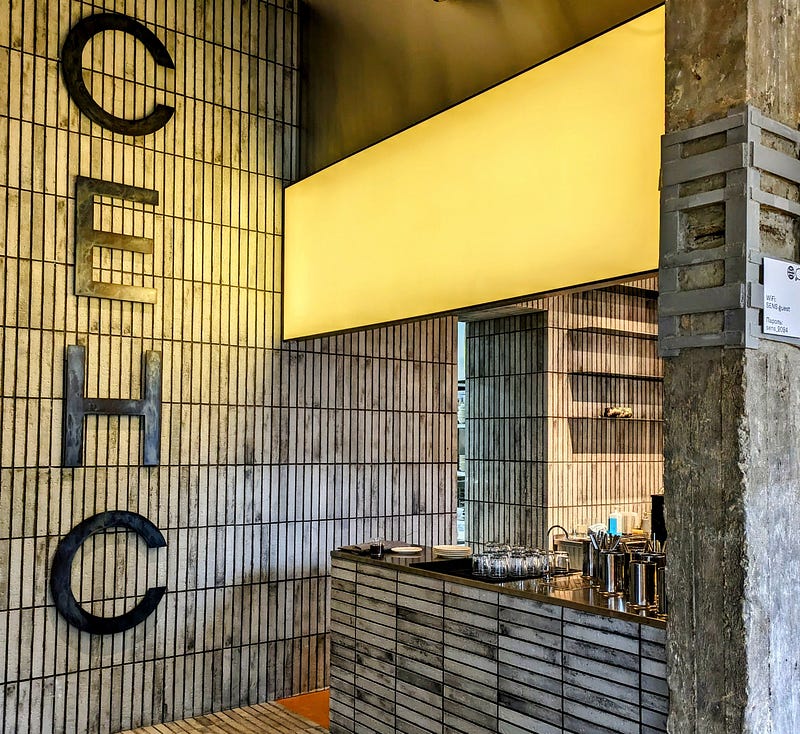
What am I doing?
I’m reading Book Lovers by Emily Henry.
Where am I?
I’m right in the centre of Ukraine’s capital. I’m on Khreshchatyk, the main street in Kyiv. I’m in a new bookstore Sens: it has just opened and it has been flooded with waves of book-hungry visitors.
I came to eat some pages, too.
While getting here, I got bombarded by a light hail of tiny and a bit feisty grains of ice falling from the sky onto my head. It was an unusual incident: in Ukraine, we’re used to other kinds of bombardment. The weather has been getting weird lately with heavy fog meeting us in the morning and leading us to bed at night. The rest of February is expected to be unusually warm. Is it an early spring? I’m not a meteorologist but I wouldn’t mind warming up.
An early spring is inspiring. What can be even more inspiring than that? Books and bookstores, especially when they defy odds and expectations.
A while ago, I was listening to Oksana Zabuzhko — a prominent Ukrainian novelist, publicist, and poet — giving an interview to someone on YouTube. I remember them talking about the state of the book market in Ukraine after the collapse of the Soviet Union. Specifically how decades of language suppression affected local authors and their work. At one point, Zabuzhko mentioned that when she published her famous novel, Field Work in Ukrainian Sex in 1996, it was much easier to find the book in Russian translation in bookstores than in the original language.
I want to repeat that.
In Ukraine, it was easier to find a Russian translation of a book originally written in Ukrainian. Russia at that time practically occupied the Ukrainian book market. The same thing was true for other industries, both in culture and in business. I watched the interview when we were deep into the war — many horrible atrocities had already happened and nothing should have felt surprising — but this information still felt maddening to me. I wondered how deep the roots go and how much I still don’t know.
Now, almost thirty years later, nothing is the same. You can hardly find Russian books anywhere and shelves are bending under the weight and quantity of Ukrainian books: big and small, classic and contemporary, fiction and non-fiction, local and foreign, highly intellectual and wildly-entertaining. The publishing industry is booming, too, with new titles constantly being released and distributed throughout the country.
Every big story has individual characters who move it forward to achieve great things.
Sens is one of those heroic characters.
With a breathtaking, three-storey bookstore opening here — on Khreshchatyk— it feels like Ukrainian culture has taken one more leap towards independence and away from Russian oppression.
Before Sens grew large, however, it was born small and local.
Two years ago — and two months before Russia began its full-scale invasion of Ukraine — a small bookshop opened not far away from Kyiv-Pechersk Lavra. At that time, my boyfriend and I lived in a neighbouring area. On one of our regular walks around the Park of Eternal Glory, we noticed a new space getting ready to meet the world. We, of course, couldn’t get inside yet so we just briefly contemplated it in a half-ready state from afar. Then the war happened and the life of familiar senses was lost.
In early summer, we moved to a flat near the bookshop. I began to go there often. The place was called Sens and was very much alive and thriving despite the circumstances. When the war began, the bookshop had turned into a volunteering headquarters for a local organization called “Kitty Pechersk”. Later, when the situation became less critical, Sens returned to its main passion: selling books and cappuccinos.
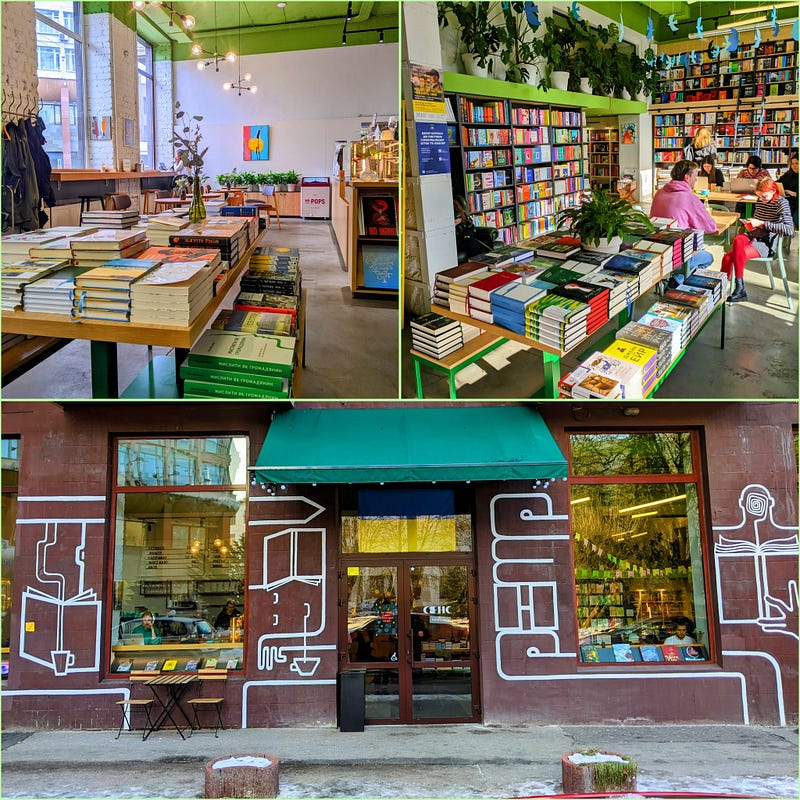
This, of course, is an understatement.
The story would be different if Sens just sold books and brewed coffee for its visitors.
In times when so many things were on the decline or dying, Sens was getting only bigger and bigger. In collaboration with a literary scholar Anastasia Evdokymova, the bookstore launched a YouTube channel and a series of interviews with Ukrainian writers and other notable people of the Ukrainian literary scene. They began hosting events, lectures, and a book club. In the winter of 2022, when Russia attacked Ukrainian infrastructure and left many people with no light at home, Sens — like many other public places — was our lighthouse. We would sail through the dark waters of hopeless days to work, eat, and hide there.
Sens has become a place of enlightenment in all the ordinary and wondrous meanings of the word. Hence, it only made sense for Sens to expand further and spread the light beyond its neighbourhood.
And it did, magnificently so, it did
Welcome to Sens
The new place looks as monumental as Khreshchatyk Street itself. I enter through big glass doors. I see huge, archesque windows around me. They overlook the busy metro station and the neo-classical Stalinist-style building of Kyiv City Council. Shelves are high. The ceiling is even higher. A high ego is better left at the entrance. It’s unbecoming to carry it with you to such a place. It’s all about books, and books here are everything everywhere all at once.
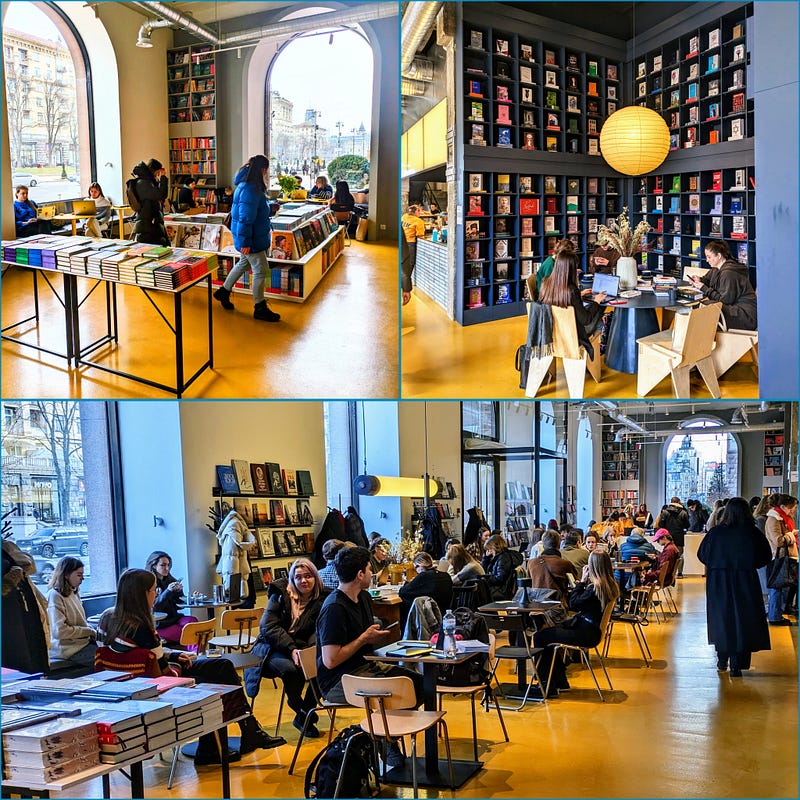
I go to the bar. I order an americano and a sweet nut with condensed milk. I look for a free spot to land all of me. I see how people work, drink, eat, and read in a sitting area scattered across the first floor. The flooring here is painted in the yellow colour of the Ukrainian flag. In one corner, that yellow meets the blue colour of a huge bookshelf. Patriotic, simple, and fresh.
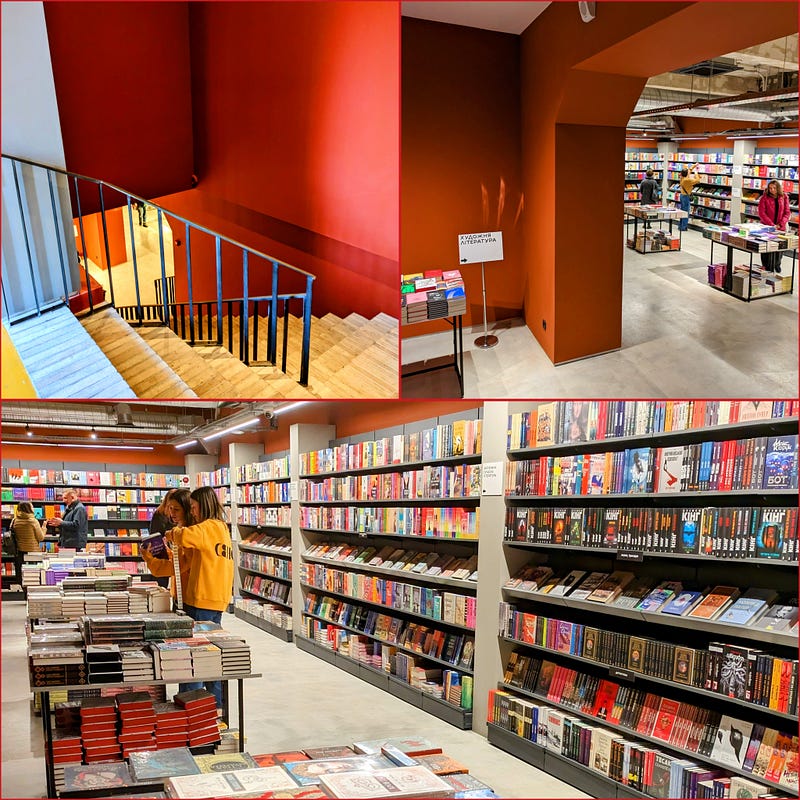
I sit for a bit. A bit is the exact length of time an anxious person can sit without moving. Guess who’s anxious? I want to go for a stroll. I stand up. I move, gracefully. I reach the stairs to the ground floor. I go down. The ground floor is where most of the books stand and wait to be taken home. It’s painted in a rich, deep crimson colour. I see there’s a section with English books. Do I need to buy another book to add to the pile of those I don’t have time to read? I always do but maybe not today.
The second floor is reserved for events and exhibitions. On the opening evening — which I of course attended because I’m that obsessed with new places in Kyiv — one of the most popular Ukrainian writers Serhiy Zhadan played a concert with his band Zhadan i Sobaky there. It was busy. It was fun. It was a party.
I always judge an establishment by its toilet. In Sens, the toilet is quite wonderful. It has several booths to accommodate the needs of many visitors. There’s a mirror, too. You can take excellent selfies with a deep khaki-coloured background so be ready and wear a green sweater on the day you go to visit the place. As I do.
The virtual tour is over.
I hope the war will end soon and you will be able to see it in real life.
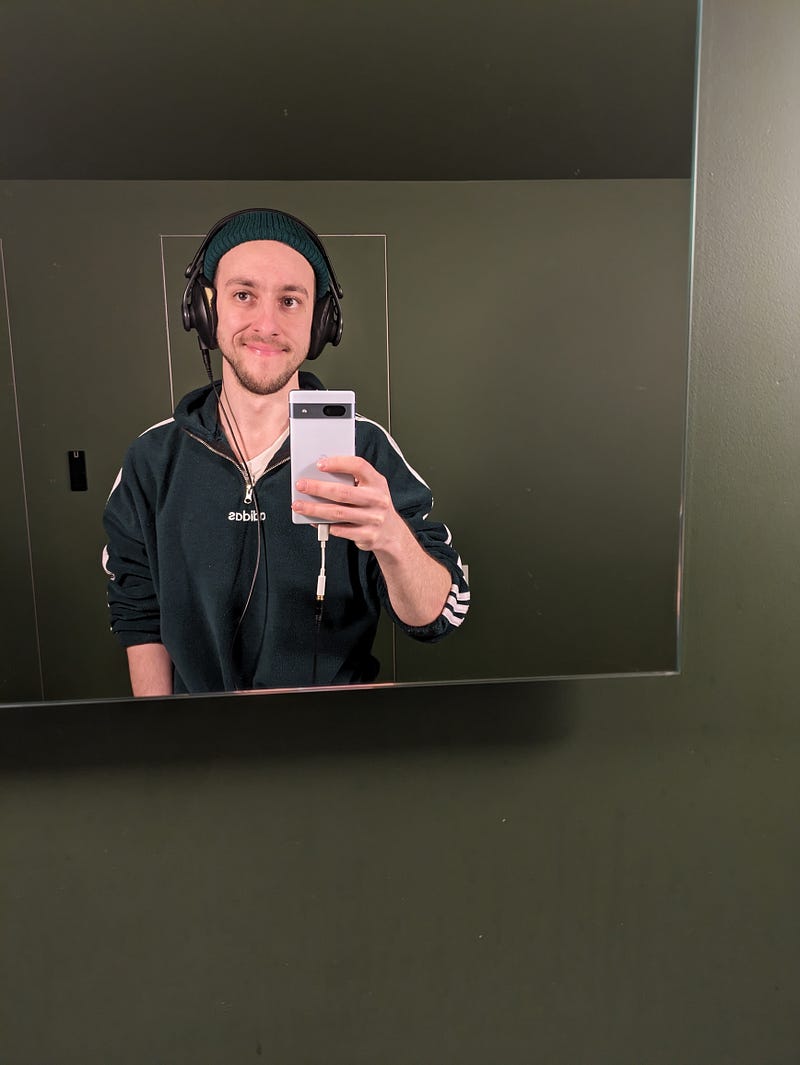
At this point, I’ve been coming to Sens almost every day as some kind of literary freak. There’s something creepy about my obsession. Perhaps, it stems from a kind of sentimentality and want for something uplifting, inspiring, and hopeful. This modern literary temple is that. It’s also one more non-lethal weapon in our collective fight against darkness and ignorance. It doesn’t kill. Vice versa, if anything, it inspires us to live and create a world that’s kind, thoughtful, and just.
War is so much about death and destruction it makes it painfully hard to celebrate life. I, as I’m sure many people around me, feel guilty for occasionally feasting in times of plague. I just finished lunch made of two fried eggs, beetroot humous, roasted chicken, and a side salad. I had two cups of energizing filtered coffee today. I’m about to finish my job and read a book.
Aren’t those pretty normal things to do for a modern human being? Today we live in an extraordinary, fucked up reality where eating, drinking, and reading feel like shameful acts of hedonism and privilege.
We shouldn’t feel that way!
By living a civil life and creating new things, we continue to break the lies that the aggressor spreads about us.
By opening this bookstore in the very centre of the Ukrainian capital, we share our truths with the world at large.
Here are our truths
This nation isn’t dying, it’s thriving.
This nation is more than its territory, it’s people, culture, food, books, movies, songs, art and everything else a nation is supposed to do.
This nation is not peasants who live on the edge of an empire, it’s resilient and highly intelligent people who live in their home, in their kray, in their krayina.
This nation speaks not a dialect of some other language, it speaks, writes and thinks in a beautiful mova that gave birth to thousands of literary works written by Taras Shevchenko, Ivan Franko, Lesya Ukrainka, Olha Kobylianska, Mykhailo Kotsiubynsky, Marko Vovchok, Lina Kostenko, Serhiy Zhadan, Oksana Zabuzhko, Maria Matios, Ihor Pavlyuk and many many others.
And, yes, while many of our people are giving their lives on the front line to protect our right to exist right now, we here are writing books and opening bookstores to secure that right forever and let no tsar steal it from us.
For you can’t steal something that's eternally engraved in the minds of people, both here and around the world.
Everyone knows we exist and everyone knows we are not you (you know who).