
How A Safari in Kenya Changed Me
I’m grateful. But haunted by questions
The day before I left on a long-planned, dream trip to Kenya, a blogger friend sent me a bon voyage message. In part, it read:
Let it change you.
Indeed it has, in ways I’m still discovering.
A wildlife enthusiast my whole life, a former docent who once led tours at the Los Angeles Zoo, I’d dreamed for decades of seeing the astounding animals of East Africa — especially the large mammals — in their own habitat instead of in captivity.
Now, after two weeks of visiting four major Kenyan game reserves and two of its lakes, traveling in between on roads that ranged from truck-clogged single-lane highways winding through mountains to bone-rattling jeep tracks (“the African massage,” our driver said), I am still processing all that I saw and experienced.
It’s not easy to put into words
Most of the animals I saw on safari are ones I’ve seen in zoos: elephants; the big cats (lions, cheetahs, leopards); antelope and gazelles (impala, Thompson’s gazelles, waterbucks, eland, topi); Cape buffalo; and troupes of baboons, vervet monkeys, and the spectacular colobus with their black coats festooned with long, white fringe.
I beheld ostriches, herds of wildebeests, and so, so many zebras. Tiny dik-diks darted through the brush while doe-eyed gerenuks stood upright on their slender hind legs to reach the tops of their favorite bushes.
Giraffes wrapped long, black tongues around acacia branches, stripping off tender leaves while somehow avoiding ferocious thorns. Hippos bobbed in the shallows or sunned on riverbanks in huge, communal piles of flesh — unbothered by the presence of enormous Nile crocodiles who waited with prehistoric patience for a zebra or wildebeest to cross their path.
Warthogs, innately humorous, strutted with their tails held high or kneeled on their front legs to root in mud wallows.
A mother zebra stood guard over her unmoving, stillborn foal, its stripes visible through the amniotic sac that had failed to break. Nearby hyenas trotted back and forth, looking sinister as only hyenas can, waiting for the right moment.
It was nothing like visiting a zoo
Not at all. I wanted to pinch myself. My traveling companions and I kept looking at one another, our eyes wide, saying things like, “Did that just happen?” or, “Are we really doing this?”
The sheer scope of the landscape is hard to convey. We traveled through forested mountains, verdant valleys, dry scrubland where every struggling tree or bush was armed with murderous-looking thorns or stickers, and the vast, rolling grasslands of the Masai Mara.
In each landscape, we were the aliens. Most of the animals are used to the presence of vehicles, especially the safari Land Cruisers outfitted with sturdy springs, sturdier tires, and pop-up tops (“Toyota migration,” our guide said when such vehicles converged on a sighting of a leopard).
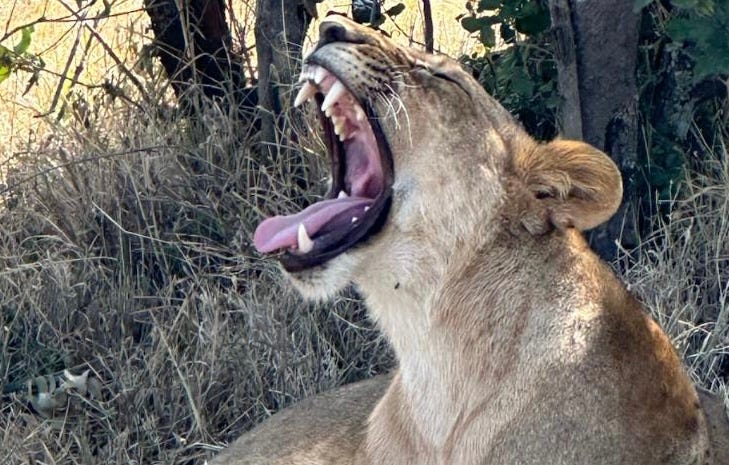
As long as the humans stay inside the vehicles, the animals go on about their lives as they have for millennia. More than once, a lion walked within six feet of our car, though our driver was careful never to crowd an animal and kept a particularly respectful distance from elephants.
You don’t see anyone harassing the wildlife like some of the stupider tourists in Yellowstone are known to do. It’s not tolerated by the rangers and guides, for one thing.
And seeing, up close, just how large a lion’s teeth and paws are, is a powerful antidote to human arrogance. Which forms the basis of one of my takeaways:
Humans are puny
I knew that before, in a way. We don’t have big teeth or sharp claws. No horns, hooves, or even tough hides, and we’re slower than just about anything that might want to eat us.
But being close to those animals — and seeing how Nature operates with such merciless efficiency — brings home how astounding it is that humans survived to become the most dominant, if troublesome, of Earth’s species.
All we had to work with were our opposable thumbs and largeish brains. I’m sure there were many times in our early development where the survival of homo sapiens was touch and go.
I’d thought I respected Nature
But not until going to Kenya did I realize how much I’d romanticized the natural world nor how inadequate my notions about it were. An appreciation for the circle of life and the balance of nature, a love of the outdoors — those are lovely, but they fall short of the awe that is Mother Nature’s due.
Her system, left to its own, is perfect. All the animals we saw, the live ones, anyway, were sleek and in robust health. They were in harmony with their surroundings, ideally adapted to their environments — which are pristine when undisturbed by humans.
Except for a few sun-bleached bones, there is no trash on the savannah.
Nor is there illness or injury, at least not for long. A man I met on the flight home showed me a photo he’d taken of a Nile croc closing its jaws on a zebra in the Mara River. The zebra, after a monumental struggle, had managed to survive, he said. Bloodied, it escaped the crocodile and struggled up the opposite bank — where a lioness was waiting for it.
I knew intellectually that Nature is ruthless. But now I get it. Peeping out from the insulation that usually shields me from the natural world was both a privilege and an awakening.
I’m still a nature-lover, even more so now. But that love is freighted with less sentimentality and more reverence, properly tinged with fear.
The wilderness is not where humans thrive
We can venture into it — a few of us can spend years in it, and there are still some cultures that can live in harmony with it — but it’s not where the vast majority of us belong. Obviously, or it wouldn’t be the wilderness.
But if untamed Nature is not our proper home, where do we belong?
Kenya is a developing country. Once outside the game parks and reserves, trash is everywhere, despite the national ban on plastic bags. With no waste management services in most of the villages and smaller towns, garbage is burned or simply left to molder. “Makes me sick,” said our Masai driver every time we passed a pile of refuse.
Considering the challenges faced by the residents of those villages and towns — unpaved roads that turn to mires in the rainy season, a lack of clean water, and often no electricity — it’s understandable that trash collection isn’t top of the list of concerns.
We saw little actual homelessness, but plenty of heart-rending poverty. Outside of Samburu National Reserve, villagers live in oval-shaped, windowless, corrugated tin dwellings, thatched with rags, newspapers, and bits of plastic. Women walk for miles to fetch water, backs bowed under five-gallon plastic containers strapped to their foreheads.
In the towns, market stalls constructed from sticks and tarps line the roads, some displaying colorful fruit and stacks of potatoes and onions while others are piled with used clothing and shoes.
And everywhere, as we bounced past in our Land Cruiser, children, all of them beautiful, grinned and waved excitedly at us.
We smiled and waved back, and in some places, we handed out colored pencils to eager kids who collected around our vehicle (we’d been told not to give out sweets).
At the lodges and camps where we stayed, where the service was unfailingly attentive and kind, we tipped lavishly.
It was impossible not to feel like a colonist.
The family members I traveled with and I agreed that this year we’d divert our holiday gift money to helping fund a well project or a health clinic in Kenya.
Whatever we do, it won’t feel like enough.
“Conditions of absurd luxury”
This phrase echoed in my mind as we rested at night in comfortable lodges and glamping camps, enjoying abundant meals and hot showers.
It’s one I remember from Alexander McCall Smith’s charming mystery series set in Botswana, №1 Ladies Detective Agency. In one of the books, the main character, Mma Ramotswe, describes attending a theater showing American movies. She observes, off-handedly, that the characters live “in conditions of absurd luxury.”
Now that I’m home, back in my middle-class neighborhood, I am acutely aware that I dwell in conditions of absurd luxury. So does everyone I know. Many of us have so much stuff we need storage units to contain what doesn’t fit in our closets and garages.
And still, we are anxious.
Children here do not wave excitedly at passing vehicles unless they’re selling ice cream. As adults, we generally only register the miracle of electricity and running water when we’re annoyed by a shutoff. We’re too busy keeping up with what it takes to have all these things to notice that we’re surrounded by marvels.
Post-safari, I am left in awe, and with questions
The natural world is full of wonders. Nothing is more improbable than an ostrich, more remarkable than a giraffe, or more entrancing than watching half-grown lion cubs wake up and wrestle with their siblings.
Nothing is more monstrous than a full-grown Nile croc.
Nothing is more serene than watching the brief equatorial sunset turn the grasses of the Masai Mara into a deep gold.
And nothing is more disturbing than seeing a young boy dredging water from a muddy hole, or a child covered with mosquito bites in a region rife with malaria.
And so, the questions.
In a world where so many people do not have enough while others have far too much, what do we really need? What are the requirements for a decent, happy human life?
Does that depend on our culture or the socioeconomic norms of where we live? Should it?
As humans, we create wonders of our own. Airplanes, movies, and cities. Art, literature, and music. We split atoms and explore space. We have even begun to explore our own brains.
Why can’t we ensure that every member of our human family is provided with the basics? Clean water and food, safe and comfortable dwellings, and a chance to reach our potential?
Nature does as much for her creatures. Her system is perfect. But it’s merciless. We humans don’t accept its checks and balances, or that our children are potential meals for predators, or that our numbers are governed by rainfall, diseases, or the availability of food.
A great deal of human history and what’s called progress is the story of our struggle to overcome nature. And just as I’m grateful that there are still untamed spaces, I’m grateful that there are cathedrals, concert halls, art galleries, theaters, universities, restaurants, and places where I can sit down with a good book and a terrific cup of coffee.
But we don’t all have access to such things. Many of us, too many, are left out or left behind. We haven’t figured out how to substitute the raw justice of Nature.
Can we? Will we? What would some of us have to give up in order to create a society that was truly fair? Will that ever happen?
I went to Kenya to see Mother Nature at her most spectacular. I returned with questions that will haunt me, probably for the rest of my life.
And for that too, I’m grateful.