
How a Productivity Journal Can Improve Your Writing Sessions
The practice of asking yourself a simple question can have a huge impact on the productivity of your writing sessions.

For the longest time, I had no control over the productivity of my writing sessions. I’d wake up, get my coffee, and sit at my desk, ready to write my heart away. But whether I ended the day with 5 words or 5,000 words was anybody’s guess. There were a lot of things getting in my way, such as distractions and the occasional bout of writer’s block. The biggest one, however, was feeling like I didn’t know where to start.
I had a long to-do list of the content I wanted to write and the content I had to write. I was overwhelmed with options and had no real way of figuring out where to begin. This caused me to have many word-less writing sessions. It wasn’t until I started incorporating a productivity journal into my writing sessions that things began to change. It all started with a simple question: What’s the plan for today?
If you’ve been dealing with the same issues, consider incorporating a productivity journal into your writing routine. With the right pre-writing system, you can make the most out of your writing sessions by focusing only on what matters.
What is a productivity journal?
A productivity journal is just that, a journal in which you discuss your productivity. Many people use productivity journals to keep track of the productive habits they want to build and monitor their progress. I’m sure this is an incredibly helpful way to become more productive, but my method is a little different.
The productivity journal method
In a previous article, I wrote about writer’s block and how typing out random words always helps me break the block and get to writing. The idea behind this trick is that typing random words on a document will get me reacquainted with my keyboard, thus helping me get into a state of flow. My productivity journal method is similar, though what you type on a document is much more focused.
First, you need to get yourself a nice notebook. If you’re anything like me, you probably have a collection of notebooks already. Pick a notebook you enjoy writing in so you can keep yourself motivated to write in it every day.
Next, you simply incorporate the notebook into your writing session. Before you do anything related to your writing, open up your notebook and answer a simple question: What’s the plan for today? Avoid answering this question in a list form. The idea is for you to jot down what you’re going to work on that day, as well as why and how you’re going to do it.
Here’s an example of a simple, yet concise entry on my productivity journal:
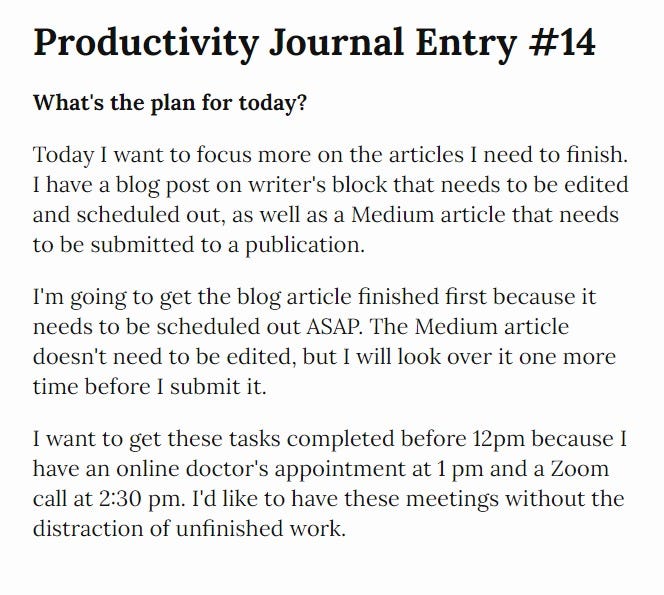
You could write a lot more than I did, of course. Or you could write a lot less. As long as you are detailed enough about your plans and motivations, it works.
I would also suggest you avoid decorating your notebook or trying to make it cute in any way. I love my stickers and washi tape, but taking the time to decorate a notebook meant to inspire productivity simply feels like procrastinating. But if this isn’t the case for you, feel free to decorate your notebook all you want.
Benefits of using a productivity journal
I’ve been using my productivity journal for a few weeks now, and have experienced a variety of benefits. Here are the biggest benefits I’ve noticed from using a productivity journal before each of my writing sessions:
It warms you up
I’m a firm believer that no matter what you’re writing, you need to get reacquainted with your keyboard before a writing session. To me, this means typing out random words to get into the groove of things. But when it comes to the productivity journal, writing down what you intend to accomplish in your writing session is the perfect way to warm yourself up for the marathon of words you’re about to participate in.
It helps you get organized
Writing it out forces me to get organized in a way that a to-do list can’t. Why? Because a to-do list is just that. A list. It tells you what you have to do, not when or how, or even why you’re going to do what you do. A detailed entry in your productivity journal will answer all those questions and more, offering you a sense of mental clarity and organization that will boost your motivation and increase your productivity. This brings me to my next point…
It clears up your mind
Often times, when I sit down to write, it feels as if my brain was going a million times faster than my fingers on the keyboard ever could. Do you feel that way sometimes? Where there are so many things you could write — a million ideas you could bring to life — that it’s difficult to pick just one and put them on paper?
I think of these racing thoughts as mental clutter. And the best way I know to clear the clutter is to write out what I’m going to do. Putting your plans on paper is a way of talking to yourself. Of telling yourself, “Listen, I know we want to do a lot of things, but for this session, we’ll only focus on this one thing.” Somehow, this is enough to clear the clutter and allow yourself to work without distracting thoughts.
It helps you avoid writer’s block
As a result of all the previous benefits I mentioned, the productivity journal also helps to prevent writer’s block. With a detailed plan on what you intend to do and how you’re going to do it, you’ll decrease your chances of getting stuck or distracted during your writing session. Your journal entry not only helps you determine your goal for your writing session, it also helps you focus on achieving said goal without worrying about anything else.
Key takeaways
A productivity journal makes a great addition to your writing sessions. The method I use consists of a 1–2 paragraph that answers the question: What’s the plan for today? This simple method helps you take more control over your writing sessions by allowing you to decide exactly what you will do, why you will do it, and how you will get it done.
A few of the benefits of this system are:
- It warms you up and gets you ready for your writing session.
- It helps you get organized with what you need or want to do.
- It clears the mental clutter that can get in the way of your writing session.
- It helps you prevent writer’s block.
Find a notebook you love to write in and incorporate this simple practice right before you begin a writing session. Notice what parts of the practice work best for you and make the necessary adjustments to make the most out of your writing time. You might find yourself more motivated to write. which can increase the productivity of each session.
Don’t forget to subscribe to the mailing list to receive more content like this directly to your inbox!


