
How A Little Old White Lady Celebrates Her First Juneteenth
By finally answering a burning question from the Trump era.
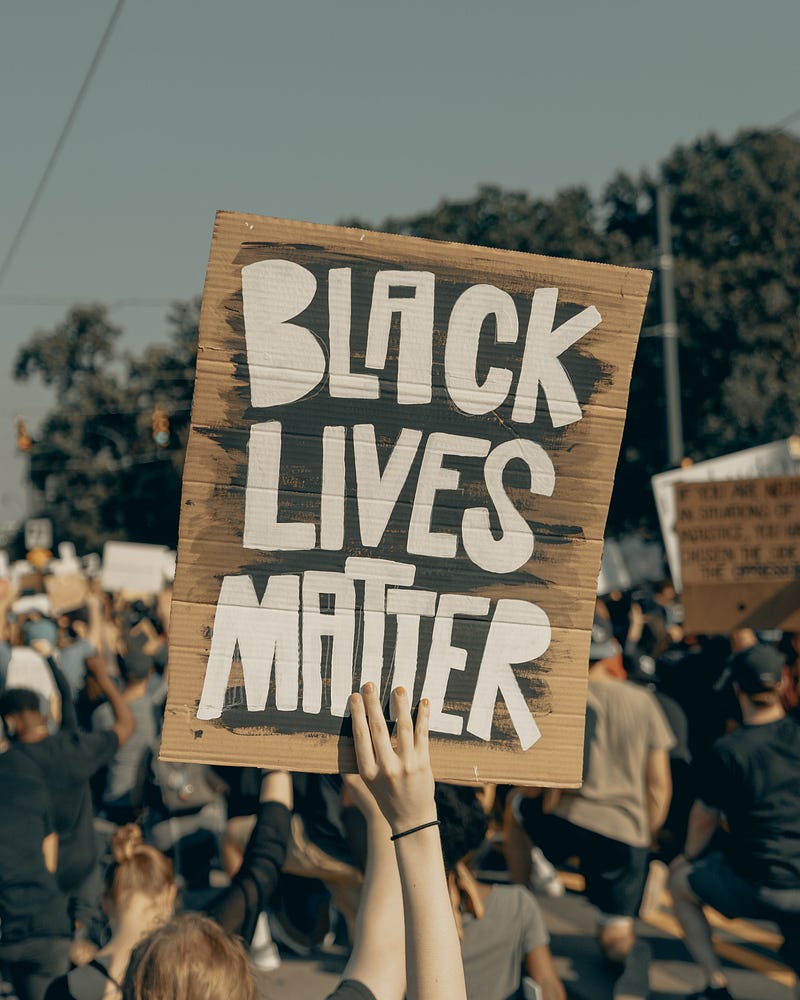
It was like any other day of the Trump administration. I don’t recall the specific date, except it occurred during the quarantine.
I remember that detail distinctly because when the bile in my throat finally subsided enough for me to tear through my apartment in search of some craft supplies (I couldn’t leave my apartment to purchase some pretty construction paper and sparkles), the only material I could find for my window sign was the refrigerated wrapper for the meats and dairy products that came with my Imperfect Foods delivery. I’d subscribed once I realized I was trapped in my digs for the duration of the pandemic and needed food to sustain me.
The cause of this burst of artistic fervor? I’ll forgive you if you don’t remember the Orange Man declaring Black Lives Matter a terrorist organization. His racist rants were a daily occurrence, each one bleeding into the next.
I’d learned after several years of his administration that if I were to survive without a blown artery from regular bouts of outrage, I’d have to learn to let them roll off my back — after dashing off a letter or two to my representatives in Congress, of course.
But somehow, this one stuck in my craw.
I wasn’t a card-carrying member of BLM, though it certainly had my support. Maybe I’d had it up to my back teeth with the senseless murders of Black citizens. Hearing about Trayvon Martin, Tamir Rice, Eric Garner, Ahmaud Arbery, etc., etc., etc., etc., etc., etc., can get old. And I think this was even pre-George Floyd.
I believe that it takes more than a bumper sticker or a sign in a window to change anybody’s political leanings. Yet, when the news broke that morning of Trump’s latest insult to POC, I distinctly recall my blood boiling and thinking, Oh no you don’t. You don’t speak for me.
Within the hour, I had taped to my window in big fat amateurish letters BLM.
I’m sure in the year or so since they’ve stood as a lonely sentinel to my support for the Black community, no one driving past my busy street has even looked up the four stories to my window and noticed them.
Why lonely? Because once I crept out of my apartment, masked and distanced, hoping and praying that was sufficient protection against the deadly virus, I saw that mine was the only BLM sign on what is a very long and busy thoroughfare in my city.
But that’s not my point today.
Over the past year or so, especially since TRUMP LOST THE ELECTION TO JOE BIDEN (for those who haven’t heard the news), I’ve wondered when I should remove my BLM sign.
First of all, there’s the matter of relevance.
I live in a very blue neighborhood, so my sign didn’t impact voter behavior during the last election. I also live in a building with tenants of color and diverse ethnic backgrounds. So, no minds need opening on the housing front.
Of course, I know racism exists in every nook and cranny of this country, so every day is a good day to poke a stick in the eye of white supremacy. However, see previous note about the effectiveness of signs and bumper stickers in rooting out prejudice.
So, if my sign wasn’t going to change anybody’s mind about long-held beliefs, and if it was only, at best, an act of preaching to the choir, what was its purpose now?
I’d been thinking about Juneteenth long before I was aware that Congress was on the cusp of declaring it a national holiday.
Mention of a novel by that name had come across my screen months before, and I recalled the tragic story of Richard Wright’s work.
But wait, I discovered the review wasn’t of Wright’s Juneteenth, but of On Juneteenth by historian Annette Gordon-Reed. And my aging brain had mismatched the author. A friend reminded me that it was Ralph Ellison who struggled for over forty years and 2000 pages to give his story shape, only to have it snatched away from him by a fire at one point.
But once I got my ducks in a row so to speak, I vividly recalled reading about Ellison and that work long before it was published posthumously, in part because his unfinished (at the time) work introduced me to Juneteenth.
Fortunately, now that the occasion is marked with a national holiday, we have no excuse for such ignorance or the type of narrow-minded education that deprived New York children of the 40s and 50s of such historical landmarks as the Japanese internment camps and Juneteenth.
But as I sat in my living room pondering Ellison, Juneteenth, and my BLM sign gathering grit in my window thanks to an interminable roadwork project on my street, I realized why I was loath to remove the sign.
I’d read about Ellison back in my relative youth along with Richard Wright, James Baldwin, etc., the time of my political coming of age. It was the ’60s, those horrible civil rights summers of church bombings, murders of civil rights workers, Rosa Parks and MLK protests, all of it.
Out of it came the Civil Rights Act and a feeling of vindication that only someone who hasn’t lived under the yoke of racism can enjoy. The perception that “We did it.”
Only sixty years later, with the grace of age and the ability to look in a rearview mirror, I studied my sign and thought, what exactly have we done?
Well, I live in a nice building in a major city with a diverse mix of tenants, and we all get along. That ain’t nothin’, and it wouldn’t have happened when I was growing up eighty years ago.
Yet, despite the wins in housing, I still felt the need to put a BLM sign in my window to push back against the openly racist attitudes flourishing in my country once again.
I thought about how society can change, laws can change–slowly and with effort. And then swing back again.
We’re a blank slate when we’re born, neither racist nor tolerant. We absorb attitudes and beliefs that shape us. If we learn they don’t serve us, we try to change them. Above all, I’ve learned change is hard.
When the Civil Rights Act was signed, I thought it was the beginning of so much good change in this country. I had no idea of how much I didn’t know.
In the decades since that historic day, I’ve traveled some, read some, and been propelled to write a novel about the Irish famine. In my research for that book, I started out blaming the English for all that suffering.
By the end, I came to understand how tribal a species we humans are. Nations are in part made of people being cruel to each other in large and small degrees because one faction thinks they’re better than another.
In America, we have our own shame. If you don’t know about what we did to indigenous peoples starting in the 1400s, look it up.
This past year has re-opened our eyes to the scourge of slavery for those who would wish to overlook it. Now, people have been enslaving others since the first man decided his pair was bigger than his neighbor’s.
America, despite its vaunted exceptionalism, didn’t invent slavery, we only capitalized on it, monetized it, and if there had been a way to keep it going, no doubt we would have.
Our new federal holiday acknowledges that stain on our history, and it celebrates the ending of it in 1865, 156 years ago.
I’ve written before of my wish to end my time on this earth free of the habit of casting judgment on others. And it was that wish that also found its way into my thoughts about when I should remove my BLM sign.
For if, as I have learned in my own writings, that after 1000 years, England and Ireland are still fighting their territorial, religious, and nationalistic battles, and if we look around the globe and see nations continuing animosities that go back to biblical times, we get a perspective on why eradicating the traces of slavery in America is so difficult. One-hundred and fifty-six years is unacceptable but understandable.
On a trip to South Africa, a country split with its own dark racial ugliness, an Africaans woman seemed surprised to hear from me that we still had, back in 2009, racial unrest. Her statement helped me see more clearly my decision about my BLM sign.
If American slavery thrived for 400 years, and 156 years later, the afterburn is still scarring our society, it seems a mere lifetime of 70 or 80 years is hardly enough to reshape attitudes about justice when, as so many have said before me, we have to be taught to hate.
We can unlearn that ugly lesson, but it takes time. A lifetime in some cases. And we only learn it for ourselves, as the Trump administration has shown. The next generation has to learn it all over again, if that generation has been taught that putting a foot on the neck of another is a good look. And the news coming out of the MAGA camp says that they believe it is.
Where am I going with all this? Back where I started when I began writing about judgment, realizing that cleaning out my psychic attic as it were, meant ridding myself of the impulse to judge others.
Evil has many roots, not just money, and judgment certainly helps hold up the tree.
Slavery, for example, for those in the cheap seats who can’t hear, exists because some people judge themselves sufficiently superior to others. In America, white people have the upper hand, but go back to Roman times and we discover Romans enslaved Romans. See reference to the biggest pair.
I won’t remove my BLM sign because I need it to keep me honest. Nobody is in danger of me putting them in bondage, but you know how quickly things can get out of hand.
One day you’re smiling sweetly at your neighbor while silently thinking, Good God, woman, what made you think you could leave home wearing that color lipstick?
Before you know it, it’s Good God, man, what makes you think you can own a home in my neighborhood wearing that skin color?
The sign in my window is my own stick in my eye, to remind me not to judge, to be kinder, to keep me humble.
The BLM movement has made us aware of many injustices, politically, socially, economically. I no longer have the energy to take on these challenges.
However, many, if not all roads lead to Rome. For example, lately Blacks have been cataloging possibly well-meaning but casually insulting white attitudes, the perpetrator clueless about the effect of their words and actions.
Was I taught this as child who owned a fair share of white privilege and was made to recite Love Thy Neighbor As Thyself in catechism class?
But it’s never too late to reinforce my belief that everyone deserves to be treated with respect and dignity. And when I get lazy, I have a sign in my window to give me a virtual kick in the head every time I look out onto the world.
Ridding oneself of all judgment and poor behavior can seem like a daunting task. If you don’t believe me, try it. But as Robert Browning said, one’s reach should exceed his grasp.
So when is my sign coming down? When they carry me out of this place. I still have a lot to learn, because the one thing worse than judging others harshly is judging yourself favorably because you think you’re better than you really are.
Congratulations, America, on finally recognizing Juneteenth.