
How A Lidl Slogan Shattered My Perspective On Risk: Risk-Taking Isn’t For The Moment, It’s Forever
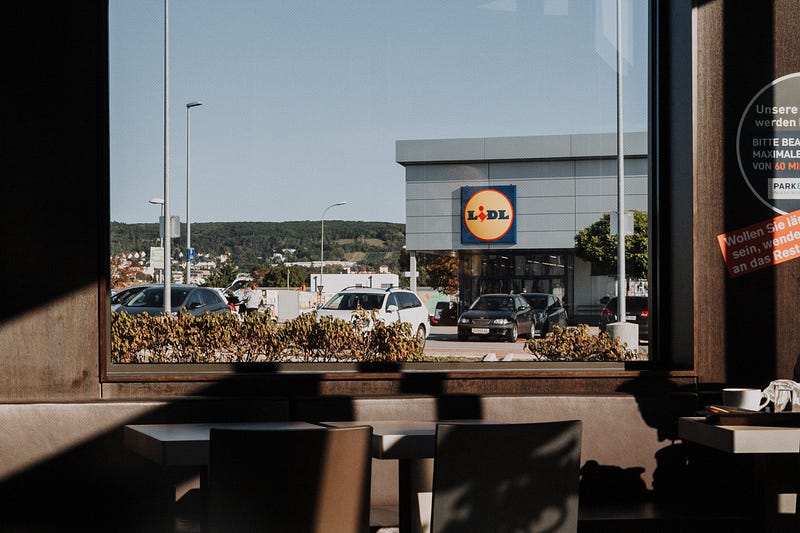
Thursday, July 6, 10:04 a.m.
I was watching Love Island on catch-up.
As usual, whilst suffering through the advertisements, I occupied myself elsewhere; this time I was scrolling through Twitter — until I heard something.
“When you change a Lidl, you change a lot.”
As I registered this, my head shot up and my brain started whirring.
I had an idea in the works.
You might think, what’s so special?
It’s just an advertisement?
And I agree; albeit catchy and impactful on the surface, it’s just another slogan.
But what about beyond that surface?
Often, we don’t make the small changes because they’re small.
They’re overlookable, negligible, and of low priority.
It won’t be the end of the world if we gloss over them.
And that’s the real issue.
Beyond the huge after-effects of accepting small, negligible mistakes, which we’ve covered in:
There’s something else.
Something on top of habitual self-destruction.
Something sacrificed.
And that Lidl slogan hit the nail on the head.
Opportunity.
That’s what you lose.
In his book “Beginners,” Tom Vanderbilt has a subtitle titled:
“How Skill Learning Is Like High-Intensity Interval Training For Your Brain”.
He talks about one scientific benefit of “being a perpetual beginner” (endlessly beginning new skills/avenues).
He writes that,
“Rather than grinding out a marathon, you are putting your brain through a variety of high-intensity interval workouts. Each time you begin to learn that new skill, you’re reshaping. You’re training your brain again to be more efficient. “
Often, we look at skill learning as something for younger people.
Once we hit an age, trying new things isn’t for us anymore.
I’ve heard “leave that for kids” a million times— I’ve even said it myself! —but Vanderbilt’s writing shifted my perspective.
As Vanderbilt put it,
“Even if there’s little chance you’ll become an expert,” as Schmidt-Wilcke had told me, “you should try to learn something new.”
Why?
Because,
“Curiously, the plasticity shown in learning to juggle didn’t seem to depend upon how well one learned it. “The brain wants to be puzzled and learn something new,” one researcher suggested. It likes learning for learning’s sake.”
Even though picking up a new skill without the outcome of mastery or significant proficiency seems unimpactful,
It is impactful.
Significantly, at that.
What’s more, the older you get, the more important it is to be a “perpetual beginner.”
Vanderbilt further writes that,
“He was also keenly aware of another truth in skill learning. “The older you get,” he said, “the harder you have to work.” In the juggling study that found that older jugglers had just as much gray-matter change as younger jugglers, another fact stood out.
Over three months of training, 100 percent of the younger group (mean age twenty) achieved the target of sixty seconds of uninterrupted juggling. In the older group (mean age sixty), only 23 percent did.
The study concluded with a recommendation that…: “As people age, they should not do less, but do more to keep and maintain their abilities.” “
However, most importantly,
“The more learning older adults take on, the faster they seem to learn — the more they become like younger adults.”
Quite literally, when you change a little, you change a lot.
It’s always the small things.
And as aforementioned, the cost is lost opportunity.
For adults, the longer we stay entrenched in the mindset that new things are for the young and over-energetic, the longer we fuel our own deterioration.
So, even it seems like a little change,
Insignificant,
Unnecessary or a waste of time in the grand scheme of things.
We just never know.
And as I learnt recently after reading Beginners, I have lost so many opportunities.
Not only to learn, but simply to help my brain keep up with my younger self.
I have unknowingly shot myself in the foot a million times.
So, why not take a risk?
Try something new.
Throw yourself into the deep end.
You might not be Michael Phelps immediately, but just getting into the water is enough.
Next time you say no, either because you don’t have to or because you’re unsure of the immediate or even prospective benefit,
Think of this.
Say yes instead.
Unknowingly, you might change your life.
I guess they were right — “When you change a Lidl, you change a lot.”
LM
Thank you for reading!
American psychologist Alok Konojia, or ‘HealthyGamerGG’, says:
“The absence of reflection is the reason you’re stuck.”
To solidify our growth, let’s reflect:
Petrichor’s 1-Minute Reflection:
- How did you feel before reading?
- How did you feel whilst reading?
- Do you feel any different now that you’ve finished?
- What is your one takeaway from reading this?


