
How A Former War Correspondent Is Battling Hyper-parenting and Bettering Herself
Critical Life Lessons from the Front Lines
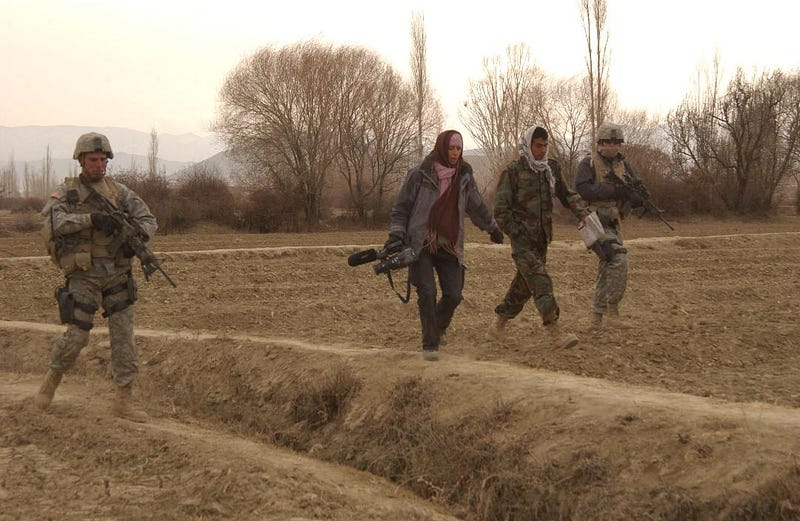
Becky Diamond listens from the kitchen as her nine-year-old son argues with a friend. The voices get louder, but she is determined to let the boys work out their scuffle without intervention. When they appeal to her, she says, “You’ve got this — you’ll figure it out.”
It takes every bit of strength and restraint for her not to play referee, not to cajole or control, not to protect either kid from hurt feelings. But “short of blood spurting,” Becky has learned that the right choice is to let the boys work it out.
It has been a hard-won lesson — one that this war-correspondent-turned-mom is still mastering — and not only where her son is concerned.
She reveals her struggles and triumphs in her Psychology Today blog, aptly titled, Risking It.
“I didn’t expect motherhood to be so stressful,” she writes in a recent post about avoiding back-to-school stress:
Raising a child feels more pressure-packed than war reporting. I should know. I’ve done both.
Parents have more fear in their eyes when they talk about kindergarten admissions than U.S. soldiers had while on patrol, in the back alleys of Baghdad.
Diamond is engaging and honest about her own anxieties as a mother and her evolution as a woman since the birth of her son. Where she once conceptualized motherhood as “a series of boxes I’d check off,” she now understands that “it’s about the journey.”
“Risking It” is not simply another meditation on motherhood. This readable and highly recommended blog is, at the core, about a woman’s investigation of herself: where resilience comes from and resides, how risk is an important aspect of growth, and why courage is important as an everyday value.
Full disclosure: I’m not impartial.
Becky is my daughter’s college friend. I’ve followed the roman numerals of her life since the early nineties. College. Rock-climbing. Boyfriends. A broken engagement. Success as an on-air journalist for CNN. Traveling to war zones. Becky Diamond reporting from Baghdad. Reporting from Afghanistan. Our Becky.
At first, I traced her trajectory mostly from a distance. But when Becky became a mother at 43, our paths crossed more often. A car ride from Manhattan to a restaurant in New Jersey for my son-in-law Pete’s 50th birthday. A play date at the Central Park Zoo with Jen and my three grandsons who adore “baby Marty.” Breaking the Yom Kippur fast at her apartment, surrounded by her large and loving extended family. Her mother-in-law Judy, lost to COVID at 93, was once one of my old ladies.
From one year to the next, I got to see snapshots of Becky-as-Mom. Like my own daughter, she is of the generation I address in various parenting books. So, of course, I paid attention. Reading her blog and witnessing her transformation, I decided to interview her.
The “Madness” of Early Motherhood…
When Marty was born, Becky reminded me of the older mothers I encountered in 2000, when I began to work with Tracy Hogg on our Baby Whisperer books. She came to motherhood a fully empowered adult in the midst of a successful career and with a strong sense of her own agency.
“I approached parenting like a project and as a journalist,” she says now, recalling her first few years as a mom.
“I interviewed other mothers. What are the best practices? What mistakes did they make? In my head, I imagined I could control motherhood. I could produce Marty. I could prepare him for the battlefield.”
All around her, other mothers — equally well-educated and serious about their careers — were doing the same thing. “My generation of women is a working generation. We transferred that mindset to child-rearing,” says Becky.
Judith Warner called it “perfect madness” in her 2005 book of the same name. The mothers Warner interviewed were victims, she wrote, of “a new set of life-draining pressures.”
The New York Times reviewer described the phenomenon as the “mommy trap.”
….in affluent America, mothering has gone from an art to a cult, with devotees driving themselves to ever more baroque extremes to appease the goddess of perfect motherhood….Desperate to maximize their children’s levels of attachment and developmental capacity, they turn marital beds into family beds, flash “Baby Einstein” cards at their 3-month-olds, enroll toddlers in nonstop improving activities, and give up quiet evenings at home to plan Girl Scout cookie drives…”
The pressure starts the moment a new mother fears that her infant isn’t “on time,” according to what she’s seen, heard, and read about babies. Once she begins to socialize with other moms and their babies, playgroup conversation adds competition to the mix. Tracy called it the “developmental Olympics.” Look! My baby is sitting up at eight months. Oh, no, yours is almost standing.
Becky thinks of it as “the race” and admits that she once ran alongside her fellow moms. She agonized over every milestone. She read books which, in retrospect, made her more anxious.
…Only Gets Worse
Surprisingly, the pressure intensified once Marty started school. Which is when Becky first decides to swim against the tide of hyper-parenting.
Becky describes her son, then and now: “He’s a boy. He doesn’t always listen the first or second time. He has an active body.”
She enrolls her bright, energetic, creative boy in a school that, she thinks will stress play and imagination, only to find out that it is “more like nursery university…I had no idea that I was stepping into a world where there wasn’t an instant to waste.”
Other parents ask if Marty is writing and reading “yet.” The pressure is on after school, too. “Everyone around me was putting their kids in groups and programs, so I signed him up too. I over-scheduled him at first.”
Deep down, though, Becky is “bothered” by the constant push. The race to nowhere. All work and no play.
In pre-K, there was “writer’s workshop.” My little, four-year-old guy could hardly hold a pencil.
By the following year, she is ready to push back.
Mustering the Courage to Change
“It started as an inside job. I kept asking myself, Why does this bother me? So I looked into what was happening.
“Why are children so anxious in pre-K and kindergarten? What’s making kids develop tics, tap, rock, chew their shirt? I slowly discovered that the system we have is not developmentally appropriate.”
She also begins to see the hovering everywhere and in a new light. “Parents are solving their kids’ problems. A mother holding a hamburger for a four-year-old. Part of me wants to shout, So what if the meat slips out?!
In kindergarten, Becky decides to “course-correct and live in the moment.” It helps that Marty has “an unbelievable teacher,” who confirms that Becky is right to protect her son’s downtime.
She also finds peers she trusts enough to share her concerns and help find solutions — “women who are emotionally available and who don’t see vulnerability as a weakness.”
Today, Marty has only one afterschool activity a week. “The rest of time,” Becky says, “I look for play dates.”
Equally important, Becky says, “I started realizing that I’m on a parallel journey.”
Becky’s Story
Becky’s earliest blog posts are inspired by her observation of other parents and kids at school and on the playground — the rush, the push, the competition and constant pressure to do.
Seeking an alternative narrative, she delves into the science of resilience, risk, and courage. She is a reporter, after all, someone who investigates and taps into “sources” — other mothers, psychologists, educators. She concludes that she must allow her son the freedom to experiment, to take risks, even to fail.
This is Becky — the mother — talking:
She pushes past her own fears about Marty getting hurt to let her son “dabble in danger in order to keep him safe.”
She also looks at how her independence and strength was honed by her mother and ponders what she learned in her own family:
My mom never told me to “Be careful!” and I turned out fine.
“As I raise Marty in a world of ‘be careful,’ which I used to say a lot,” Becky says, “I think of how brave my parents were to give me space to find my passions and to explore the world on my terms.”
This is Becky — the woman — talking:
She faces risk and musters the courage to change. She suffers failure and enjoys success.
One of her most affecting pieces opens with…
The worst day of my life was the best thing that ever happened to me.
The post is about her engagement to a guy who has everything but doesn’t think she has enough. Three days before the wedding, her tailor declares the wedding gown “perfect,” but…
After the fitting, I returned to our apartment, and Eric told me, “I can’t do it,” as if he were canceling dinner and a movie.
She goes on to tell a hero’s tale. Rejected and wounded, she summons enormous inner strength and a healthy dose of what her grandma called “chutzpah” and begins to cover war zones for a living.
The Lessons of War
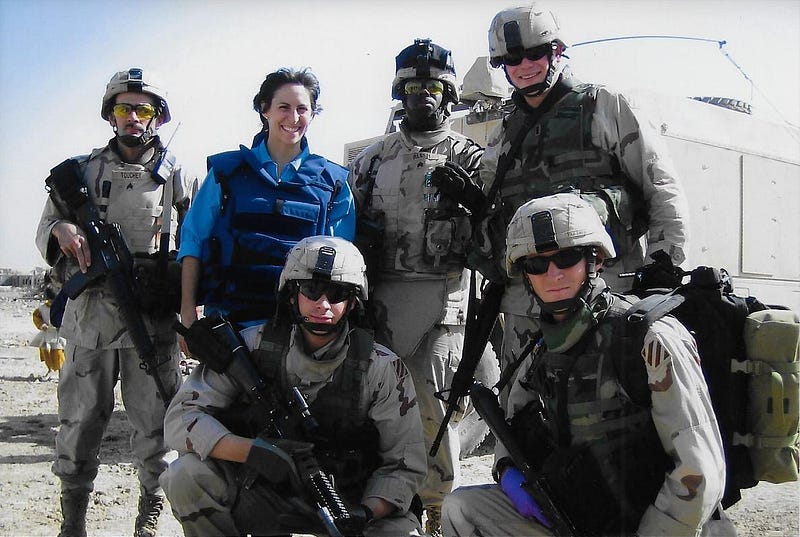
Being in faraway places with soldiers who literally put their lives on the line offers a sobering dose of reality.
In a place where there was no comfort, I transformed. I learned not to fear being afraid. To accept that terrible things can happen. Not to sweat the small stuff. To inhale gratitude and never give up.
War, as it turns out, will teach Becky, the woman and the mother, what matters most.
And the insights keep coming…
“My experience in war zones made me braver. More grateful. More resilient and compassionate,” she says, trying to sum up the effects of enduring both the physical discomfort and the emotional toll.
“I’ve seen people suffer and struggle in ways that are unimaginable. People are real-life superheroes. And while I didn’t personally experience war-related trauma, covering war is grueling and exhausting in a way that is extreme.”
The easy times are fun, says Becky, but they don’t teach us anything. Still, she adds, “I want to emphasize that I don’t feel Marty (or anyone else!) needs to go to Baghdad to feel brave. We can challenge ourselves by taking everyday, reasonable risks.
“War zones taught me that challenging moments give us a chance to discover an inner strength we never knew we had. We emerge bionic, with better parts.”
Becky works hard to apply those lessons to everyday life. “I keep telling my son and myself, ‘If it makes you nervous, do it!’ If we stay in our comfort zones, and we don’t struggle, we won’t know what we are capable of becoming.”
An Ongoing Mission
As with any change in strategy, some days go better than others. Becky still has moments of wanting to protect and control her son, moments of self-doubt — but like a good soldier, she keeps advancing, as a recent email suggests:
Over the summer, I encouraged Marty to walk home from a friend’s house — alone. It was a ten minute walk, and he did it. It was scary. He’s only 9 but, I knew he would be OK. He gained so much confidence from feeling nervous and working through it.
Clearly, she also gained confidence from Marty’s solo walk. “Knowing” your child is capable of a new task is nothing compared to letting it happen and actually seeing him succeed.
She agrees and adds. “I lean into taking reasonable risks as a way to become my strongest, bravest and most authentic self, and I encourage my son to do the same. I think when we are brave and dip outside of our comfort zones, our kids will, too.”
If you like what you’ve read, by all means:
- Subscribe to my Medium articles — you’ll get an email when I publish.
- Subscribe to my blog. (I won’t charge you or share your info.)
- Follow me on social media via LinkTree
- Subscribe to Medium using this link, and I will earn half of your membership fee: $5/month, or $50/year — a small price to pay to support a favorite writer and unlimited access to a world of great thinking and writing.


