
How a $200 Pen Enhanced My Writing Process
At the Fountain of Creativity with a Lamy 2000
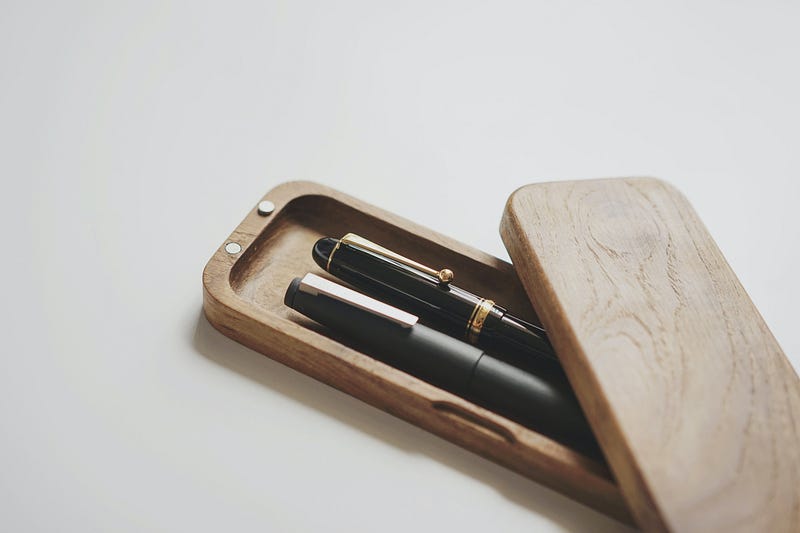
For me, writing has always relied on flashy ideas, fast fingers, and tedious after-the-fact editing. But the most significant investment I’ve ever made in improving the overall quality of my writing has been picking up a fountain pen priced at the not-so-measly sum of $200, plus tax.
What you are currently reading is a love letter to that pen and fountain pens everywhere. It was first drafted by hand on 70lb smooth finish paper, with Anti-Matter blue ink that flowed seamlessly from a Lamy 2000 Fine Nib (Tip) fountain pen.
If the sound of a $200 pen makes you nearly spit your morning coffee, then you are a lot like I was. I got my first itch for expensive pens after listening to an interview on the Tim Ferriss show with my favorite author, Neil Gaiman. Gaiman gushes about pens for the first 40 minutes, remarking their simultaneous simplicity and complexity, and sharing some of his favorite pens for writing. I’ve included that video below for anyone interested.
If it’s not apparent already — I was inspired. But after looking up the price for something as seemingly simple as a pen, I — much like you might’ve— nearly spat out my morning coffee. It wasn’t feasible or necessary. It just couldn’t be.
Fast forward
One year later — I’m standing in Truphae Pens, Ink & Accessories in Greenville, SC, getting sized for my first fountain pen. As it turned out, my ever-loving and thoughtful wife had taken notice of my distant admiration of pens and hatched a plan to surprise me with one for my birthday.
Before long, I had in my hand a Lamy 2000, complete with a sleek, modern, brushed metal design; a white-gold, fine tip; and an intuitive inner piston system for drawing ink. It’s a weighty pen that confidently says without needing to scream, “Precision German Engineering.” I tried out many different pens, but the Lamy 2000 was for me.
Today, I find that I’m writing smarter, more intentionally, and in higher volumes than ever before. But why? It’s just a really expensive — albeit fancy — pen, right? Well, yes. But also no. And here’s why.
Easy to Use
There isn’t much else to say about it. I’ve seen examples of first-draft manuscripts to books written in inky pen and been astounded by the hand stamina and super wrist strength required to pull it off. But then I cracked the case — fountain pens.
Fountain pens require virtually no pressure to put ink on the paper, meaning I can write for long durations without my hand cramping from over-pressing. Instead, the ink seamlessly flows from the nib allowing beautiful, fluid strokes. It’s as exciting to do as it is mesmerizing to watch.
Visual Word Tracking
A trick straight from Gaiman’s playbook — Fountain pens come equipped with their own system for tracking word goals. Try it by starting each day of writing by filling your pen with a new ink color (or at least a different color than the previous day). Then, date your page and start writing.
Not only will this augment your morning routine with the grounding process of emptying and filling your pen, but you will have a visually stunning record of each day’s progress dictated by ink color.
By referring to my notebook and ink colors, I can determine where, when, and even how to be my most productive self.
Your Customized Writing Experience
If you struggle with the motivation to write at a regular cadence, then a fountain pen could be what you need to inspire a little extra creativity.
Fountain pens are a personal and highly customizable thing. You could spend hours or more on research choosing nib sizes (extra-fine, fine, medium, or broad), inner mechanisms for drawing ink, ink colors, and — of course — pen models. Holding something that you know is uniquely yours — configured by choice — is an enriching and exciting part of the writing experience, and I’m all the more excited to sit down and write because of it.
Every Line with Intention
When you are smashing keys on a keyboard, it’s easy to write a line; delete a word; try another word; delete it; and so on. Writing with a pen offers less freedom for editing on the spot — unless you prefer a mess — and writing with a fountain pen provides even less room for such errors. You don’t want to waste your favorite ink on scribbles, and there is such artistic satisfaction received from the moment the nib touches the paper, to the sentence’s end. To disrupt the magic for mistakes is like getting called by your parents in the middle of sex.
Consequently, I find I’m much more intentional about starting a new sentence — giving pause to plot it out in its entirety while asking myself, ‘How should I put this? What words do I want to come out of this pen?’
Sometimes the answer is a well-thought line where every word carries weight. Other times it’s a sex joke.
Capping up
They say that everyone has a story. It lives on the tips of our tongues or in the nibs of exorbitant pens. Some are good — some are bad, but we’ll never know until we unleash them on the world.
Fountain pens have introduced me to a culture of creativity. And I haven’t even mentioned the best part — it doesn’t need to cost you $200. In fact, there are plenty of decent pens in the $20 range that offer the same functionality and fun mentioned above.
More than anything though, fountain pens have gotten me really excited to write more. And hopefully — with enough practice — find my story. To revisit Mr. Gaiman, who says in his Top 13 Writing Tips:
“As a writer, and especially as a young writer, your job is to get the bad words out, the bad sentences out, the stories that aren’t any good yet. And you don’t ever get them out going, ‘I’m gonna write a really bad story now. I just have to get this out.’ You think it’s a great story, you think it’s a great idea, you think it’s good at least — and it may be — but the most important thing is just you got it out.”
-Neil Gaiman


