
How “4 Months, 3 Weeks, and 2 Days” Tells a Story
Analyzing the corruption of intimacy in Romania’s famous film
The story
The plot of 4 Months, 3 Weeks, and 2 Days—the Romanian winner of the Palme D’Or in 2007—is simple.
Otilia helps her college roommate Găbiţa—who is nearly 5 months into an unwanted pregnancy—get an abortion. Because of a directive by the Romanian leader Nicolae Ceaușescu, this abortion is illegal. Otilia does everything to make it happen: she borrows money, handles the hotel reservation, and meets the mysterious abortion doctor Bebe.
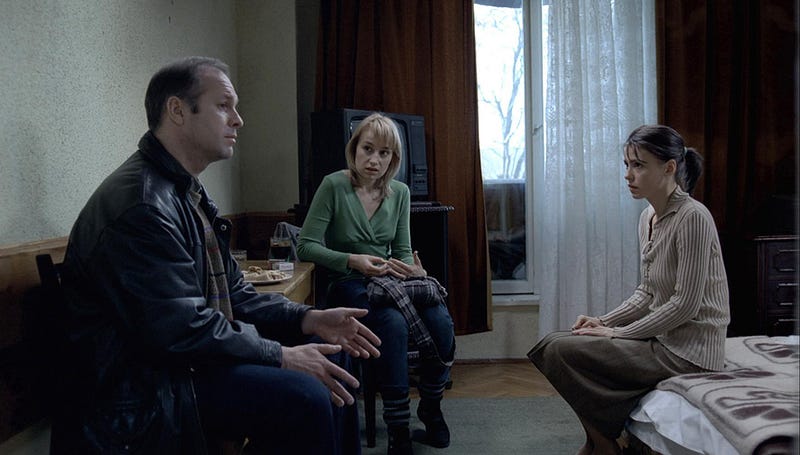
They gather in the hotel room, and in a chilling single-take shot they negotiate the terms of the procedure. They are reluctant to utter the word abortion and never use the word sex. This is ultimately what Bebe demands from the two women, not just money but sex.
After he rapes them, Otilia leaves Găbiţa to walk through more circles of personal hell: sitting through an exasperating and isolating family gathering at her boyfriend Adi’s home, and eventually running through the streets at night in search of a place to dump the dead fetus.
The role of the camera
Otilia’s movements are captured by an unsteady, but relentless camera. Without a musical score, special effects, or even a tripod to hold the camera, there is nothing between the audience and the story. There is no concern for smoothness, making spectatorship a difficult sport.
Otilia is followed endlessly, with a notable exception being the rape in the hotel. This is the film’s method, reflecting intense intimacy while also making one aware of the dark underworld outside of the camera’s lens. It is a wonder that this film, hailed as a supremely accurate representation of life in Communist Romania, can make absolutely no reference to Ceaușescu or employ the appellative “comrade.”
This theme is encapsulated in one of the film’s central symbols: the fish tank. This is after all the very first shot of the film, a tank of fish in the centre of the frame. The glass is reflective and the water has a thickness, an amniotic quality that paves the way for the oppressive atmosphere of the film. We become aware that there are people off screen only when a hand reaches into the frame toward an ashtray. In its opening, the film breaks our sense of omniscience, and makes us unsure about the relationship between these two young women who make demands of each other for a purpose that we can only guess at.
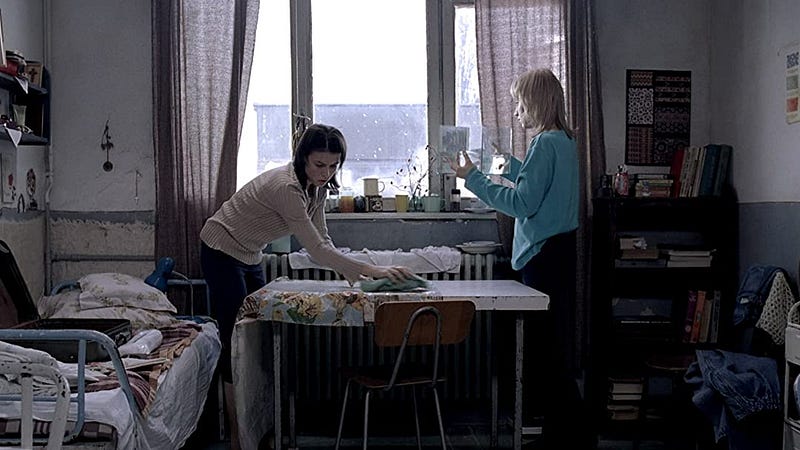
Găbiţa is already pregnant, although we can’t know that from her appearance. They’ve made arrangements through the advice of a friend, Ramona, who is much talked about but never encountered. We never learn about the circumstances of Găbiţa’s pregnancy, about the emotions of fear or grief that may have gone into the decision to abort, or really any reflections on the moral issues of the narrative. We are forced to participate in the physical and mental ordeals of two people who haven’t shared the full story with us.
How can we trust them? Indeed, this is the question that Bebe asks time and time again during the negotations in the hotel. Găbiţa lies to him about how long she’s been pregnant, she promises to meet him in person but has Otilia go in her stead, she is unable to reserve the proper hotel under her own name and forgets the essential plastic sheet for the abortion procedure.
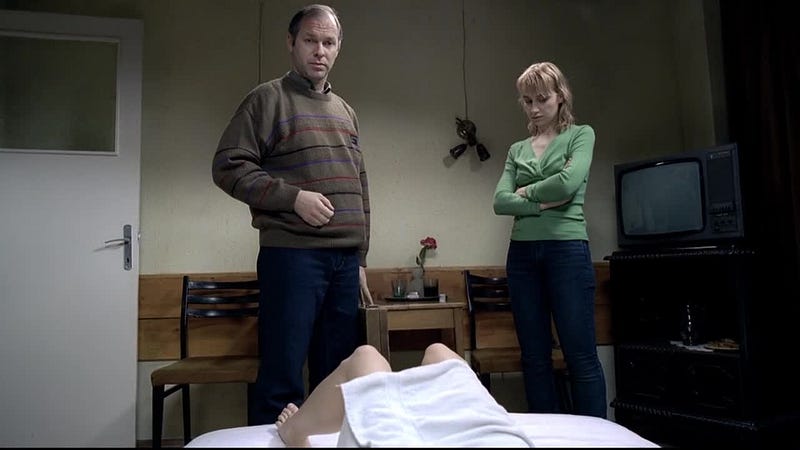
The only thing that she seems to accomplish is shaving her legs, an act of hygiene that is seemingly forced onto every female body in the film. It’s trivial, but it’s what Găbiţa has when she raises her perfectly smooth legs and waits with the probe inserted in her.
It’s hard, therefore, to imagine why the two roommates trust each other so much. They became increasingly entangled and dependent on one another, yet also alienated. This becomes overt when Bebe rapes them.
Găbiţa escapes to the corridor, and then to the bathroom which acts as an airlock, a space of cleanliness with running water that can drown out the sound of sex. When Otilia enters, she hoses herself clean without looking at Găbiţa, who then exits the bathroom where she is also raped.
When they are alone after the abortion doctor leaves, the two sit motionless without an exchange. When Găbiţa finally thanks Otilia, she herself is out of frame and Otilia does not respond.
The abortion is completed off-screen as well, while Otilia is with her boyfriend's family. Otilia tries to call the hotel room a couple of times, but the details of what’s happening are kept a mystery. The suspense and psychological burden of not knowing weighs heavily on Otilia’s mind, causing her to vomit in the street.
The reality back at the hotel is shockingly sober. There is no blood, no screaming, just a still and sleeping figure in the bed. Otilia reaches out to her friend with tenderness, her loyalty emerging once again. She asks Găbiţa why she didn’t answer the phone, but instead of reciprocating the question with an answer, Găbiţa directs our attention to the fetus in the bathroom.
For a film that has worked so actively to exclude the audience from explicit shock, it doesn’t hide from showing us the fetus in full view. Every detail of the flesh is visible, the fetus has a tactile and vulnerable presence, invading the whiteness of the towel with blood and amniotic fluid. It only accentuates the gruesomeness of having to throw it down a garbage chute.
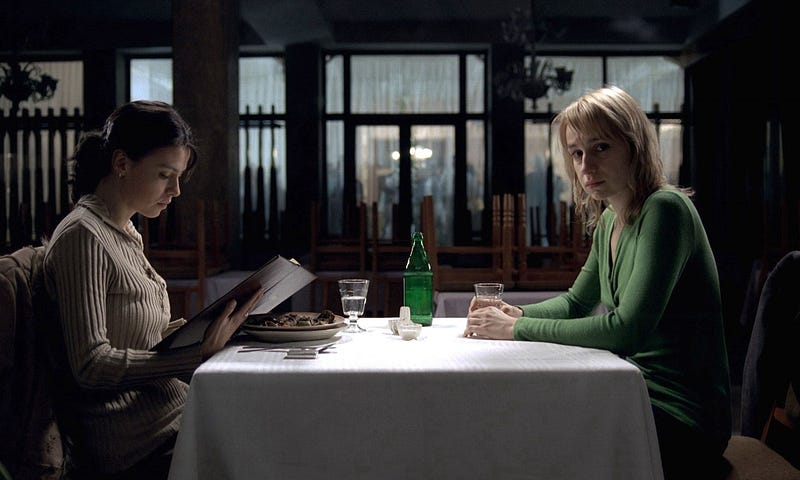
When Otilia returns to the hotel, she’s shocked to find Găbiţa sitting calmly at a table in the restaurant. They sit across from each other, with a cigarette burning in between them, reminiscent of the film’s first shot. They swear never to talk about what happened, yet the aroma of Găbiţa’s meal of meat and offal cannot escape comparison with the human flesh that has just been discarded. They sit in uneasy silence, as a wedding is being celebrated in the other room.
Otilia turns to look out at the audience, and we realize that we are looking in through the glass. Who is whose closest ally still remains the question.