
Houston, We Have an Empathy Problem
Where is the love, America?

This morning, it was reported that former President Barack Obama had called President Trump’s handling of COVID-19 “an absolute chaotic disaster.”
Political searing aside, what the former president said that same night is even more revealing of our times.
“What we’re fighting against is these long-term trends in which being selfish, being tribal, being divided, and seeing others as an enemy — that has become a stronger impulse in American life.” — President Barack Obama, May 8, 2020
Mr. Obama’s quote above, in my eyes, is more significant than his rebuke of Trump. The reason why is simple: we forgot who we are.
We live in a day and age where the country is more divided than ever before. It hasn’t helped that the current POTUS regularly shames those who disagree with him.
If the country were a body, we’re experiencing chronic inflammation. Instead of feeding ourselves the nutrients we need — in this case, unity behind the American cause — we’re consuming toxic media that’s making our country more tribal than ever.
What have we become and why are we here?
The answer lies in the difference between empathy and sympathy. One is lost, and the other is abused.
Empathy v. Sympathy
I bring my mom up in my writing from time to time because — let’s be honest — she’s a badass woman.
One of the many philosophical conversations I’ve had with my mother is on the subject of empathy versus sympathy.
Before we get into that, though, let’s look at the definitions of each.
empathy: the ability to understand and share the feelings of another.
sympathy: understanding between people; common feeling.
At first glance, the two definitively and phonetically seem the same. Yet they couldn’t be any more different.
Empathy is when I’m able to understand where you’re coming from. This doesn’t mean that I agree or disagree with you. In fact, I can be empathetic and disagree with someone. A great example of this is my grandfather, who’s a big Trump supporter.
I’ll never forget the time when, in December 2015, I flew to Nashville for Christmas holiday to see my grandparents. My step-dad is from Nashville and it was a tradition for us to go every year for Christmas. This was our first time coming up in four years, but we still saw his parents and everything. They came down to Florida every winter: they were snowbirds.
My grandpa has a wonderful hat selection on a rack in between the playroom and the kitchen, just adjacent to the door that permits you in the garage. I was looking for a nice hat as I grew up collecting hats. As I perused through his collection, I found…you guessed it: the words ‘Make America Great Again.’
Writing this sentence almost brought a tear in my eye, I can’t lie. I despise Donald Trump, he’s one of the most polarizing figures of our time. The emotions I felt at that moment of time, though, we’re even more bombastic than the future president. I couldn’t believe what I just saw. I couldn’t believe that my grandpa, someone who I looked up to all my life, had this nonsense physically and mentally. He genuinely believed — and still believes — in Make America Great-ism.
When this happened to me, it was only three months after my eighteenth birthday. Today I’m 22. It’s been four-and-a-half years since that moment and I’ve learned a lot about life in between.
At that time, I was only a few months into my first real relationship. We’d go out for another year-and-a-half. Then I’d be heartbroken, and shortly afterward studied abroad in a French village in the Riviera. I explored a ton of Western Europe all by myself. Fast forward to summer 2018, I started going out with my second serious girlfriend while trying to start my own business, all while graduating that following fall semester.
After graduation and hundreds of job applications, I got accepted to be a cold caller for $35,000 a year in Alexandria with an hour-and-a-half each way commute while barely affording to live in D.C. I’d call 100 people a day and it was the most thankless job ever. I quit that job after a few months when I found an even lower-paid, but slightly more satisfying internship at a government contractor. Around that time was when I got my first investors for my first real business. Which ended up as a total failure, of course. And died four days after I had the worst night of my life — abandoning my now ex-girlfriend after something terrible she did to me. Then there’s today and I’m sitting here as a daily writer while running a brand new podcast company, that I bootstrapped with my partner.
There’s a lot more to my life story than the previous two paragraphs. But the point is that I learned. A lot.
When I was 18, I didn’t know what empathy was. I didn’t really know anything back then, and I still have a lot more to learn.
Yet today I can say that, after my life experiences thus far, I truly understand where my grandpa is coming from. He was a business owner in the restaurant industry and, at one point, had 300 employees. He’s been a lifelong Republican. He watched, and still watches, Fox News every single day. The narrative that he was told was that the Obama Administration was catastrophic. He’s wealthy, but that doesn’t mean that he didn’t care about money — because that’s all he cared about. Any little policy that would tax him higher, even if it was for a good cause, was still taking away his money.
Now, do I sympathize with my grandpa? Absolutely not. I disagree with him wholeheartedly. People in a shit ton of student debt — yours truly — would be more than happy to have some sort of public relief. I also wish we had some public healthcare solution here in the States. As an entrepreneur who doesn’t have a ‘real job’, yours truly also doesn’t have healthcare. I haven’t had a real doctor’s appointment since last July. It’s been almost a whole year since I was supposed to get a blood test, but haven’t because I don’t have insurance. I have no idea how my body is doing internally.
Yet I still have empathy for my grandfather, even if his vote indirectly harms me. Let’s be honest with ourselves: am I really that important to him? Especially compared to his money? Actions speak louder than words, and it’s clear that the well-being of people like me matters less than his bank account.
There are a couple of things that I can do based off of this. I can argue with my grandpa for hours and hours (already tried) and tell him that he’s a Scrooge.
But what is that really going to do? Will my student loan debt magically disappear? Will I all-of-a-sudden get health insurance because I called him out for being a Trump supporter?
No. None of those things will happen. Because that’s not how change works.
Together: A Dichotomy
So how does change actually work?
Well, we can’t have change without coming together. But tread carefully, as coming together is not a solution in itself. The reason why is this.

Does this woman look familiar to you? Does the name Heather D. Heyer ring a bell at all?
If not, Google her and you’ll definitely remember what I’m talking about. She was the token civilian casualty of the 2017 protest in Charlottesville.
On August 11th and 12th, 2017, the Unite the Right rally happened in Charlottesville, Virginia. The protest was started by one group of people who felt betrayed from the status quo: the general alt-right. It was then retaliated by another group of people who disagreed with them: counter-protesters.
“Darkness cannot drive out darkness; only light can do that. Hate cannot drive out hate; only love can do that.” — Martin Luther King, Jr.
The unfortunate events of 2017 (and today) only highlight a problem we have in the States: we don’t know the difference between sympathy and empathy. If the two terms were people on a seesaw, sympathy would be the heavy one and empathy would be the light one.
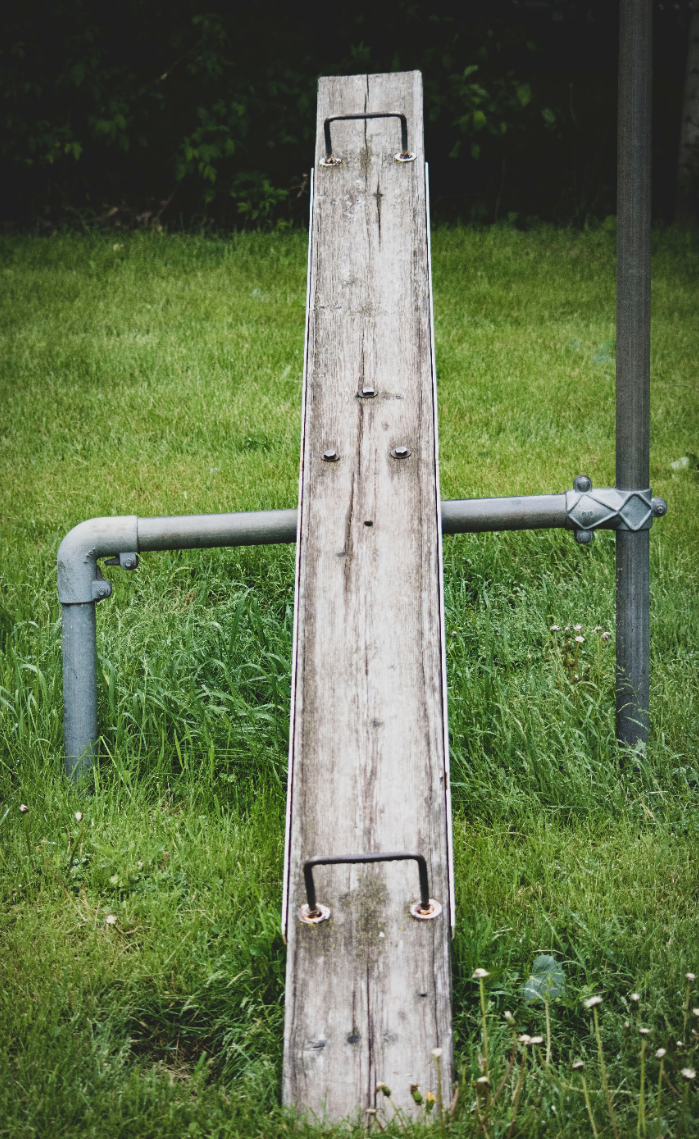
We’ve deliberately chosen sympathy over empathy. We’ve chosen to stick with people who agree with us and ostracize those who don’t. We have free will and we made these choices ourselves.
Coming together sounds sexy as a phrase, but in practice we performed it poorly. Instead of coming together to empathize, we have come together to sympathize.
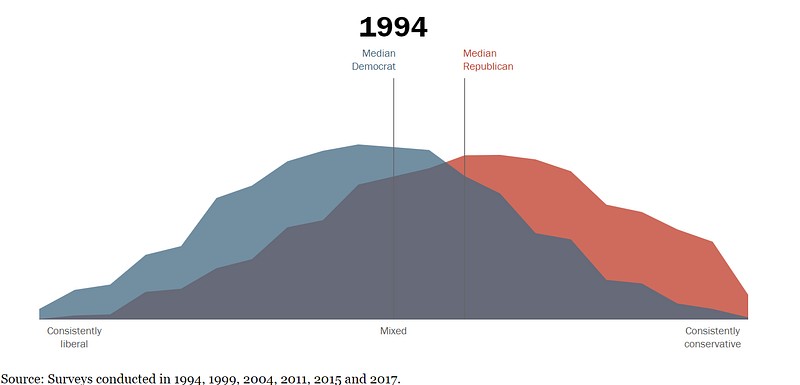
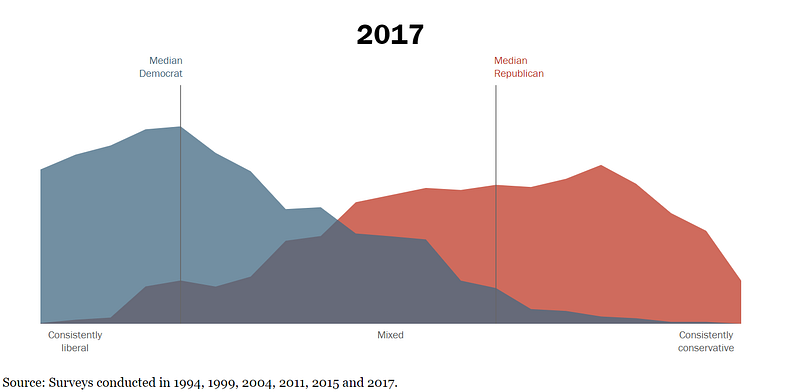
Polarization has even troubled our love lives. The amount of times I’ve seen “no Trump supporters” on someone’s Tinder profile is too many to count.
“America’s steady descent into rank partisanship is permeating every aspect of our lives. The latest installment in the saga is “The Home as a Political Fortress” (pdf) published this September in the peer-reviewed Journal of Politics. The paper’s analysis of 50 years of survey data shows that men and women are increasingly picking their spouses based on their politics, and raising families with views to match.
“Couples have never disagreed much about politics. What is new is the intensity of partisan animosity and the extremes to which spouses’ attitudes now converge, argues Tobias Konitzer, the chief science officer of PredictWise, which helps progressive groups utilize public-opinion data. In 1965, spouses’ political views were aligned about 74% of the time. By 2016, alignment was up to 82%. Political disagreement among spouses fell from 13% to 5.8% over the same period.” — Quartz, October 2018
How have we reached the point where we can’t even communicate with those who don’t sympathize with us?
This final section should reveal the answer.
The Same Story, But Two Narratives
For years, political polarization has been a symptom of a dividing media market.
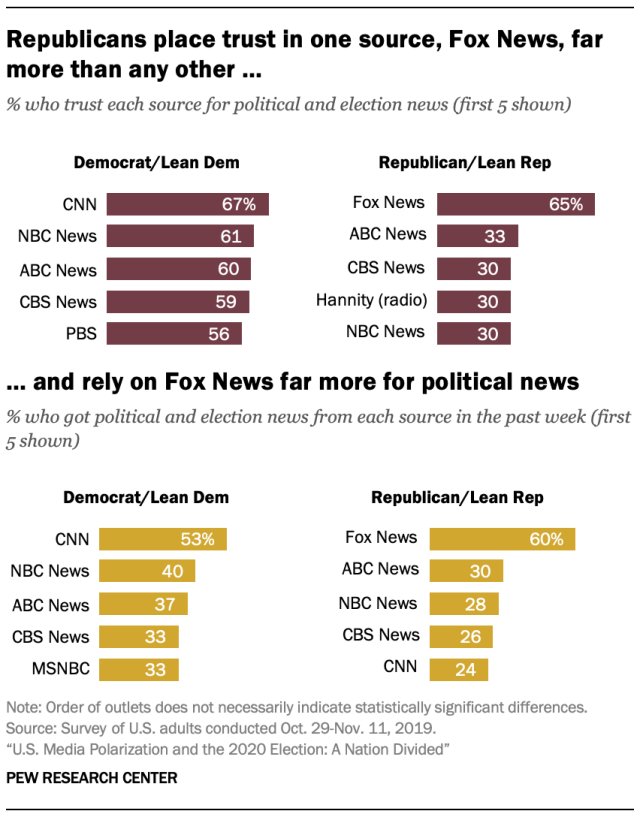
The following graphics from the Pew Research Center best explain this relationship between media and politics.
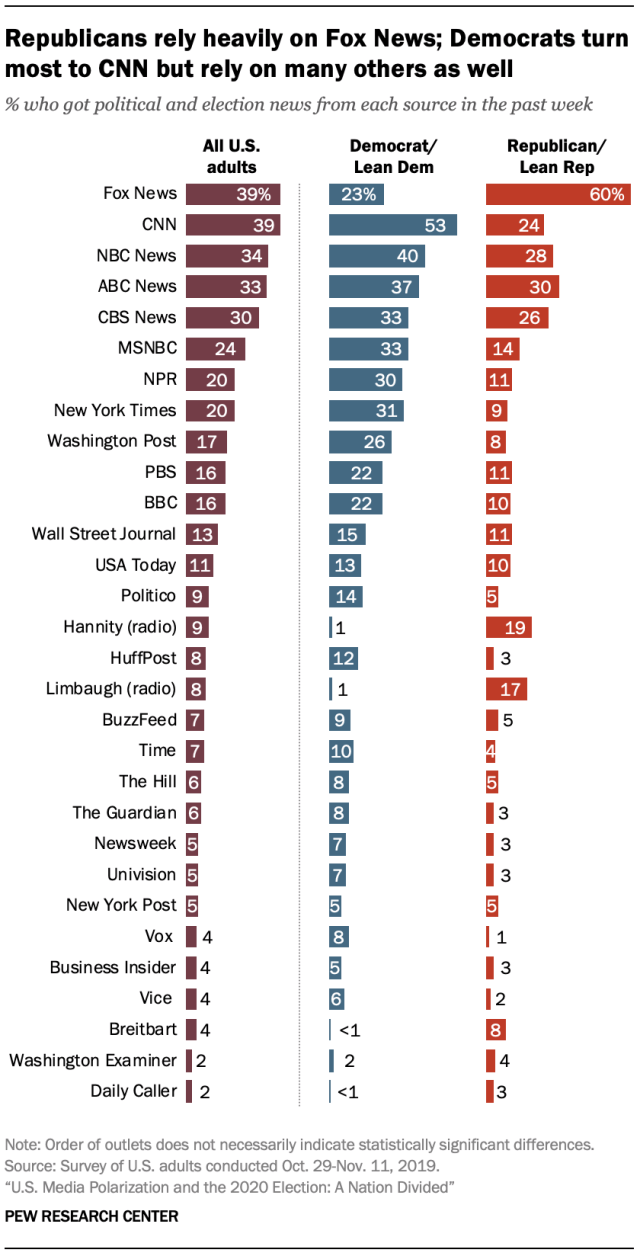
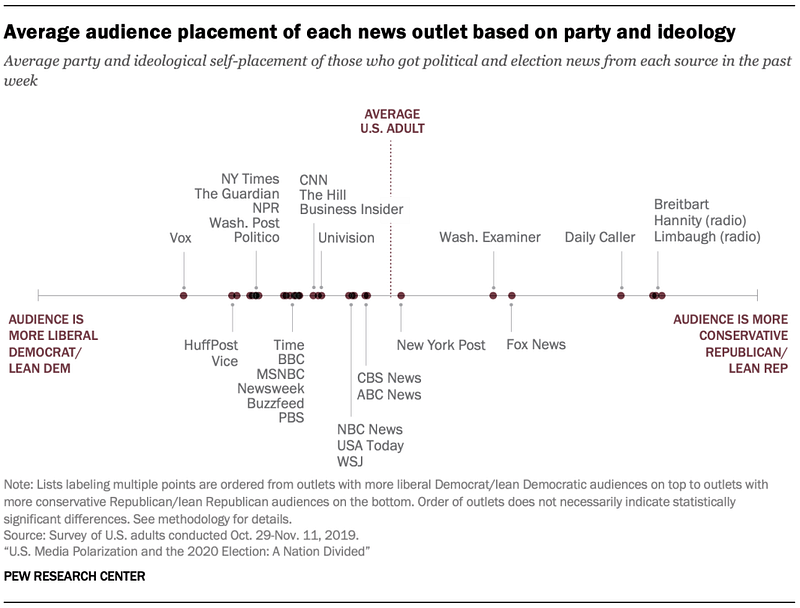
In this situation particularly, the numbers don’t lie and the data speaks for itself.
It’s not hard to imagine why this is the case.
When you go on Fox News and MSNBC when they’re covering the same story, they’re narrating it differently. While MSNBC is covering President Trump for his ‘poor leadership’ against the coronavirus crisis, Fox News is reporting that Democrats have been using the crisis as ‘fear to take aim at Trump.’
Same story, yet different narrative.
When you’re repeatedly told bullshit, you end up believing that bullshit. In this case, bullshit is actually dangerous because what you believe can literally kill people.
What’s even more dangerous is the decay of trust. If we can’t believe even trust the media that’s presented to us, how can we expect to come together and solve the issues? How can we understand others when we can’t trust them?
A nation more divided than ever wakes up one day to a global pandemic infecting millions. Sounds like the description of a horror film. It is not. It is a description of our times.
One of my favorite episodes of a show I’ve binged — Lucifer — recalls a moment when the protagonist character is about to stop someone from their almost suicide, trying to jump off a building.
“Your life sounds incredibly bleak. Ironically it seems there’s nowhere to go but up.” — Lucifer
We, too are at the same point as the man who’s about to jump. We’ve lost our ability to understand. Yet, like muscle memory, we can condition ourselves to gain this back.
But we have a choice, to choose understanding each other (empathy) over divided against each other (polarized sympathy) and make our country and reality a better one.
The choice is ours: let’s make it a good one.


