
House Hacking: How to Live for Free
What is House Hacking?
You may have heard the term “house-hacking” a lot recently, it is a huge topic of conversation in the Financial Independence (FI) community. House hacking is the act of having someone else pay for part or even all of your housing costs.
Types of House Hacking
There are many different types of house hacking, one of the most popular forms of house hacking that gets discussed a lot over at bigger pockets is buying what is called an“owner-occupied multi-family” property. Which is simply purchasing a duplex (2 unit) triplex (3 unit) or a fourplex(4 unit) property, living in one of the units and having the tenants from the other units paying for your mortgage, and if you are smart, even your property maintenance and taxes.
The primary reason that multi-family homes can be such an attractive investment is the incredible potential for cash flow. With a multifamily, you have multiple units generating rental income but only 1 roof, 1 property tax bill, 1 lawn and only 1 driveway that needs plowing. If you can command enough rent, the economies of scale using a multi-family could allow you to not only “live for free” but generate a small monthly cash flow meaning you not only live for free but “get paid to live for free”.
House Hacking with a multi-family property by definition means you are going to become a landlord to long-term tenants, so make sure to weigh all the pros and cons before getting into something like that. If you don’t like dealing with people, collecting rent or fixing leaky toilets you may want to consider a property manager if you choose to go down this road.
You don’t need to be a savvy real estate investor to get into house hacking. Do you have a spare room in your house? You can rent that room out, begin collecting a modest amount of rent, and boom! you’re a house hacker. That income from the rent will offset at least part of your mortgage and property-related expenses.
Are you going away on vacation or going to be out of town for a few weeks? Have you heard of a site called Airbnb? Airbnb is an exciting new route to house hacking for those who don’t want to share a space with a tenant. You can potentially collect a very high per night fee that could be a nice windfall to help cover some of your housing costs.
As you can see, there is no “one way” to house hack, the sky’s the limit if you are creative enough.
House Hacking Your Way to Financial Independence
Let’s tie the house hacking craze into the Financial Independence (FI) movement. As I’ve covered in great detail in previous posts, FI is having enough passive income to cover your living expenses and the fastest way to get there is to save and invest as much of your income as you possibly can.
Housing costs are by far the largest expenditure of the average family which accounts for 35% of the typical household budget. If you could free up 35% of your budget, and invest that into assets that will produce a decent rate of return, you will be on the fast track to Financial Independence.
To illustrate the potential impact house hacking can have on your monthly cash flow, consider the following hypothetical: You and your significant other are looking to buy your first home together, a truly magical experience. You have 2 options before you, the 5,000 sq ft newly renovated dream house that looks like it came out of HGTV and a 5,000 sqft house that has been converted into a “Triplex”. Both homes cost $500,000, have around $4,000 in annual property taxes and cost around $3,600 per year to maintain.
While you can certainly enjoy the luxury of living in your 5,000 sqft dream home, what are you giving up in terms of potential cash flow to live in it? Let’s do a bit of hypothetical number crunching to find out.
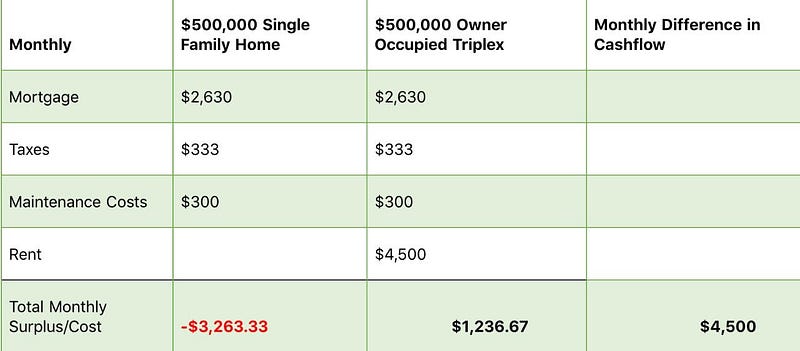
In this totally made up (and probably too simple) example, both the dream home and the Triplex have approximately the same monthly cost of $3,263.33 that goes to mortgage, taxes, and maintenance. The dream home is not generating any rental income so the net financial cost of living in it is the full $3,263.33. The Triplex has the same monthly cost but can generate $4,500 per month in rent (made up number) which generates positive monthly cash flow of $1,236.67 which can be used to pay down the mortgage quicker or reinvested into index funds, additional real estate or any other incredible savings opportunities to put you on the fast track to FI.
There is no guarantee when it comes to investing of any kind, including real estate. Housing prices, rents, vacancy rates can all change at the drop of a hat and throw the hypothetical cash flow benefits right out the window. But if you buy and rent smartly, and have a bit of luck, house hacking has the potential to reduce or eliminate your largest personal expense and do wonders for your cash flow.
Bonus: Need support to start taking action? Join the 30-day money challenge where you will be given a new action item to take every day for 30 days. You also get access to the private Facebook group of people who are in the same boat as you.
Click here to Sign up for the 30-day money challenge.
This article is for informational purposes only, it should not be considered Financial or Legal Advice. Not all information will be accurate. Consult a financial professional before making any major financial decisions