
Hottest Year Ever as Planet Heads for a Drowned World
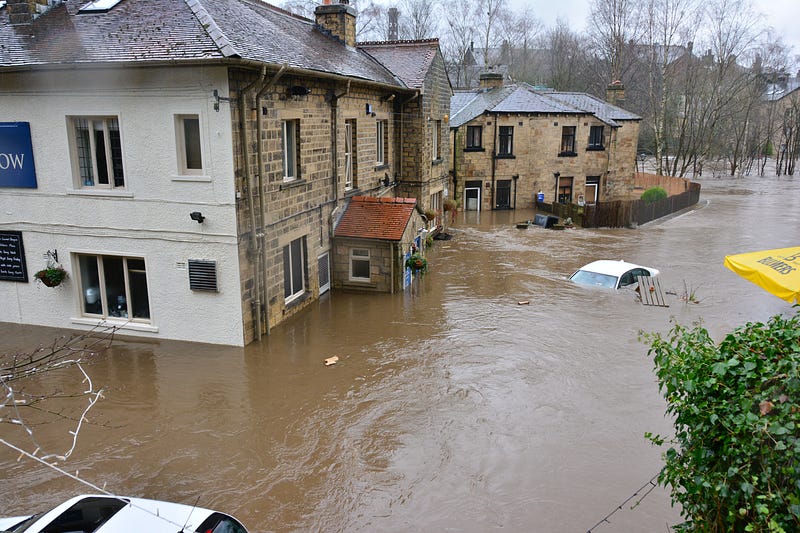
As predicted by scientists in November and December, figures released several days ago by the Copernicus Climate Change Service have confirmed that 2023 was the hottest overall year on record. This inevitable and gloomy announcement also crowns the last 12 months as some of the most destructive in terms of global warming related deaths and disasters.
Professor Petteri Taalas, the outgoing Secretary General of the World Meteorological Organization said: “It’s not just statistics . . . Extreme weather is destroying lives and livelihoods on a daily basis.”
Dr Samantha Burgess, Deputy Director of the Copernicus Climate Change Service, was a bit more colourful: “2023 was an exceptional year, with climate records tumbling like dominoes.”
But it’s not just this new record which is of concern, it’s the amount by which previous ones have been surpassed.
Like the huge margins of difference registered when those high-tech shark suits were introduced into competitive swimming some years ago (before being banned), 2023 has accelerated beyond all estimates and an unchecked future threatens to eventually transform the planet into the snake-infested swampland described in JG Ballard’s The Drowned World published back in the early 1960s.
In Ballard’s apocalyptic and prescient vision of hopelessness and steam, rising sea levels prompted by enhanced solar activity have subjected most of the planet to a tyrannical reign of unforgiving tropical temperatures, forcing most of the remaining humans towards the poles.
The story is set around a lagoon that was once the City of London where a few remaining survivors needlessly battle for existence over a deserted Amazonian kingdom where insects and reptiles have assumed command of the terrain.
One scholar described the novel thus: “Ballard’s solitary protagonists traverse liminal states, often as psychological as physical, in which civilization recedes to the status of memory, and existence comes to be dominated and defined by the environment.”
Dominated and defined by the environment . . .
The question is, have we reached a tipping point beyond which there is now no return? How will this new high-water mark figure into new predictions and what will it mean for the all-important 1.5 degree Celsius rise above pre-industrial levels below which, we’re told, will offer us some protection from the worst of the planet’s climatic wrath.
According to the UK Met Office, as reported by the BBC, 2023’s performance raises the possibility that “2024 may even surpass the key 1.5C warming threshold across the entire calendar year for the first time.”
Last year saw report after report announcing sky-rocketing temperatures, liquifying ice packs and predicting more scary extreme weather events.
But, that’s okay, because the most recent global summit (COP28) to address these pressing issues saved the day by altering some of the words regarding the responsibility of fossil fuel companies and their potential phase out, when far more stringent measures are required.
This thing is, we’ve taken extreme measures before on a global basis when the population has been under threat. Covid 19 saw unprecedented changes to our society and, for the most part, we accepted them even after it became clear that the virulence of the virus had subsided.
Estimated Covid related deaths in 2020 were between 1.8 and 3 million according to the Geneva-based World Health Organization. Admittedly that’s a lot.
ReliefWeb reckons that some 12,000 people died last year from extreme weather events directly related to climate change, including floods, wildfires, cyclones, storms, and landslides. This is a 30% hike on 2022, but what it doesn’t take into account is deaths related to high temperatures.
While relevant data is still being correlated for 2023, figures released by the Barcelona Institute for Global Health show that 61,672 succumbed to heat the previous year in Europe alone.
There are much hotter places in the world than Europe, and places where health services are less effective, and figures largely unavailable. But as you can probably work out, even a rough global estimate of heat-related casualties would be significant and it’s likely to get worse.
Remarkably some of the most vulnerable members of society have already taken legal action to address this issue. Last year some 2,000 senior Swiss women, the age group most at risk from the effects of heatwaves, sued their federal government for failing to take sufficient action to prevent climate change and although this and other valiant suits are probably doomed to failure, we can expect further action of this nature in the months and years to come.
Meanwhile scientists predict temperatures will continue to climb, swatting records aside and increasing risks from heat and other extreme weather events.
And while the future of our children remains solely in the hands of capricious governments and insatiable fossil fuel companies, JG Ballard’s vision becomes more and more likely.
“Without the reptiles, the lagoons and the creeks of office blocks half-submerged in the immense heat would have had a strange dream-like beauty, but the iguanas and basilisks brought the fantasy down to earth. As their seats in the one-time board-rooms indicated, the reptiles had taken over the city. Once again they were the dominant form of life.”
With experience in the world of meteorology and climatology (former communications officer for the World Meteorological Organization), my intention with this blog is to deep dive into the world of climate change, to promote more understanding, more discussion, more urgency, and seek out more practical solutions. I will be publishing original content every week. Please feel free to share and comment. I know that climate change remains a controversial subject for some but, in the end, I’m working to be positive so if you disagree, which is your right, keep it polite and try to back up your opinions with verifiable facts.