
Hotter Than Ever: Our Climate Future Has Arrived
Extreme heat poses an existential threat to human health and life itself. Not someday. Now, as underappreciated heat waves grow more dangerous and deadly.
This article is part of a Wise & Well Special Report: Extreme Heat and Human Health.
Daily high temperatures here in Phoenix have reached or exceeded 110 degrees Fahrenheit for 26 straight days as I write this, smashing the previous record stretch by eight days and counting. The mercury has soared above 115 eleven times already this year. Meteorologists have run out of superlatives. Excessive. Scorching. Brutal. Miserable. Unprecedented. Deadly.
Hot. That’s what it is. Freaking hot.
Hotter than ever in recorded human history. And not just here in Phoenix. Unusually hot and persistent heat waves this year have plagued much of the United States, Mexico, China and Southern Europe, on the heels of record-setting heat waves the past two summers.
The future of global warming has arrived, a separate international group of climate experts pointed out this week. What might once have seemed like a far-off, even far-out prognostication is now the norm. “In line with what has been expected from past climate projections and IPCC reports, these events are not rare anymore today,” the scientists stated.
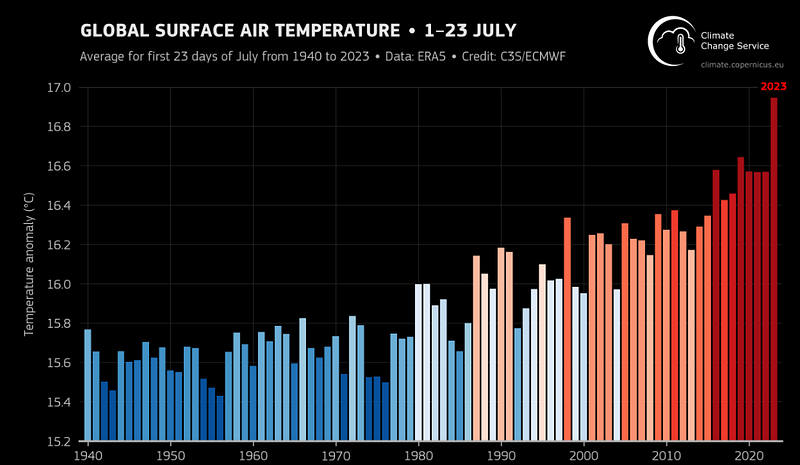
> UPDATE 7/27/23: Globally, July is on track to be the hottest month ever recorded, since record-keeping began in 1850, according to an analysis released today by the European Union climate monitor. <
The effects of rising heat on human health and mortality are not just serious but under-reported. Heat doesn’t make a big noise. It doesn’t blow buildings away or flatten villages. Death by heat can be sudden and unexpected, or slow, agonizing and silent. Either way, it rarely makes the news.
That’s why Wise & Well is publishing this special report.
In several articles, we’re exploring the realities of a hotter world that are most urgent for you to know, including the upper limits of human tolerance for heat, how hotter environments affect the mind and body during work, play and even sleep, who is most vulnerable and why, and how each of us can try to cope with the reality of a warming planet.
This article looks at what’s behind this underappreciated killer.
Hotter and deadlier than ever
Here’s the reality we face as a species circling the sun on this tiny blue ball supercharged by an increasingly dense layer of heat-trapping greenhouse gasses:
- The eight warmest years globally since record-keeping began in the 1800s are the past eight: 2015 through 2022.
- June 2023 was the hottest June on record for the planet, as measured by surface gauges around the world.
- July 4, 2023, was said to be the hottest day globally of any days in the record books. The mark was eclipsed July 5. Then again July 6.
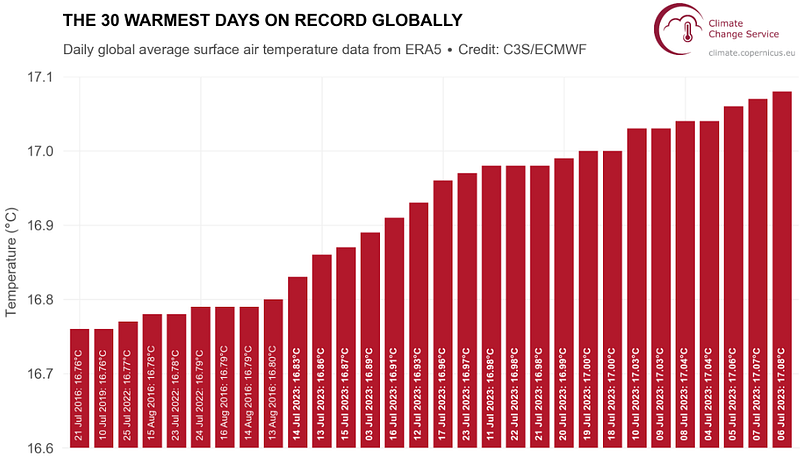
Earth has been hot before, cycling through uninhabitable warm stretches and frigid ice ages and even one period in which it was characterized as a giant snowball. But the planet hasn’t been this hot since at least the last ice age, and perhaps not for as long as 120,000 years, experts say, though estimates that far back are not entirely conclusive.
Whatever, people are suffering. A 71-year-old man died the other day after succumbing to the heat during a hike in Death Valley. Two women died while hiking on a 114-degree day in Nevada. While those deaths made headlines, far more heat-related deaths occur among older people stuck in homes without air conditioning, or among people with no place to live. Hidden amid the statistics, however, is the fact that no one is immune to the effects of extreme heat, and it’s becoming increasingly difficult to avoid the consequences.
- During the scorching summer of 2022, 60,000 people in Europe alone died of heat-related causes.
- On days of extreme heat, visits to US emergency departments soar for heat-related illnesses, including kidney disease.
- No age groups are unaffected. In fact, people 18–64 are more likely to be admitted to an ER on extremely sultry days than adults over 75, likely because they’re more apt to be outside, researchers speculate.
None of these statistics surprise David Hondula, Phoenix’s director of Heat Response and Mitigation, an office established in 2021 as the first such publicly funded department in the nation.
Hondula says heat doesn’t get the attention it deserves as a health hazard, in part because coverage of heat waves lacks the stunning imagery of hurricanes or tornadoes.
“Heat is arguably the leading weather-related killer in the United States — certainly responsible for more health impacts than most other hazards combined,” he said in a recent interview. “We can see the community that’s been devastated by the tornado. Phoenix is going to look about the same after this heat event as it did beforehand.”
And that look will still be a hot one, with blacktop mirages, hazy skies, and that ever-present blazing orange orb that’ll make the least religious among us pray for the cooling effects of a good monsoon downpour.
Making matters worse
Global warming acts as a multiplier of excessive heat, creating the potential for heat waves to be hotter and last longer. Urban development greatly exacerbates the problem.
By replacing natural terrain with pavement and an endless spread of homes and other buildings, we’ve created an environment that holds heat, rather than naturally reflecting it or absorbing and releasing it, as do trees, other plants and even the natural ground. Where I live, on the distant outskirts of Phoenix near undeveloped desert, it’s typically 5 to 7 degrees cooler than in downtown Phoenix on any given summer day or night. The effect at night, with elevated low temps, is particularly noticeable, with thermometers frequently staying above 100 degrees past midnight.
“What urbanization has done in Phoenix, its rise of high low temperatures, outstrips any city that we’ve ever looked at,” says Pope Moseley, MD, a research professor in Arizona State University’s College of Health Solutions. “This is a major metropolitan area with a massive rise in the temperature markers that determine human illness.”
Urban heat islands exist all across the country and around the globe.
About 85% of the US population lives in a metro area affected by some degree of urban heating. In the most highly developed cities, temperatures can sometimes be 15 to 20 degrees warmer than surrounding regions on a summer day, according to Climate Central.
Meanwhile, regardless of the reasons for extreme heat, Moseley and colleagues have found that during heat waves, most hospital visits aren’t due to heatstroke or heat illness directly. Instead — and this serves as a warning for anyone already in ill health when a heat wave strikes — several related and often pre-existing conditions account for the bulk of cases in which people need medical attention during a heat wave:
- Heart attacks
- Bloodstream infections
- Drug overdoses
Given these complexities, the lack of attention paid to heat as a major risk factor, and the paucity of research like Moseley’s, not all of the illness and death attributable to extreme heat is properly accounted for.
“If you tell me 200 people got sick, I’m going to say, ‘No, 2,000 people got sick. We just didn’t recognize it,’” Moseley said.
Solutions will take time that we don’t have
We are a highly adaptive species, when we apply knowledge gleaned from science to generate personal and societal solutions. Slowing global emissions of greenhouse gases is crucial to slowing the warming of our world, but there are ground-level measures that cities can take to greatly lessen the sun’s impact on any given day.
In Phoenix, the official temperature is measured at Sky Harbor Airport, which is surrounded by a vast, human-made desert of concrete and blacktop. Downtown, too, is mostly a built environment, contributing to the heat-island effect. More reflective roofs and cooler, whiter pavement surfaces are among the solutions that can curb the heat-island effect, research has shown.
Another proven approach: Plant more trees, Hondula points out.
“A more comfortable Phoenix of the future is one that has more shade,” Hondula said. “It could be 120 degrees at Sky Harbor Airport, but the experience of a person in the shade moving throughout the city can be much more comfortable than 120 degrees in the sun.”
While we wait for these trees to be seeded and grow, the world just keeps getting hotter. The atmosphere is already too loaded with greenhouse gasses for the current string of record-hot years to suddenly end. The next five years are expected to see ongoing above-average temps, according to the World Meteorological Organization, with a 98% chance of exceeding the warmest year ever, which was 2016.
Record-breaking heat waves will become “much more common” in Europe, North America and much of the globe, a study last year predicted. “The number of days with dangerous levels of heat in the mid-latitudes — including the southeastern and central US — will more than double by 2050,” said study co-author David Battisti, PhD, a professor of atmospheric sciences at the University of Washington.
Already in much of the world — even previously cooler coastal and northern climates — days upon days are becoming intolerable without air conditioning. And overnight lows are rising, too, making it harder to cool oneself down after a sweltering day, then making it hard to sleep well and find the rejuvenation needed to get up and do it again.
Poorer sleep is just one of the many knock-on effects of extreme heat.
My wife and I are runners, and here in Phoenix that means running in the heat, which we normally enjoy. But in the current month-long heat wave, we’ve been heading out just after sunrise, while temperatures are “only” in the 90s. Even with that tactic, many of our runs have been cut short by the rising temps. And we rarely see another runner or even people walking, where on cooler days we’d see several of both.
“Failure to reduce greenhouse gas emissions and to develop and deploy evidence-based heat action plans will mean a very different future awaits many people and communities around the world,” says Kristie Ebi, PhD, a University of Washington professor who researches the health risks of climate change. “Day-to-day summer activities — such as exercising and working outdoors — may change dramatically as increasing warming means people are at greater risk of exposure to intolerable heat far more often, particularly in tropical regions.”
Meantime, those 60,000-plus heat-related deaths in Europe last summer? That sort of annual tally is expected to become the norm by 2030, scientists say.
Learn more about the problems and solutions to extreme heat, including things you can do to stay healthy:


