
Hot in a hot car
My post-World War II parents were raring to shed the log cabin image of the Appalachian mountains, and power into mid-century modernism. But not so fast . . .
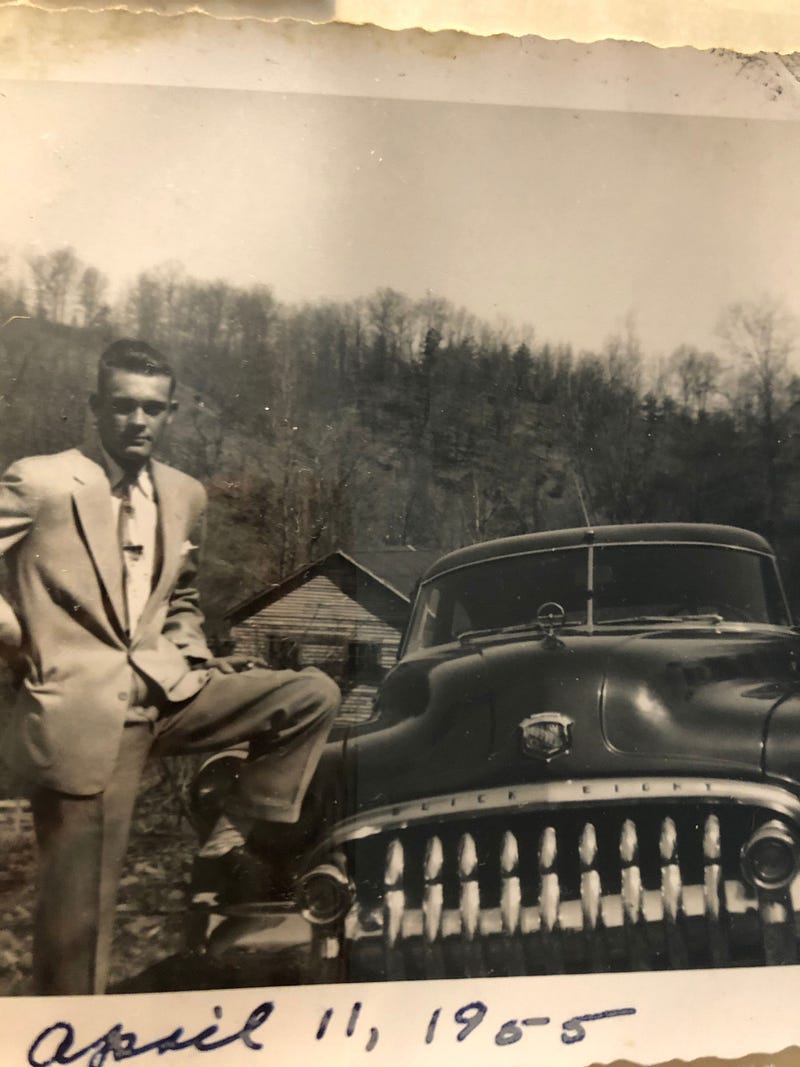
I owe my existence to a jet black 1951 Buick Special Eight, a toothy, but fashion-forward dynamo with wraparound windows and VentiPort holes on either side of the front fender. Powered by a Fireball Straight-8 engine, the Special was topped off with a sleek chrome bombsite hood ornament.
My dad was back from his stint with the Military Air Transport Service, in the United States Army Air Force. His oldest brother Hubert died in Belgium in October 1944. His brother Clebert was gravely wounded in June 1951 in North Korea as an infantryman in the U.S. Army. The horror and sacrifice of World War II and its aftermath was a fading memory. My mom was back in town, after a stint as an executive secretary in Lexington, chastened when she realized she wasn’t cut out to live in the Bluegrass.
These two were beautiful and hot, hot for each other, and hot for that sexy car. That was enough to justify Holy Matrimony, so the sexy Buick powered Carl Jones and Myrle Kelly to the courthouse in Tazewell, Tennessee in May 1954. By February, they had a son.
The Buick was still roaring when I was born on November 12, 1956, at the Middlesboro Hospital and Clinic, located on the Wilderness Road just north of the Cumberland Gap in Kentucky. I was 20 inches long and weighed 8 pounds, 7 ounces, the smallest of my mother’s four children, with thick black hair.
As a second child, there was not the exhilaration at my arrival that there had been for my older brother, who was the first grandchild on my mother’s side and very much doted on. But my mother was still enthused enough about her baby daughter to have kept a baby book. My mother wrote:
“When I was in the hospital, one morning about 3:00 they came in for the mothers to feed their babies and gave me a baby. I gave the baby the bottle and after he drank the bottle we were talking and I happened to discover that I had the wrong baby. So Judy had the breast, one time in her life.”
There I was, feeling the warm cocoon of being cradled in someone’s naked arms and drawing on the sweet warm vanilla of mother’s milk. The mothers, who are supposed to have a mystical bonding with their own child, look up and go “Whoops!” Then I am sent back to be poked with the cold nipple of technology. My mother never spoke to me about this incident.
There was another incident, though, that she told over and over. The first frost was unusually late the year I was born.
When my grandmother Gladys Kelly came to the hospital to meet me for the first time, she brought cut flowers from her yard, plants that would have died that night amid the heralding of fall, that slow strangulation of the hardwoods that produces the deprived and beautiful amber, citrine and claret leaves.
My other grandmother, Eva Jones, came not with flowers but with a warning. “That’uns color’s bad. Don’t get too attached to her. She’s not going to make it.”
By 1956, Middlesboro had long ago cloaked the meteor-strike site in a verdant robe of hemlock, oak, yellow poplar, and dozens of other trees. In most parts of town, the sun didn’t crawl up over the mountains until 10 a.m., the dew didn’t dry until noon and the setting sun didn’t get in anybody’s eyes driving home from work.
It was beautiful except when it rained too much, and the bowl started filling up. “You can throw the mop water out the back door and cause a flood in Middlesboro,” the old-timers used to say. In 1959, there was a particularly disastrous flood.

I remember being a little girl and walking out onto the back stoop and watching the floodwaters rise. Spiders and snakes raced just ahead of the gray, filmy, dead swirling water that came climbing up the back steps and inching into the furnace. Mixed all in the gray water were the little animals that didn’t make it, a field mouse that didn’t run ahead fast enough, along with the sewer overflow. A bunch of us kids got hepatitis.
Even though I was already skinny, and according to my grandmother Jones wore the Mask of Death, I got even skinnier. Looking in the bathroom mirror, I pulled the lower lid of my eyes down and saw how yellow the white part was. I started pissing bright orange and I felt too weak to get up. When everybody else got pork chops for dinner, I didn’t get any because they weren’t on my diet. I remember feeling really, really hungry and being the only one that couldn’t eat.
At night, while I was sick, I would start coughing and couldn’t stop. My mother would scream into my room, “Shut up. Shut up, Typhoid Mary!” and I would put the pillow over my head and cough as quietly as I could. I could tell from her screaming “Shut up” that she was really afraid that my Mammaw Jones’ prediction would come true, and that I was going to die. I had an awareness that my life was in danger, but I had a strong sense that I was going to survive. I felt sorry for how scared my mother was and how crazy she was to take it out on me. Looking up at her big wild blue eyes, I closed my eyes and wrinkled my forehead, and tried to send pure, positive thoughts directly into her head.
By October, Middlesboro was part of a four-state national disaster area due to flooding. In Middlesboro citizens were publicly protesting, boiling mad about flooding and frighteningly sick kids with legs and arms twisting and white like strands of twine. Kids like kids who don’t live in America.
Notes on the Buick Special: History of Buick: the bombsite hood ornament gave the feel of an imaginary fighter airplane. Combined with the bombsight mascot, VentiPorts put the driver at the controls of an imaginary fighter airplane. The idea for VentiPorts grew out of a modification Buick styling chief Ned Nickles had added to his own 1948 Roadmaster. He had installed four amber lights on each side of his car’s hood wired to the distributor so as to flash on and off as each piston fired simulating the flames from the exhaust stack of a fighter airplane.
https://www.gmheritagecenter.com/featured/Buick_Styling.html