
Horrible Ways to Die
Warning: This article is painful…
Punishments are just not as colorful as they were in Medieval days. When my kids act up, I like to regale them with tales of medieval torture devices. They, of course, roll their eyes because they know I can’t even spank them without DCFS at my door. Although medieval punishments are clearly barbaric, you have to admire our ancestor’s industriousness. Here are my favorite torture devices to inspire fear…
Hanged, drawn and quartered
Ever have a wishbone breaking contest with someone? Here’s the secret to getting the bigger end — don’t move. More stress builds up on the side that is being pulled.
Drawn and quartering is similar. But instead of two ornery siblings yanking on a turkey bone, your body is ripped apart by four whipped horses galloping in four opposite directions. It’s not a good way to go.
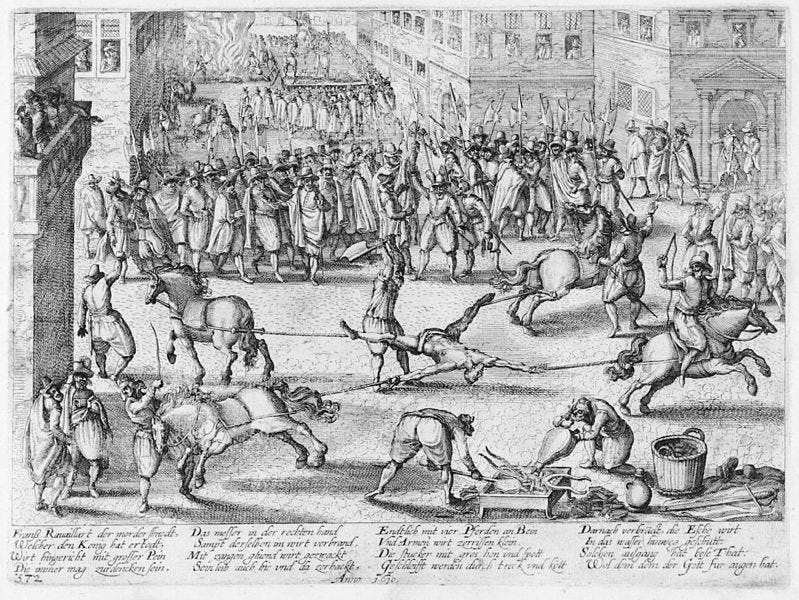
Drawn and quartering was reserved for the crime of treason. The process could involve many steps depending on the ruler’s creativity (and boredom).
First, the treasonist criminal was “drawn” — tied to a horse — and dragged to the gallows. In the next stage, the person was hanged but not until death. (Because that would spoil the fun.) Then the skies were the limit… The criminal could be castrated, disemboweled, beheaded, or quartered by four horses. Sometimes the criminal was chopped up into quarters first with their remains dragged around town. But you get the point. This gruesome death served as a spectator sport to deter treason.
The Pillory and Stocks
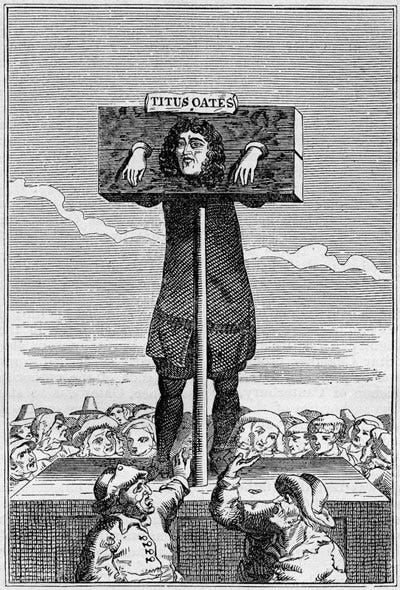
The pillory has become a playful prop in many Renaissance Faires, but this torture device would not have inspired a selfie.
The pillory was a wooden frame usually mounted on a post where the criminal would place their head and hands through the holes. Sometimes the offender’s ears were cut off and nailed to it as a public service announcement to all the village hoodlums.
Crimes that could get you pilloried include; libel, cheating, stealing, forging, vandalism, and even selling bad meat. (If you have ever had food poisoning, this seems like a fair punishment.)
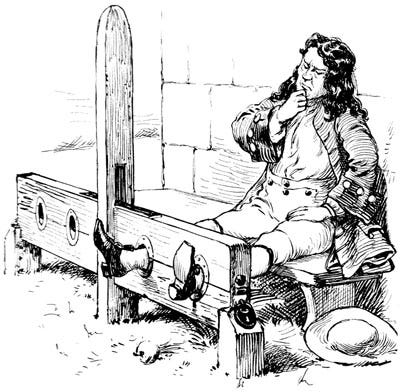
The stocks device was a wooden frame with holes for just your ankles. You were free to use your hands to make that “I wonder why I can’t move my legs” pose.
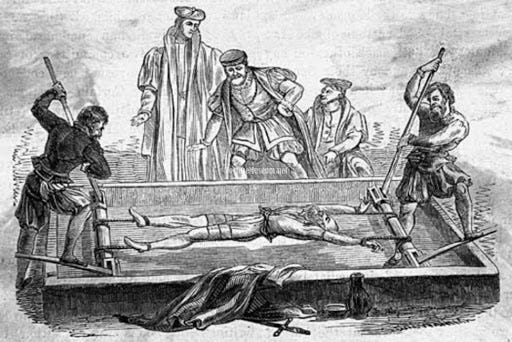
Breaking on the Rack
As someone who has had nine shoulder dislocations, the rack scares the bejeezus out of me. It truly was torture by inches.
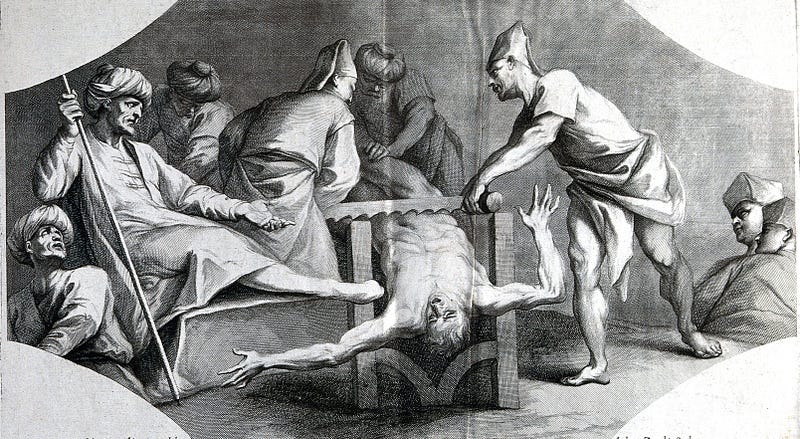
The victim would lie across a wooden frame with his hand and feet tied to a winding mechanism on opposite ends. Then the torturer would wind the wheel to stretch the person like a human Gumbi. Shoulders would dislocate, and limbs would sometimes be torn right off.
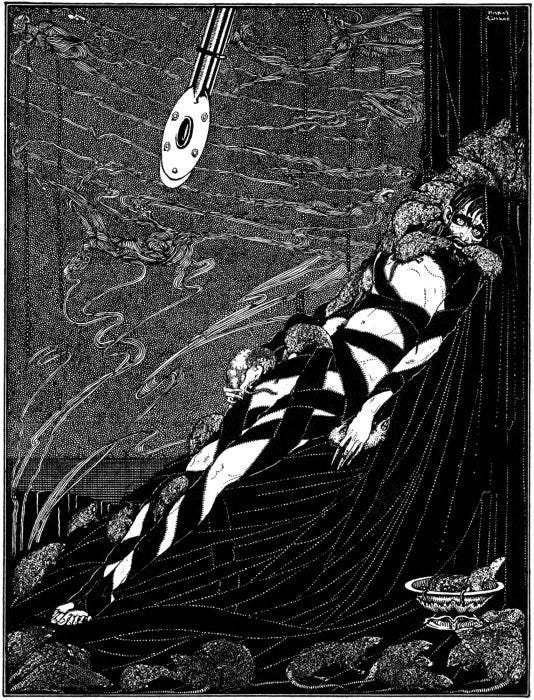
The pendulum
The pendulum was less common but wins on creativity. (Especially since it inspired Edgar Allan Poe to write The Pit and the Pendulum.)
The victim was strapped underneath a huge metal pendulum with a sharp blade affixed to it. The pendulum swung back and forth until it reached your helpless body and sliced you up like shishkabob. Most historians are not sure this one existed, but let’s not have them wrecking all our fun.
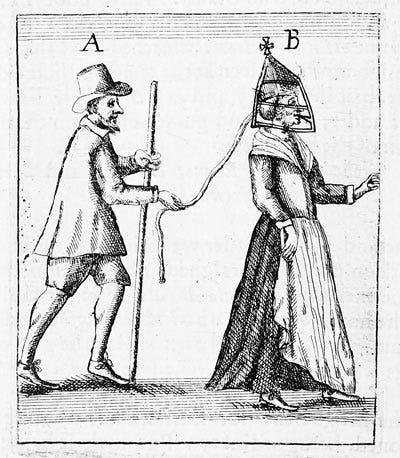
The scold’s bridle
Medieval men simply didn’t tolerate nagging women. Thus, this punishment was used to silence women who couldn’t hold their tongues.
The bridle was an iron cage that enclosed the head. Sometimes, a metal spike was placed inside the mouth to pierce the tongue if she tried to speak. Then the offending shrew was led around town like a horse. Women accused of witchcraft were often targeted, but sometimes husbands could lock up assertive women who “scolded.”
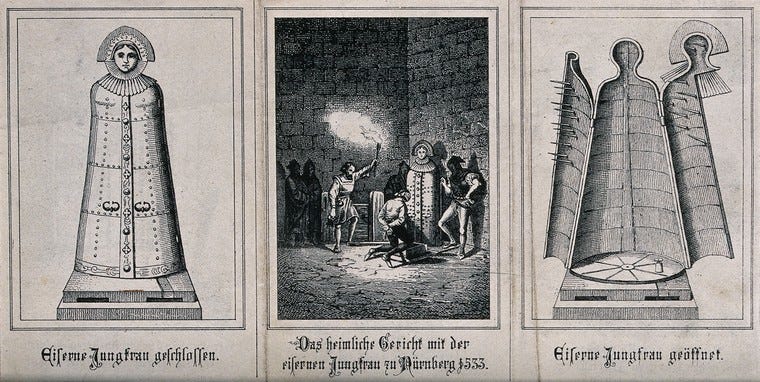
The iron maiden
Everyone’s worst nightmare is to be entombed alive in an iron sarcophagus. But trapped in a sarcophagus with impaling spikes…now that is just genius. The maiden had 21 spikes that were just long enough to penetrate your organs and kill you slowly. Historians long thought the maiden was the stuff of scary fiction until one was found in a castle in Nuremberg, Germany, in the 1800s. But this torture device was most likely never used in the medieval period.
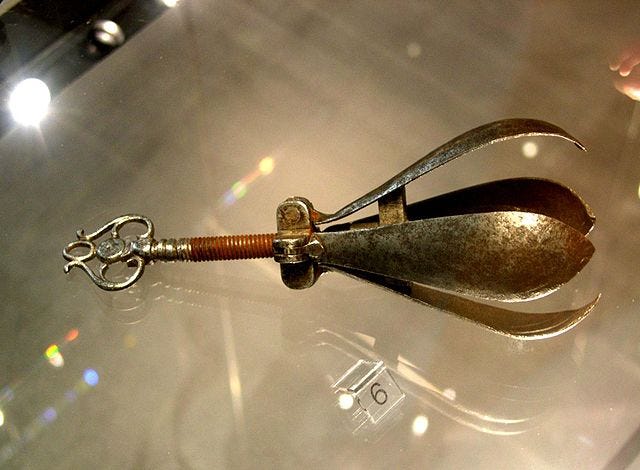
The Pear of Anguish
If I had started with this one, I probably would have lost half of you, so I saved the best for last. This egg-beater-looking device was placed inside the orifice of choice (use your imagination). It was then cranked open so that the four leaves slowly expanded and ripped open your internal organs. This torture was reserved for those accused of witchcraft and homosexuality. And it probably inspired future gynecologists.
If you enjoy the macabre, I recommend a trip to The Torture Museum in Siena, Italy. Good times for the whole family!


.png)

