
HOPR Launch Phase 2 — Balancer Liquidity Bootstrapping Pool
Phase 2 of the HOPR public distribution is about to start, and anticipation on our Telegram channels is reaching fever pitch! As voted for by the Genesis DAO, 30m HOPR tokens (plus any leftover from the presale in Phase 1) will be placed in a Balancer Liquidity Bootstrapping Pool (LBP) for 72hrs, balanced against the initial capital of almost $2.5m DAI (converted from xDAI) raised in the presale. This will be the first chance for people outside the Genesis DAO to get their hands on HOPR tokens and will serve as a price-setting mechanism for the HOPR token as it moves into the wider world.
But what is a liquidity bootstrapping pool, and how do you participate?

How to Participate — The Basics
Participating in the public launch is simple. First, make sure you have DAI or any other asset that is supported by Balancer. DAI is a stable token on ETH mainnet, so each DAI ≈ $1. (Note that this is NOT the same as xDAI, which was used in the presale!)
Any time after the LBP starts on Wednesday 24th February at 14:00 CET, head to our dedicated token page, click the blue button, read and accept the disclaimer, and you’ll be taken to the dedicated HOPR LBP.
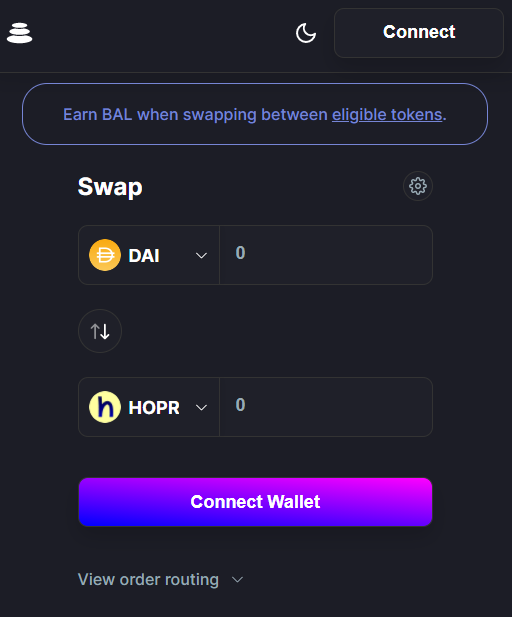
Once there, connect your wallet (e.g., Metamask) and select your exchange pair. Be aware that if you choose anything other than DAI to pair with HOPR, Balancer will route your transaction via at least one intermediate pool, which will incur an extra gas cost and could also introduce costs from asset slippage in the intermediate pool.
Follow the prompts — being careful to provide enough gas for the transaction to complete — and you’ll be able to get some HOPR (or vice versa — any HOPR acquired in this phase of the public distribution is immediately liquid and available to trade).
Please keep in mind that trading ERC20 tokens (such as DAI or HOPR) on Balancer requires two transactions: in the first transaction you approve Balancer to withdraw DAI from you and in the second transaction you do the actual swap.
That’s all there is to it! Once the transaction confirms, you’ll be one of the first people to hold liquid HOPR tokens. Congratulations!
But before you rush off to participate, there are a few things worth understanding about how LBPs work. An LBP is very different from other ways you might have gotten crypto in the past, such as launch sales, so it’s important to understand the mechanisms that will determine the price of HOPR tokens over the three days in which the pool is active.
Liquidity Pools
Let’s start with the basics of a normal liquidity pool. If you’ve spent any time in the DeFi space, you’ve probably at least heard of Uniswap, the most well-known tool for liquidity pools.
A Uniswap pool holds two tokens, let’s call them X and Y. The value of each asset in the pool is a simple matter of the ratio between them. If a pool has 100 X and 1000 Y, then 1 X is worth 10 Y. Looked at another way, you could put in 1% of the total available X and receive 1% of the available Y in exchange.
But doing this would change the amounts of each asset in the pool. There would now be 101 X and only 990 Y, so the relative value of each will shift. If this deviates from the price in other exchanges and pools, arbitrageurs will swoop in and swap tokens until the price returns to the market value.
Uniswap implements the most basic version of a pool, where the price is set solely by the relative amounts of assets in each pool. Balancer lets you create pools where assets are given different weightings. In the example above, you could set up a Balancer pool which, e.g., shifts the weighting in favor of token X. This makes sense for traders who want to provide liquidity on Balancer to earn trading fees but also keep the majority of their exposure on that token even if the market moves.
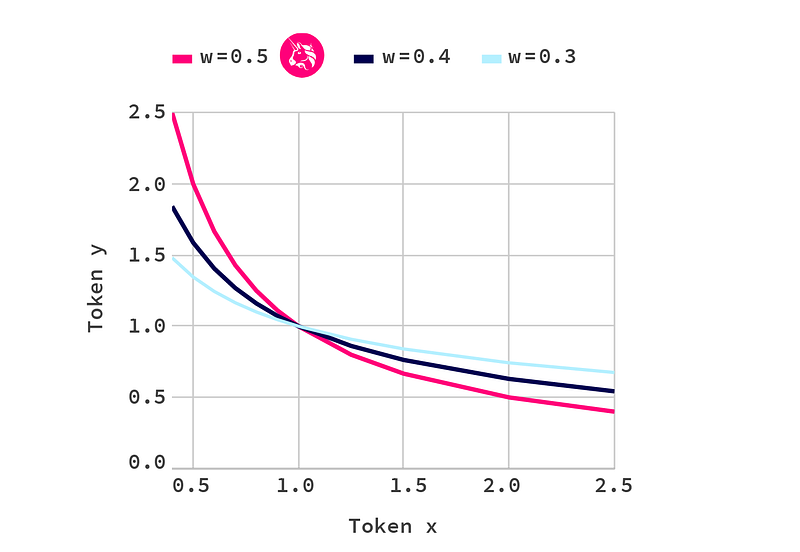
This is mostly important for liquidity providers — the people who provide the underlying assets which let pools run — and needn’t concern regular users too much. But this ability to weight assets creates some very interesting new ways to use pools.
Uniswap and weighted Balancer pools are a great decentralized tool for exchanging assets where the general price of both assets has already been established through trading elsewhere. The relative value of each token is known, so it’s easy to work out how many of each should be added to the pool at the start, having factored in the desired weights. Then as the relative price shifts, people will add tokens to the pool to take advantage of temporary arbitrage opportunities, ensuring the pool returns to the correct ratio of tokens.
But what if the correct price for a token hasn’t been established, because it’s coming onto the market for the first time? This is the situation for the HOPR token.
Balancer Liquidity Bootstrapping Pool (LBP)
A Balancer Liquidity Bootstrapping Pool is a tool designed to allow a project to generate liquidity from a smaller amount of seed capital than would normally be required. This is achieved through variable weighting of assets.
Unlike Uniswap (where the two assets in a pool are given equal weighting) or a standard public Balancer pool (where the weights are different but fixed) the weights in a Balancer LBP can be programmed to change over time.
In our case, the weights for HOPR and DAI will start at 96:4 and gradually shift towards 40:60 over the 72hrs the pool is live. Thus, assuming no-one makes a trade, the price will start very high and tend towards a much lower figure. If you think the price is too high, all you have to do is wait a few minutes or hours until it reaches a value you think is correct. Again, assuming no-one makes a trade.
But of course people will be making trades! And then the normal supply and demand mechanisms we discussed for regular pools come into play: If you send DAI and receive HOPR, there will be less HOPR in the pool and the price of HOPR will rise accordingly.
Thus unlike a standard pool, with a Balancer LBP there are two ways the price can change: there’s a constant downward pressure on the price from the variable weightings, but this price will be bumped up every time someone sends DAI to the pool in exchange for HOPR tokens.

One great analogy we’ve been seeing on the HOPR Telegram channel is the viral mobile game Flappy Bird. In that game, Flappy Bird would constantly drop towards the bottom of the screen, unless you tapped, which would give a temporary boost in height. Adding DAI to the HOPR LBP is a similar nudging mechanism, pushing the price up slightly each time and counterbalancing the downward pressure of the shifting asset weights.
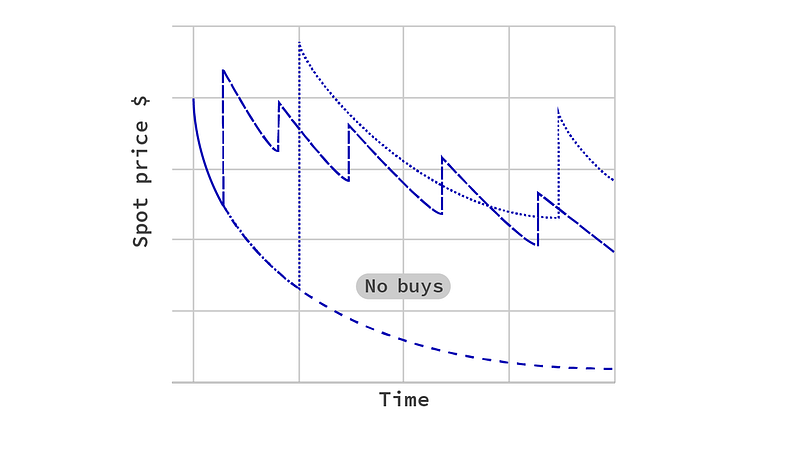
The graph above shows some examples of how the sale might proceed, with the bottom dotted line being the hypothetical extreme case of no buys. Every “jump” in the top two lines represents a different sized purchase of HOPR tokens, after which the LBP re-weighting continues its downward price pressure.
What Will The Starting Price Be?
The starting price for an LBP is determined by the amount of reserve asset (in this case DAI) and the initial weighting.
One common assumption we’re seeing on Telegram and elsewhere is that the starting price will be $0.30. This is an example price we’ve been using to illustrate how Balancer works, based on fairly modest expectations for the presale. Since those estimates were blown away and the presale has almost raised its maximum of 2.5m xDAI, expect a starting price well above $1.70.
Remember: that doesn’t mean HOPR tokens have been valued at $1.70! As explained above, the starting price is just a place for the LBP to start before the decreasing weight function kicks in, and will drop rapidly.
The actual starting price will be announced on Telegram once the presale closes.
When will the Weightings Change?
Although the reweighting mechanism is modelled as a smooth curve, weights are actually updated manually. A `pokeWeights` function is called on the smart contract, which then updates the weight based on the time since launch. This will happen in steps: quickly at first, then more slowly as the launch progresses so that the pending price update is never over 10%.
0–5h after launch: Weight updates every 30 mins
6–19h after launch: Weight updates every hour
20–41h after launch: Weight updates every 2 hours
Afterwards: Weight updates every 3 hours
Note that these are the pre-arranged times when the weights will be updated by the Genesis DAO — anyone can choose to update the weights at any time using the `pokeWeights` function. This costs a fee, so it only makes sense to do if the change in price will cover the gas cost. If you’re not experienced at using these pools, we don’t recommend doing this, just be aware that the weights can be updated at any time. The more times the weights are updated, the closer the reweighting behaviour for the sale will be to the theoretical curve.
So What’s The Best Strategy?
We can’t give you direct advice on how best to participate in the LBP, as that will depend on your own circumstances, but based on the conversations we’ve been seeing in Telegram over the past week, here are some things to consider/remember:
It’s not a race!
Balancer LBPs are a price finding mechanism, so the initial price is high by design and will fall quickly in the absence of any trades. FOMO can be strong in crypto, but here it can really hurt you here. We had people participate in the very first block that our presale was available, which is great because the price was fixed. An LBP is more of a waiting game.
It’s not a sale!
The Balancer LBP is the first public opportunity to acquire HOPR tokens, but it’s not a one-way street. Unlike the presale, where the only option was to send xDAI in exchange for HOPR, you can both buy and sell HOPR for any token supported on Balancer.
Make Sure You’re On The Right Network
The Genesis DAO presale was hosted on xDAI chain, but the LBP is on the Ethereum mainnet, and denominated in DAI. You can’t accidentally send the wrong token to Balancer, but if you’ve accidentally got xDAI instead of DAI for this phase of the launch you’ll need to convert them, which will cost you gas.
Watch Your Gas
The Balancer LBP is an Ethereum smart contract, so it costs gas to interact with it. While there’s no limit to the number of transactions you can make, in both HOPR and DAI, remember that it will cost gas every time. In the current market conditions, making lots of rapid trades or changing your mind could get expensive, fast.
Also, make sure you adjust your gas settings to ensure that the transaction completes in a timeframe you’re happy with. All transactions sent to the pool with sufficient gas should complete, but if you set a low price then this could take some time, at which point the price you get could be significantly different from the one you saw when you initiated the transaction.
I hope this quick overview has given you everything you need to know about Phase 2 of the HOPR launch. If you have any more questions, the ambassadors are ready to help on Telegram as always.
The HOPR LBP will launch at 14:00 CET on Wednesday, February 24th and run until 14:00 CET on Saturday, February 27th. Don’t forget we also have our global event on the 24th to kick off the LBP and celebrate the upcoming HOPR Jungfrau release.
I hope we’ll see you there!
Sebastian Bürgel, HOPR Founder