
Hopes and Fears of Migration in a Poignant Painting
The beginnings of a life-changing journey

Works of art sometimes have a way of capturing a truth that might otherwise seem hard to imagine.
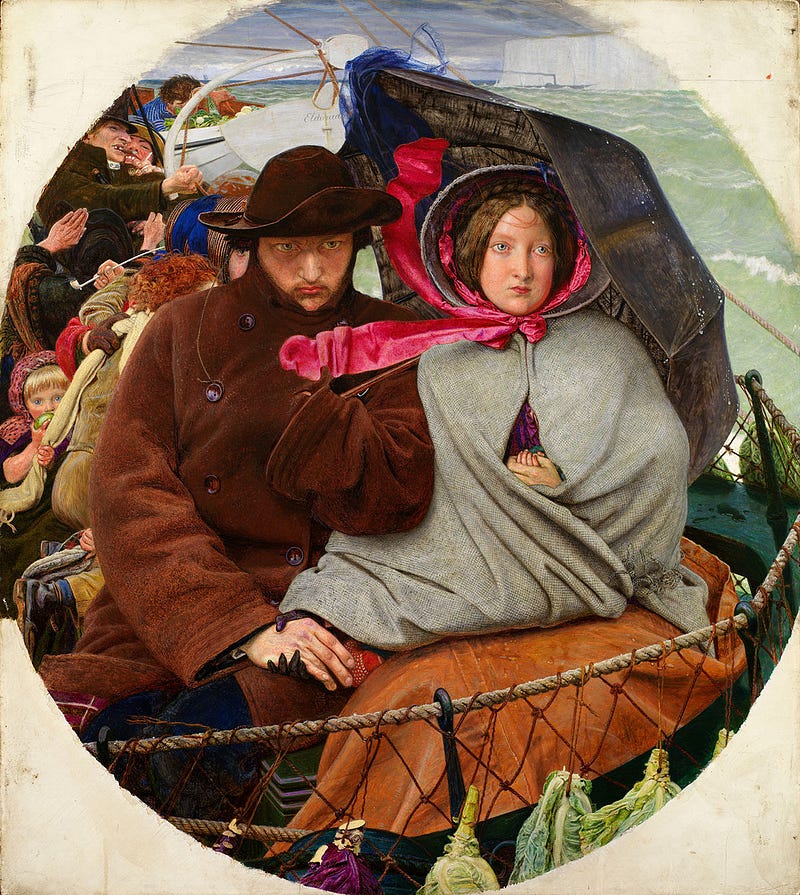
The first impression of this painting is rather forbidding, but give it a few moments and this image will take you into the life-changing moments of a couple relocating to a new life.
It achieves its power through the artist’s meticulous attention to detail and brilliant use of colouration, coupled with the psychological depth of the foreground duo.
Painted by the English artist Ford Madox Brown, The Last of England depicts a boatload of families leaving the shores of their home country in the hope of finding better fortunes in a new life overseas. Most likely bound for the gold fields of Australia, the white cliffs of Dover — their port of departure — recede into the distance behind them.
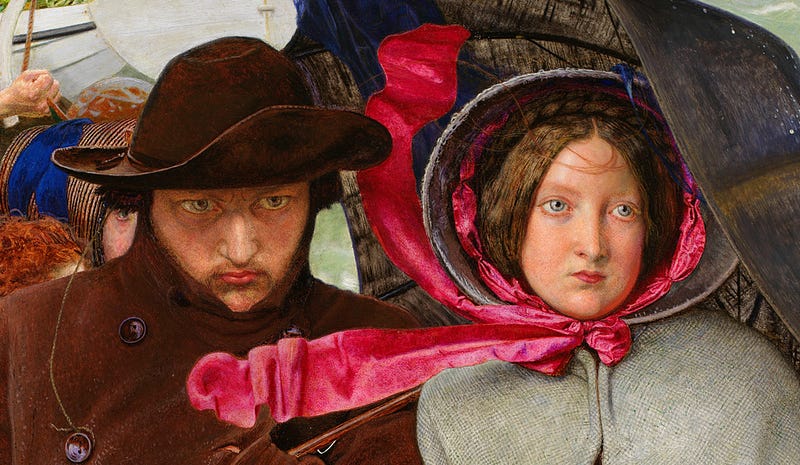
The two main characters are husband and wife sitting side-by-side on the outer deck of a boat. They are huddled beneath a wind-warped umbrella that protects them from the spray of the water. Her pink scarf ripples across them, whipped up by a fierce wind. One of the easily missed details is the piece of string the man has used to tie his hat to the button on his coat — presumably to stop it from blowing away.
The husband bears a forlorn appearance, staring ahead with piercing eyes and a somewhat crestfallen frown. Emigration was not an easy choice, and his expression tells us much about the misgivings that such an uprooting might bring about.
Beneath the rim of the hat, his facial expression supplies a sense of his inner feelings. Brown described: “The husband broods bitterly over blighted hopes and severance from all that he has been striving for.”
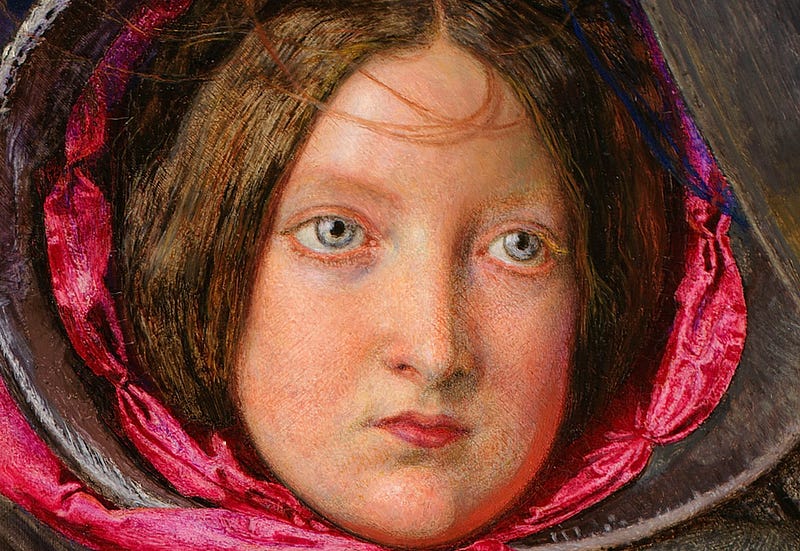
In contrast, the woman gazes headlong, perhaps invigorated by a sense of hope and perseverance that comes with the opportunities that change can bring.
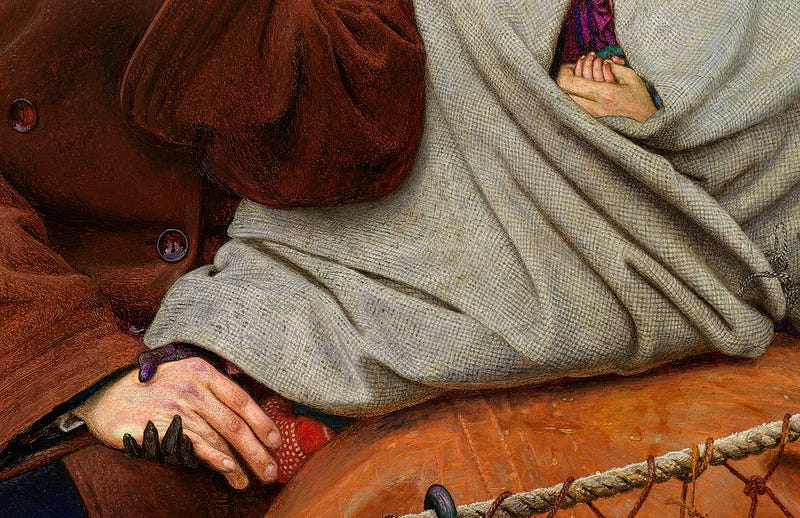
The husband and wife are actually a family of at least three. If you look very closely, you can see the suggested form of a child — inside the woman’s shawl — whose little hand clutches onto its mother’s between a gap in the material. These two hands holding each other are echoed in the hands of the child’s parents clasped nearby.
Brown was a member of the Pre-Raphaelite movement, a British group of 19th-century painters who believed that every detail of the visible world could reveal a truth. This is why every thread of their clothing and every ruffle in the woman’s pink scarf is so immediate — almost there to touch.
Behind them, the pale-green waves of the sea race towards the side of the boat relentlessly. The volatile conditions tell us that the crossing promises to be long and arduous. Around the boat’s edge, a row of green and red cabbages dangles from the netting — the passengers’ sustenance during their journey.
During the 19th century, Britain had one of the highest rates of emigration of all European countries. People travelled to the territories of the British Empire. Many of them were farmers, labourers and craftsmen from traditional trades, with many who departed en masse in family groups.
Brown himself was by no means insensitive to the social conditions of his country at the time, writing, “The educated are bound to their country by closer ties than the illiterate, whose chief consideration is food and physical comfort.”
This couple’s situation is perhaps a little different to the norm — reflecting the artist’s own circumstances. The woman’s expensive-looking headscarf and the books stacked under the man’s seat tell us they are most likely middle-class. Being from an educated background, their migration is more likely out of choice, as opposed to the working classes who may feel they must move out of necessity.
Brown painted this work between 1852 and 1855. It was not an easy time in the artist’s life, since his professional success was faltering and his lifestyle was dominated by poverty. He was considering his options over what to do next.
In 1852 he watched his friend and Pre-Raphaelite sculptor, Thomas Woolner, leave Gravesend harbour to emigrate to Australia. After this, Brown also considered emigration — himself to India — in an attempt to alleviate his worsening circumstances. He described himself at the time as “…very hard up and a little mad.”
Brown never did emigrate from Britain. The couple in the painting are modelled on himself and his wife, imagining a journey they never took. He described the painting in a catalogue entry for an 1865 exhibition:
“In order to present the parting in its fullest tragic development, [I] singled out a couple from the middle class, high enough, through education and refinement, to appreciate all they are giving up, and yet dignified enough in means to have to put up the discomforts and humiliations incident to a vessel.”
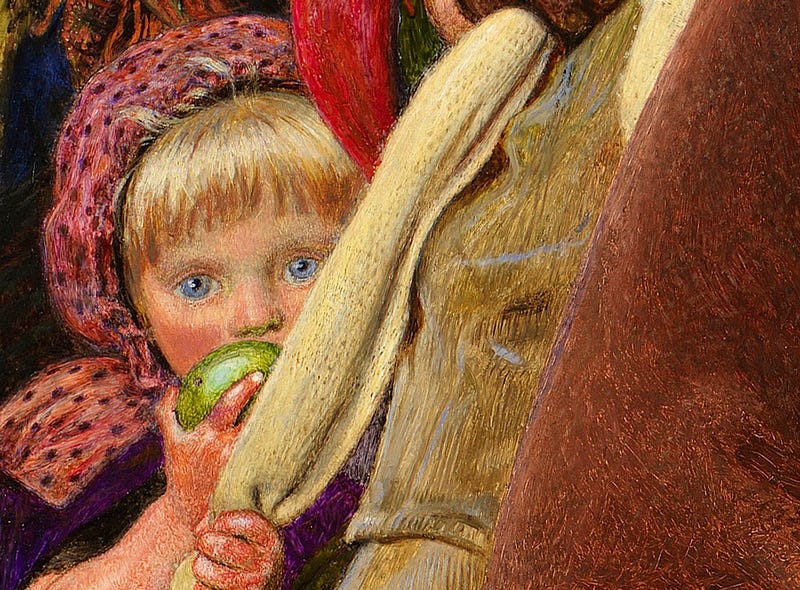
Other voyagers are on board too, all tightly packed onto the ship. A father smokes a pipe, a blonde-haired child eats an apple, and a mother and son huddle together for warmth.
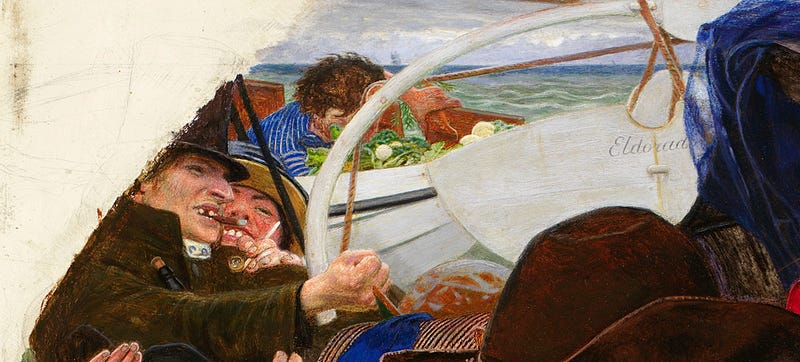
All of these details are crammed into the narrow left-hand margin, giving the composition a convivial yet hectic feel — reflecting Brown’s “discomforts and humiliations”.
The dinghy painted in the background gives a clue as to the hopes (if not expectations) of those aboard: its name, Eldorado written on the white stern, refers to the mythical “city of gold”.
Above all, Brown’s work revels in the precisely painted details of the boat and the couple aboard it. Just looking across the clothes of the main couple, one finds an extraordinary description of various fabrics, from the woven cloth of the woman’s shawl to her silk headscarf, from the fur of the man’s coat to the leather tarpaulin they use as a blanket, not to mention the realistic details of the sea and sky.
The work is painted in a circular composition known as a tondo. The word tondo derives from the Italian word rotondo, meaning “round”. Many Renaissance artists used the circular composition in their works, including Botticelli and Michelangelo, a technique which they revived from Greek precedents. Brown appears to have wished to renew the technique for his own times, perhaps because of these eminent predecessors.
Indeed, the Pre-Raphaelite movement sought to revive the fine pictorial detail, vibrancy, and intense colours of early Renaissance masters. Rebelling against the established rules of picture-making taught at the Royal Academy School, their paintings were characterised by a commitment to visual precision in every corner of the canvas.
It is through these graphic details that the viewer can empathise with the family’s experiences of both loss and steadfastness, and in doing so, turn the work from a comment on social reality into a distinctively vivid image of fear and hope, anxiety and tenacity.

This painting is featured in my book, How to Read Paintings, a beginner’s guide to learning more about inspirational works of art.
Would you like to get…
A free guide to the Essential Styles in Western Art History, plus updates and exclusive news about me and my writing? Download for free here.
Join me…
On Instagram for more great paintings on the go!