
FUTURE
Hope Is the Key Word Today
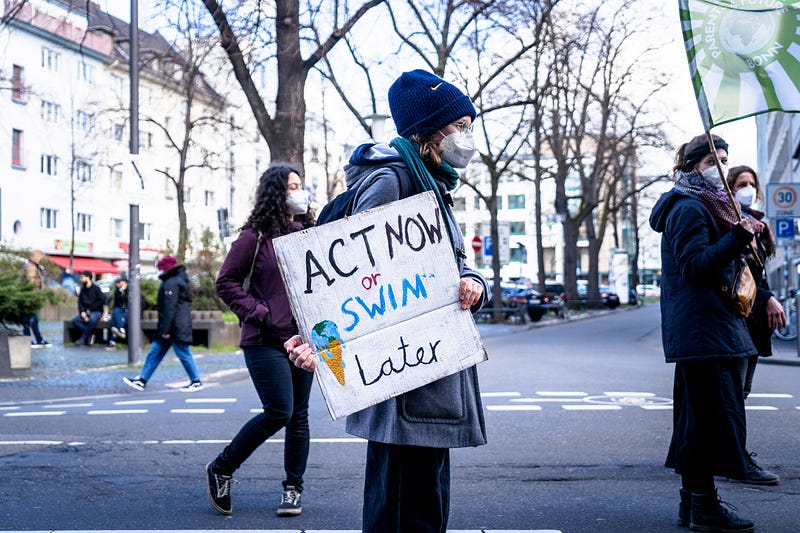
If we want to convince those who do not believe that climate change is real, we should not convey only negative messages saying that we are heading for a global climate catastrophe. This way of arguing works against its purpose in the public debate.
What are we doing wrong when we talk about the future and the disasters that are about to occur? The worst thing we can do is take hope away from the generations after us.
It is not the facts we come up with that are wrong; it is not the facts we use to describe the situation that are wrong, but it is the message we present when we deliver the conclusion, the sum of the factors that science points to and that leads us to where we say we’ll end up: in a catastrophe.
Shouting warnings we are heading for a global climate catastrophe works poorly if we want to convince those who do not believe in climate change. What climate skeptics are looking for is something to believe in — a hope for the future, either that the climate changes are not so dangerous, or that humans are able to create a society where everyone can live safely and feel good in the future as well.
We do not have to hide the facts about climate change and its consequences. But we need positive descriptions of the future that show the way to measures that can be implemented today and in the near and distant future, measures and plans that provide hope!
We must not take away from people the belief in the future and make them feel that they have no influence or that it is impossible to fight against the negative consequences of climate change.
Painting a black picture of the future is useless
What I think is about to happen is that the adult generations, my generation and some generations after me, have accumulated a great deal of knowledge and insight into problems, and we have so much scientific evidence that we must tell the world about.
We are the 1960s, the 1970s and the 1980s generation. And when we were younger, we got quite a lot of thought and action space from our parent generations — didn’t we?
But today we forget to see it from the perspective of the younger generations, those who today are 20, 30, 40, maybe 40 years old. — What do they think about this?
The big danger here is that many of the younger ones do not speak out. Maybe they are insecure. They have read and heard about all the sinister and horrible things that will happen in the future, and learning this does not have a positive effect on them. Some of them may be sad and depressed because they feel they have no future. And this is obviously a completely wrong way of looking at things.
The worst thing we can do is take the hope away from the generations after us.
It is quite natural and logical that the younger generations see it this way because all their lives they have hardly heard of anything but disasters and gloomy predictions about the future.
The defense mechanism for many of these may be that they avoid talking about the future. I’m a little unsure of this, because I do not know people who think like that. Actually, I don’t know anyone who says he or she believes in conspiracy theories à la Q-Anon.
Some people turn to the comfortable illusions of conspiracy theories and think that it is better to believe in such theories than to believe that the catastrophes happen. If you turn your back on the unpleasant, you will not see it. And when you do not see it, you stop thinking about it all the time. And then you can rather think other thoughts, about other things that disturb less the peace of mind.
It is more comfortable to believe in alternative truths, because we then can create distance between ourselves and the ugly prophecies that come with the climate crisis rhetoric. People who refuse scientific evidence and facts about the dangers that threaten in the future in many cases activate their mental defense mechanisms to feel relief from the ugly threats. And they turn to alternative truths, as they do over there in America.
I think that’s exactly what’s happening over there. There are very many people who have lost hope, for many reasons, and it is catastrophic! You must never lose hope, because then I think the road is short to turn to conspiracy theories and think that — yes, things will go well in the time I live, the time when I love, drink prosecco, wine and beer, dance, and enjoy life!
I think this is what happens. People who lose all grip on themselves and the world around them, they only see themselves and their own misery. And they turn away from the prophecies of the catastrophe.
They turn to Q-Anon, Trump and that kind of drug.
You’ve got the point, right?
The climate crisis is real, the future is uncertain
That’s the truth. But we must avoid grinding black, because we must avoid taking the hope from the generations that will come after us.
Catastrophe, so we said?
Yes, right here we are at the heart of the problem, namely that these are changes that are very sure to happen and that have been going on for many decades, part of it all from the middle of the 19th century, when the industrial revolution began and CO2 emissions start.
These are the important facts in the new report from the UN’s climate panel, the IPCC, which was published a few days ago:
The IPCC estimates in the report that humanity from 1850 to 2019 emitted 2,390 giga-tons of CO2. This has led to a global warming of 1.07 degrees compared to the period 1850–1900. According to the IPCC, future CO2 emissions must be limited to less than 500 giga-tons if the probability of limiting heating to 1.5 degrees is to be higher than 50 percent. If the probability is higher than 67 per cent, the emissions must be kept below 400 giga-tons of CO2. This means that the budget will be used up in just ten years if the current global emission level of around 40 giga-tons of CO2 a year continues. Source: www.tv2.no/nyheter/
CO2 emissions have led to changes that are not reversible. The report from the IPCC confirms that a development is underway, and some of the changes that have begun cannot be reversed. It’s been too long, it’s too late.
Thinking the future
We must try to think ahead for longer periods of time — for generations and not for months, years or decades. What happens in the future will happen, no matter what, not now, but in several decades to come. But it’s not that far away, it’s when my children and grandchildren live, when my children turn 50, 60, 70, or 80. And that’s when my grandchildren turn 40 or 50. And that’s not nice to think that they will live in a world that is much more insecure than our world. For this reason, we should intensify our efforts to prepare for the future.
There is hope
We should rather include in the message of the future catastrophe that there is hope, and concretize these hopes in the form of creative proposals and positive descriptions of what can be done to counteract the negative consequences of the climate crisis. We should make great efforts to imagining what can be done to create a future society where it is possible to live and feel good also in 50 years, and in 100 years.
I rarely see anyone write about it, or that someone discusses what kind of society we can have in the future. What we see today is simply a sign of illness: Very rich people, billionaires are finding out that they are going to buy land in New Zealand or in similar locations. And they will settle in their bunkers in New Zealand, because this and other island states are supposedly the safest place on earth to be when it comes to the risk of being invaded by foreigners who want to enter the country because they are fleeing natural disasters, war and other misery.
What is needed for us — and the younger generations — to read and hear about what man, we, can do to survive. Because we must not be history less! We have managed, and we have developed ourselves and society further already through many thousands of years — not least through the 20th century, with its two great wars and with the threat of nuclear war hanging over us up through the 60s, 70s and 80s.
In my view, we have done well at the beginning of the 21st century as well. But we need more stories, more facts about what can be seen as positive also in the future. We do not need to be told dystopian stories!
We just have to stop painting the devil on the wall all the time. We have to be more careful when talking about the catastrophic consequences of the climate crisis. We must dare to think in other ways. We must think constructively and see what can be done to give our children and grandchildren faith that we can create a good future also for their children and grandchildren. In the world today there is a huge lack of positive stories on how humanity can build a safe and happy future.
An example of a constructive way of meeting the challenges can be what happened and still is happening in the automotive industry — maybe with Tesla in the driver’s seat — I do not know. Many other companies also have taken the challenges of developing electric cars as seriously as Tesla. Efficient and functional electric cars were something we did not think was possible just a few years ago. The automotive industry produces in large-scale cars that are profitable to produce, price competitive and reliable in operation. In just a few years, they have realized something that for the 15–20 preceding years was considered an unattainable utopia.
But is this not what we have utopias for? They show us the way, show us what might be possible to accomplish! It is also important that we create opportunities for those who have ideas and a willingness to invest in what may not seem feasible in the first place.
Media have a special responsibility
I think the media have a special responsibility here. Media tend to focus on sensational stuff, mostly negative events that occur in the society. Media should in a much larger scale present positive visions of what the future can be, and what is possible for us to aim at.
For example, we — the politicians, the media, the tech world and the industry, together with all of us, people of the world — should think about concrete changes that the climate crisis is likely to lead to, and we should think about what measures we can implement to prevent or limit the harmful effects.
An example could be that the sea level rises by a meter or two. Sea levels are rising, and the question is: What do we do about it? Many countries have large areas of land that that will be inundated — what does one intend to do with it?
These are colossal, big challenges, but it is possible to read about them and discuss them — and it is possible to plan.
It is possible to think ahead and work together to make plans for us to bring about changes, and it will be profitable for everyone, at the same time as it saves our future.