
Honoring Native American Art
Giving thanks and visibility in the Southeast
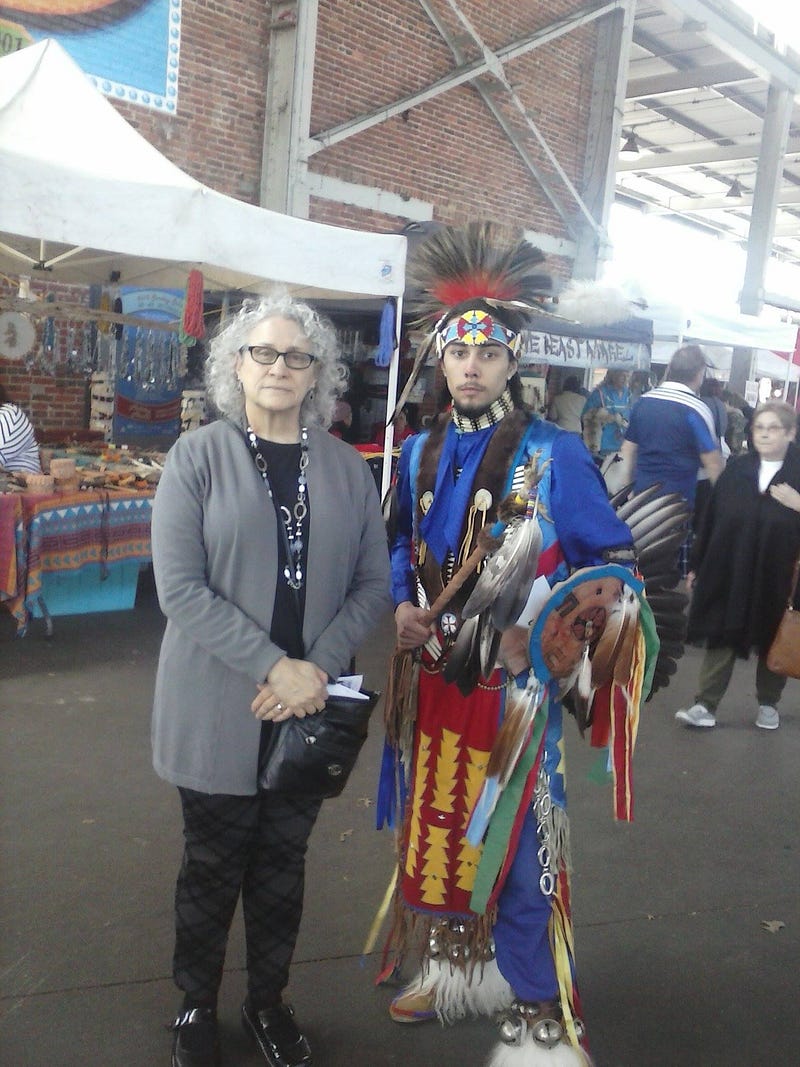
There is much beauty to celebrate in Native American art, but that it’s a struggle to create given the devastating historical events surrounding Native Americans. The Cherokee Nation had a culture that thrived for almost 1,000 years in the Southeastern United States: in Georgia, Tennessee, North and South Carolina, and parts of Kentucky and Alabama. Life of the traditional Cherokee changed drastically with European expansion and cession of Cherokee lands to the colonies in exchange for trade goods. Migration from the original Cherokee Nation began in the early 1800s as Cherokees wary of white encroachment moved west and settled in other areas of the country’s vast frontier. Their eventual removal by force prompts the question of whether there is any Cherokee cultural presence remaining in the Southeast.
The Indian Removal Act of 1830 was authorized by President Andrew Jackson, once an ally of the Cherokees. Despite opposition from Senators Daniel Webster and Henry Clay and a Supreme Court Challenge, the federal government justified its removal citing the Treaty of Echota, signed by 100 Cherokee leaders. Native American opposition to the Treaty, led by Chief John Ross, could not prevent most of the 17,000 Cherokees from being rounded up, shipped, and marched into rugged territory. Today, what remains of Echota is a only a small museum in Georgia. It’s estimated that 4,000 died in the journey, often referred to as the ‘Trail of Tears’. That Trail often began for them in Chattanooga.
Chattanooga began to pay tribute to its Native American history with The Passage, the nation’s largest public art project. The Passage is a link between downtown Chattanooga and the Tennessee River at Ross Landing, named for Chief John Ross. At the opening of The Passage in 2005, Cherokee Nation Chief Chad Smith said “My hope is that what Chattanooga is doing is not an anomaly, but the beginning of future positive relations with the US.Over the next 20 to 100 years, we hope to see relationships between the Cherokee Nation and the US begin to grow, both personally and economically … Our homeland is still a spiritual and important place for us. The Trail of Tears is the most tragic event the Cherokee Nation has ever experienced but with the creation of The Passage, Chattanooga is sending to the Cherokee people a message of hope. I hope The Passage is the first step towards a new relationship between Native Americans and the US government.”
In 2004, artist Bill Glass, Jr. established Cherokee Artists Gadugi Inc., a group of five Cherokee artists, which Chattanooga, Tennessee commissioned to create artwork for the Tennessee River walkway memorial known as The Passage. Glass is a prominent Native American artist whose work can be found in the collections of Five Civilized Tribes Museum in Muskogee, Oklahoma, Heard Museum in Phoenix, Arizona, Institute of American Indian Arts Alumni Museum in Santa Fe, New Mexico, Atlanta History Center in Atlanta, Georgia and the Stovall Museum in Norman, Oklahoma.
Glass is a contemporary ceramist who uses traditional and contemporary techniques, “The final product is durable and with the addition of glazes for colors and surface textures, I’m able to create pieces that relate to a Southeastern style of Indian Art with contemporary methods. I work in this style to reflect my Cherokee heritage.”
Along with the demanding aspects of working with clay, he researches the Southeast woodland culture through the pre-historic and historic periods. Ancient southeastern motifs provide an art basis from which the Cherokee people are culturally related. Glass describes the process, “Through design variations of this art style I am able to produce new imagery that has a relationship to those of old . . . I work with the clay but not to totally dominate it, letting its spirit coincide with mine. I am still amazed when I open up the kiln to see what the bond between the clay and myself has created.”
He works in ceramic sculpture, pottery and collaborates with Demos Glass on ceramic and steel artwork. “The most informative thing in my resume is that I share a studio with my son, Demos. His knowledge of metal fabrication allows us to collaborate and to create monumental scale work.” For The Passage, seven six foot stainless steel and clay medallions were fabricated and completed at Glass Studio in Locust Grove, a rural area in northeastern Oklahoma. Each team member and associate had expertise in different aspects of the project and all played important roles in achieving the success of the final product. Continuing their public art work, Glass and his son Demos are committed to doing a public art installation, floor designs, for an events arena, BOK Center in Tulsa, Oklahoma designed by Pelli Clarke Pelli Architects.
The list of awards that Glass has received is many pages long and spans twenty years. When asked which award means the most to him, Glass responds, “The award I would pick is being selected into the Master Artist category at the Five Civilized Tribes Museum in Muskogee, Oklahoma because of the exceptional artists past and present who are associated with this honor. Glass is dedicated to furthering Native American art and the culture it represents. Glass states, “I would like people to understand is that history of North America just didnt start at the time of contact. Native Americans were here thousands of years before and were doing some amazing things through their cultures, from their earthworks, to their systems of living, on into their art. I know that respect for the arts can help to be the bridge that enlightens people of different cultures.”


