
Honoring Ancestors and Embracing Mortality: Reflections on Mexico’s Day of the Dead
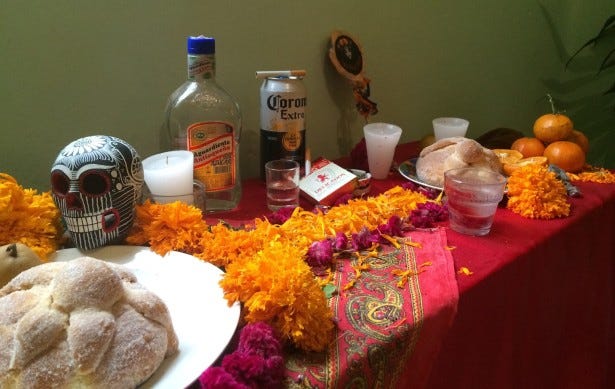
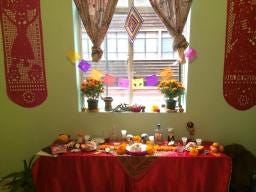
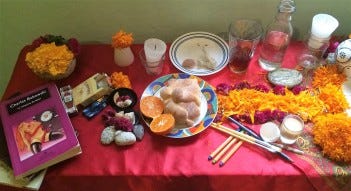
A quarter bottle of Churupete mescal from Guerrero. A half-bottle of Aguadardiente. A tallboy Corona with a cigarette resting on top. The collected works of Shakespeare, in Spanish. A glass jar filled with drinking water. Two painted skulls in the center of the table-black, white, and red. Bukowski’s short story collection ”Fuck machine,” also in Spanish. White candles. Bunches of small oranges. Pan del Muerto, a sweet bread shaped like bones, resting on plates. The strong, almost metallic smell of copal smoking in a clay incense burner. A small mirror reflecting two seashells, beach stones, and a small bed of red cockscomb flowers-a sunrise. The heads and scattered petals of orange-yellow Cempesuchil flowers. Two toy race cars. A pack of Camels with one cigarette left. A thumb-sized quartz crystal. A purple and blue painted ceramic sun. And above the table on the windowsill a wooden skeleton, laid back, legs crossed, his sugar skull resting on a bed of flowers.
An eggshell for my grandma who made the best scrambled eggs.
A pencil, joint rolled in coconut flavor paper, and a cocktail for my aunt who liked to throw parties and was a journalist and hippie in her younger years.
Paintbrushes and pens for my grandmother — an artist.
I’m winging it. I’ve never thought about what objects I’d offer the dead on an altar made for them on a day meant to honor them, but that is exactly what my girlfriend asked me to do this Sunday, a few days before el Dia de los Muertos (the Day of the Dead) is celebrated all over Mexico. In the morning, I accompanied her to the market to buy incense and flowers, sugar skulls and sweetbreads, and later that afternoon I helped her and our roommates — an acrobat, filmmaker, acupuncturist, musician, and dancer — construct an altar in our living room, an altar for our dead. For most of the afternoon, we drank beer and mescal, told stories, and built our offering.
Truth is, I don’t know much about this holiday. I’ve never celebrated The Day of the Dead before and even though the themes in the streets — skulls, monsters, ghosts, vampires — scream Halloween to me and my American sensibilities, the act of making an offering to the dead is unlike anything I’ve ever done. I usually spend this time of year scrambling to put together some half-ass costume; two years ago I fastened a kitchen pot to my head and hit the Halloween streets as a “pothead.” But now I find myself pensive, thinking of the people I know who’ve passed away, and about the things they loved, their life-objects, desires, pleasures, and how I remember them.
Today, I smoked the joint I rolled for my aunt on Sunday and sat by the altar and thought about death. About my experience with it. About what I think it means. I thought about how it was for my aunt, who passed away this summer. The sterility of the hospital. The slow, painful fight to the end. I thought about my grandmother’s nursing home. About church funerals. Family and friends huddled together in the graveyard. A preacher reading a poem.
I thought about the Second Line I’d attended in New Orleans earlier this year for Will Smith, a Saints player who was senselessly murdered, where I witnessed a life-affirming, rebellious, joyous and impossibly sad dance and celebration through the streets of the city and into an obscure bar enveloped by music, dance, smoke, drink and conversation.
Today my girlfriend asked me what I would want as for an offering when I die. A basketball? A pen? Something to drink, no doubt. A party. And she told me about her experience with death; a cousin like a brother gone in a car crash. An aunt’s long battle with cancer; her childhood memory of a house full of family and friends, awaiting the final, cold silence.
I thought about how death is inevitable and yet also so sudden, surprising almost.
I also wondered if my culture is afraid of death, of talking and thinking about it, and in many ways, of dealing with it. Wouldn’t it be beneficial for Americans to include death in our lives the way it is done here in Mexico? With a distinguished time for offerings, stories, and parties in the cemeteries. I wondered what the consequences of a culture that is afraid of death are, or if there are any at all.
I thought again about the objects on the table, objects which days earlier represented nothing other than themselves — a book was a book and a candle was a way to light a room — but that now carried new life. A soul had been breathed into them through thought, feeling, intention, and love. I wondered if this wasn’t the point after all — to instill life in death through thought and memory.
I reached no conclusions during The Day of the Dead. For many of us, I think, death is a giant question mark (at best), which is perhaps the reason we prefer not to think about it all. But it was good for me to stop and remember, and to consider how thinking about death doesn’t have to be solemn and sad. In fact, it is life-affirming to remember one day death is coming, slowly or suddenly, the big question mark will arrive, and because this is certain for all of us, it begs questions like: How do I wish to be remembered? What would be on my altar? What do I wish to do while I am alive? Who do I love and am I good to them? Can I be better?
And in thinking about death we also remember that we are alive, right here and right now, and if nothing else, we can and should be immensely grateful for this life.
This article was first published in 2016.